

China’s export orders dip in April as Trump’s tariffs begin to bite
Advertisement
Read this article for free:
or
Already have an account? Log in here »
To continue reading, please subscribe:
Monthly Digital Subscription
$1 per week for 24 weeks*
- Enjoy unlimited reading on winnipegfreepress.com
- Read the E-Edition, our digital replica newspaper
- Access News Break, our award-winning app
- Play interactive puzzles
*Billed as $4.00 plus GST every four weeks. After 24 weeks, price increases to the regular rate of $19.95 plus GST every four weeks. Offer available to new and qualified returning subscribers only. Cancel any time.
Monthly Digital Subscription
$4.99/week*
- Enjoy unlimited reading on winnipegfreepress.com
- Read the E-Edition, our digital replica newspaper
- Access News Break, our award-winning app
- Play interactive puzzles
*Billed as $19.95 plus GST every four weeks. Cancel any time.
To continue reading, please subscribe:
Add Free Press access to your Brandon Sun subscription for only an additional
$1 for the first 4 weeks*
*Your next subscription payment will increase by $1.00 and you will be charged $16.99 plus GST for four weeks. After four weeks, your payment will increase to $23.99 plus GST every four weeks.
Read unlimited articles for free today:
or
Already have an account? Log in here »
Hey there, time traveller!
This article was published 30/04/2025 (332 days ago), so information in it may no longer be current.
Higher tariffs on U.S. imports of products from China are taking a toll on the world’s second-largest economy as export orders sink, according to monthly surveys of Chinese factory managers released Wednesday.
The official survey by the China Federation of Logistics and Purchasing shows export orders slowed sharply in April, with Beijing and Washington in a standoff after U.S. President Donald Trump ordered combined tariffs of up to 145% on Chinese goods.
China has imposed duties of up to 125% on U.S. products, with some exemptions. It has also ordered other retaliation, such as tighter restrictions on exports of some strategically important minerals used for high-tech products such as electric vehicles.
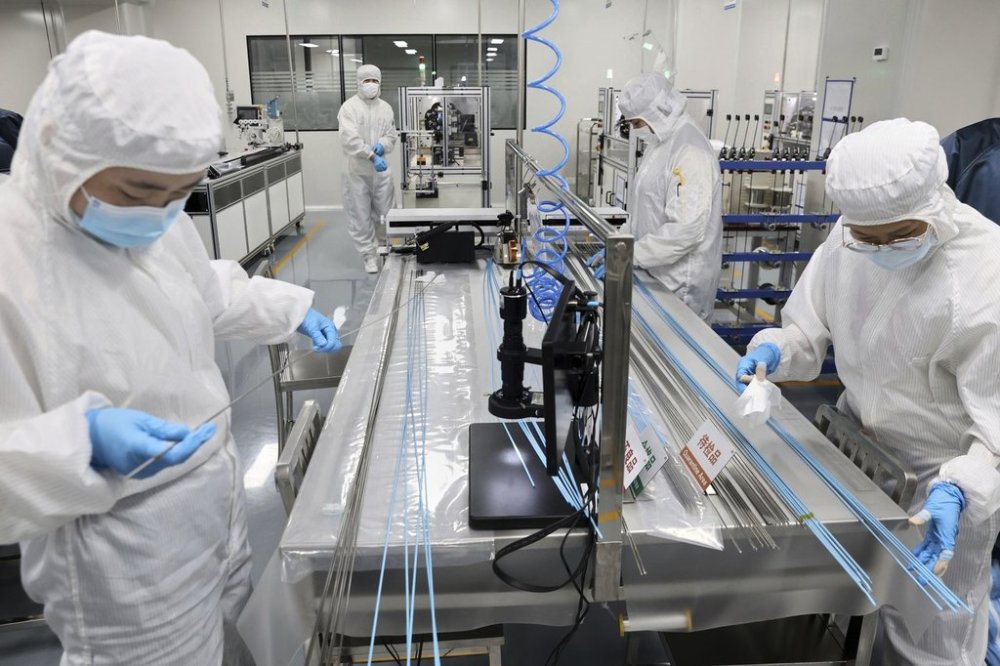
American businesses are cancelling orders from China and postponing expansion plans as they watch to see what comes.
The official manufacturing purchasing managers index fell to a 16-month low of 49.0 from 50.5 in March. That’s on a scale where 50 marks the break between expansion and contraction. A private survey by the financial information group Caixin fell to 50.4 from 51.2.
“The sharp drop in the PMIs likely overstates the impact of tariffs due to negative sentiment effects, but it still suggests that China’s economy is coming under pressure as external demand cools,” Zichun Huang of Capital Economics said in a report.
Large manufacturers are likely to be hit harder than smaller ones that are more labor intensive, since China still enjoys a cost advantage for such products, economists at ANZ Research said.
“China’s manufacturing cost for light industries may be one-fifth that of the U.S., which is unlikely to change,” they said in a report.
Earlier this week, senior Chinese economic officials convened a news conference where they showcased Beijing’s support for the economy and its capacity to do more to counter the impact of the tariffs.
The economy expanded at a solid 5% annual pace in 2024 and the ruling Communist Party has set a target for growth at about that level this year.
But that was before Trump escalated his trade war, piling on still higher tariffs with an aim of compelling manufacturers to rebase production to the United States.
“Overall, in April, the expansion in supply and demand slowed, with exports stunted and employment shrinking slightly. Manufacturers sought to reduce stocks, logistics were delayed, and prices remained under pressure. Market optimism weakened significantly,” Wang Zhe, wrote senior economist at Caixin Insight Group.
Business sentiment was at one of the lowest levels on record, Wang said.

Private economists have downgraded their forecasts for the economy this year and next. Capital Economics estimates the economy will expand only 3.5% in 2025.
The economy grew 5.4% from a year earlier in the first quarter of the year, as companies rushed to beat the higher tariffs. Chinese exports surged more than 12% year-on-year in March.
Although some Chinese exports will likely be diverted to other countries, Trump’s trade war has raised the risk of recession in the U.S. and its impact is expected to ripple across the global economy.
The International Monetary Fund said in a recent update that the outlook for the U.S. and global economies this year and next has significantly worsened.
It forecast the global economy will grow just 2.8% this year, down from its estimate in January of 3.3%.