

Average asking rents fall annually for eighth straight month to $2,129: report
Advertisement
Read this article for free:
or
Already have an account? Log in here »
To continue reading, please subscribe:
Monthly Digital Subscription
$1 per week for 24 weeks*
- Enjoy unlimited reading on winnipegfreepress.com
- Read the E-Edition, our digital replica newspaper
- Access News Break, our award-winning app
- Play interactive puzzles
*Billed as $4.00 plus GST every four weeks. After 24 weeks, price increases to the regular rate of $19.95 plus GST every four weeks. Offer available to new and qualified returning subscribers only. Cancel any time.
Monthly Digital Subscription
$4.99/week*
- Enjoy unlimited reading on winnipegfreepress.com
- Read the E-Edition, our digital replica newspaper
- Access News Break, our award-winning app
- Play interactive puzzles
*Billed as $19.95 plus GST every four weeks. Cancel any time.
To continue reading, please subscribe:
Add Free Press access to your Brandon Sun subscription for only an additional
$1 for the first 4 weeks*
*Your next subscription payment will increase by $1.00 and you will be charged $16.99 plus GST for four weeks. After four weeks, your payment will increase to $23.99 plus GST every four weeks.
Read unlimited articles for free today:
or
Already have an account? Log in here »
Hey there, time traveller!
This article was published 09/06/2025 (293 days ago), so information in it may no longer be current.
TORONTO – The national average asking rent in May was down 3.3 per cent from a year earlier at $2,129, marking the eighth consecutive month of year-over-year decreases.
The monthly report from Rentals.ca and Urbanation said Monday asking rents held steady from April, with a 0.1 per cent month-over-month increase.
Purpose-built apartment asking rents declined two per cent from a year ago to an average of $2,117, while asking rents for condominium apartments fell 3.6 per cent to $2,192.
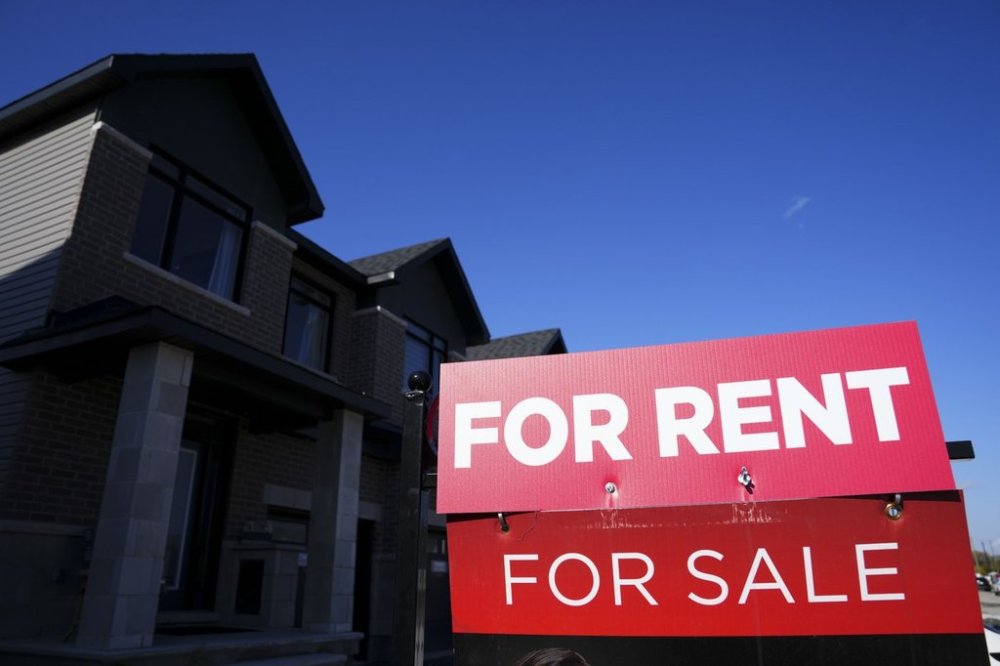
Rents for houses and townhomes declined seven per cent to $2,196.
Urbanation president Shaun Hildebrand said rents have eased in part due to a surge in supply with new apartments being completed, a slowdown in population growth and a heightened level of economic uncertainty.
“The easing in rents this year across most parts of the country is a positive for housing affordability in Canada following a period of extremely strong rent inflation lasting from 2022 to 2024,” Hildebrand said in a news release.
The report said average asking rents in Canada are 5.7 per cent higher than they were two years ago and 12.6 per cent above levels from three years ago.
Over the past five years, rents in Canada have increased by an average of 4.1 per cent annually, outpacing average wage growth of roughly three per cent, it added.
Ontario recorded the largest rent decline in May, with asking rents falling 3.6 per cent year-over-year to an average of $2,335, followed by B.C.’s 2.6 per cent decrease to $2,462, Alberta’s 2.4 per cent decrease to $1,745 and Quebec’s 1.8 per cent decrease to $1,964.

Saskatchewan led the way for year-over-year rent growth, at 3.9 per cent, to an average of $1,386, followed by Nova Scotia at 2.1 per cent to $2,284 and Manitoba at 0.1 per cent to $1,624.
Apartment rents also fell in four of Canada’s six largest cities, with the other two recording less than one per cent annual growth.
Calgary saw the largest drop at 7.9 per cent to $1,928, followed by a 6.8 per cent annual decrease in Toronto to $2,594 and a 5.9 per cent decline in Vancouver to $2,830.
Montreal apartment rents were down 3.3 per cent to $1,970, while rents in Edmonton ticked up 0.7 per cent $1,561 and 0.4 per cent in Ottawa to $2,198.
This report by The Canadian Press was first published June 9, 2025.