

Tough talk drags on in Cambodia-Thailand border standoff. But tensions appear to be easing
Advertisement
Read this article for free:
or
Already have an account? Log in here »
To continue reading, please subscribe:
Monthly Digital Subscription
$1 per week for 24 weeks*
- Enjoy unlimited reading on winnipegfreepress.com
- Read the E-Edition, our digital replica newspaper
- Access News Break, our award-winning app
- Play interactive puzzles
*Billed as $4.00 plus GST every four weeks. After 24 weeks, price increases to the regular rate of $19.95 plus GST every four weeks. Offer available to new and qualified returning subscribers only. Cancel any time.
Monthly Digital Subscription
$4.99/week*
- Enjoy unlimited reading on winnipegfreepress.com
- Read the E-Edition, our digital replica newspaper
- Access News Break, our award-winning app
- Play interactive puzzles
*Billed as $19.95 plus GST every four weeks. Cancel any time.
To continue reading, please subscribe:
Add Free Press access to your Brandon Sun subscription for only an additional
$1 for the first 4 weeks*
*Your next subscription payment will increase by $1.00 and you will be charged $16.99 plus GST for four weeks. After four weeks, your payment will increase to $23.99 plus GST every four weeks.
Read unlimited articles for free today:
or
Already have an account? Log in here »
Hey there, time traveller!
This article was published 09/06/2025 (294 days ago), so information in it may no longer be current.
PHNOM PENH, Cambodia (AP) — Cambodia’s defense ministry on Monday said that the country’s troops haven’t withdrawn from a patch of land whose ownership is hotly disputed by neighboring Thailand, but the declaration also echoed recent statements by both sides seeking a peaceful resolution to their competing border claims.
Cambodian and Thai authorities engaged in saber-rattling last week, after an armed confrontation at the border on May 28 left one Cambodian soldier dead. The incident, which each side blamed on the other, reportedly took place in a relatively small “no man’s land” constituting territory along their border that both countries claim is theirs.
A declaration by the Cambodian defense ministry on Monday had “No Withdrawal of Troops” as its first principle. It said that “Cambodian forces have not been withdrawn from any areas under Cambodian sovereignty where they have been stationed for an extended period.” The wording left unclear exactly which positions had been occupied for “an extended period.”
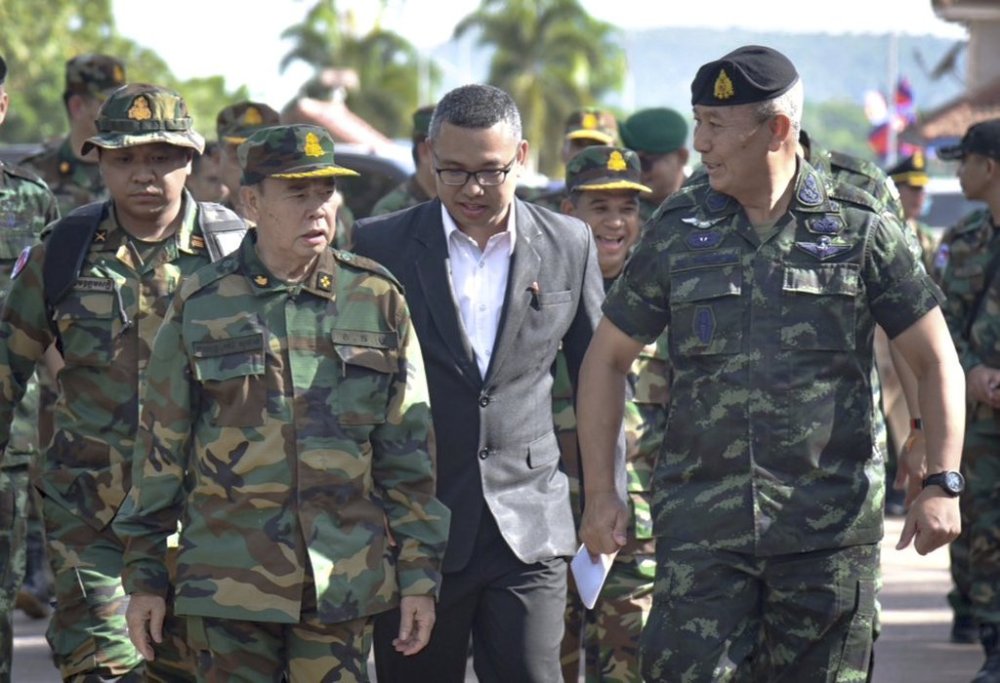
His statement also reaffirmed Cambodia’s territorial claims covering not only the spot near Morakot village in Cambodia’s northwestern province of Preah Vihear where the soldier was killed, but also three other pieces of disputed land.
Cambodian Defense Minister Tea Seiha himself on Sunday had painted a slightly different picture, stating that Cambodia and Thai military leaders had met and decided to adjust the military forces of both sides to return to appropriate areas in order to reduce tension and confront each other on the border.
His statement appeared to be in accord with what Thai Defense Minister Phumtham Wechayachai announced on Sunday, that both sides had withdrawn their forces to where they had been in 2024. That came after Thailand began shutting or limiting crossing hours at some of the numerous checkpoints along the countries’ common border.

The tough talk on both sides appeared aimed mostly at drumming up nationalist support among their own domestic audiences. In Thailand, the elected government of Prime Minister Paetongtarn Shinawatra has been attacked by right-wing nationalists who are longtime foes of her father, former Prime Minister Thaksin Shinawatra.
Already last year, Paetongtarn’s government was attacked on nationalist grounds for proposing to resume talks with Cambodia on demarcation of maritime territory believed to hold profitable hydrocarbon resources.
There is a long history to disputes over border territory, leaving Thailand especially bitter.
In 1962, the International Court of Justice in The Hague, Netherlands, awarded to Cambodia the disputed territory on which stands the historic Preah Vihear temple. The ruling, which became a major irritant in bilateral relations, was reaffirmed in 2013. There had been serious though sporadic clashes there in 2011.
Cambodian Prime Minister Hun Manet last week vowed to take the cases of the four currently disputed areas to the court to determine ownership, even if Thailand didn’t join in the appeal, in order “to end this problem and extinguish it once and for all so that there is no further confusion.”