

Parliamentary interpreters sound alarm over coming changes to procurement rules
Advertisement
Read this article for free:
or
Already have an account? Log in here »
To continue reading, please subscribe:
Digital Subscription
One year of digital access for only $1.44 a week*
- Enjoy unlimited reading on winnipegfreepress.com
- Read the E-Edition, our digital replica newspaper
- Access News Break, our award-winning app
- Play interactive puzzles
*Billed as $5.77 plus GST every four weeks. After 52 weeks, price increases to the regular rate of $19.95 plus GST every four weeks. Offer available to new and qualified returning subscribers only. Cancel any time.
To continue reading, please subscribe:
Add Free Press access to your Brandon Sun subscription for only an additional
$1 for the first 4 weeks*
- Enjoy unlimited reading on winnipegfreepress.com
- Read the E-Edition, our digital replica newspaper
- Access News Break, our award-winning app
- Play interactive puzzles
*Your next Brandon Sun subscription payment will increase by $1.00 and you will be charged $17.95 plus GST for four weeks. After four weeks, your payment will increase to $24.95 plus GST every four weeks.
Read unlimited articles for free today:
or
Already have an account? Log in here »
Hey there, time traveller!
This article was published 24/07/2025 (311 days ago), so information in it may no longer be current.
OTTAWA – Professional interpreters are warning that the federal government’s plans to cut its procurement costs could compromise the public’s access to parliamentary, Supreme Court and other official proceedings in both official languages.
Jeremy Link, a spokesperson for Public Services and Procurement Canada, said the department recently began a process to replace the federal government’s existing freelance interpretation contracts.
As part of that process, the government is seeking to make several major changes to the procurement of services for Parliament and other institutions like the Supreme Court.
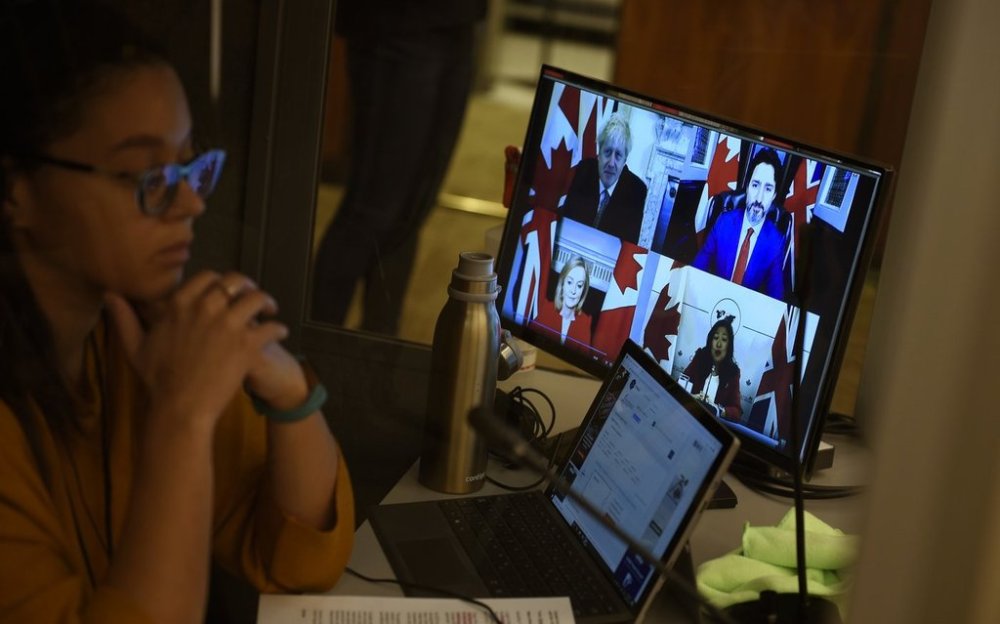
The Canadian branch of the International Association of Conference Interpreters, AIIC-Canada, said those changes include eliminating measures to protect interpreters’ hearing and adopting a “lowest bid” approach to replace the “best fit” model that considers applicants’ credentials and experience.
“This change would almost certainly have the effect of pushing the most experienced freelancers off an already short-handed team,” the organization said in a news release. It said that adopting a lowest-bid approach is “just about the money.”
In a letter to Prime Minister Mark Carney this month, AIIC-Canada president Alionka Skup said the proposed new rules would lower the quality of interpretation services and undermine public access to government proceedings in Canada’s two official languages.
Skup said the changes also ignore the current “severe shortage” of accredited and qualified suppliers of interpretation services. She said about 100 accredited and qualified freelancers now shoulder about 60 per cent of all parliamentary assignments.
Nicole Gagnon, a spokesperson for AIIC-Canada and a career freelance interpreter, said the shortage started before the pandemic but got worse as Parliament went virtual and interpreters like herself sustained injuries.
Several Parliament Hill interpreters have experienced hearing damage due to poor sound quality and feedback, and the federal government was forced to adjust the setup in the House of Commons and committee rooms last year.
“With this new standing offer, odds are they’ll decide to just hang up their headsets because it’s not worth their trouble,” Gagnon said.
Gagnon said the government is also planning to start paying interpreters by the hour rather than by the day.
“That’s a fundamental change that is totally unacceptable to us,” she said. “This standing offer goes against our standards of practice. We work by the day, we do not work by the hour. We’re not gig workers.”
Gagnon said she and other interpreters oppose the lowest-bid model because it doesn’t take credentials and experience into account.
“Quite a few of us have more years’ experience than others, have other degrees, be it in engineering or law or administration, and so these are additional credentials that should be taken into account when assigning interpreters,” she said. “You would want to assign an interpreter to the Supreme Court if they have done studies in law or if that’s their field of expertise, rather than send someone who has not.”
Gagnon said she worries about how MPs who rely on translation services will be affected by a possible decline in quality, noting that most of the interpreters’ work is translating English into French.

Link said Public Services and Procurement Canada issued a call for feedback from suppliers and industry on the new procurement approach in June. He said the input gathered will play a “key role” in shaping and refining the procurement strategy going forward.
Gagnon said that when it met with suppliers last week, the government made it clear that it likely wouldn’t reconsider adopting the lowest-bid approach.
The department is extending current contracts with freelance interpreters until the end of the year as it works to update the procurement process. Once the new process is in place, interpreters will have to decide whether to submit bids to keep working on Parliament Hill.
Gagnon said that the hourly pay and lowest-bid proposals are “non-starters” for her and that if they’re introduced, she won’t be offering her services again.
This report by The Canadian Press was first published July 24, 2025.