

Bottling essence of cognitive stimulation
Winnipeg entrepreneurs launch Memorease olfactory training aides as researchers delve into potential neural connection

Advertisement
Read this article for free:
or
Already have an account? Log in here »
To continue reading, please subscribe:
Monthly Digital Subscription
$0 for the first 4 weeks*
- Enjoy unlimited reading on winnipegfreepress.com
- Read the E-Edition, our digital replica newspaper
- Access News Break, our award-winning app
- Play interactive puzzles
*No charge for 4 weeks then price increases to the regular rate of $19.95 plus GST every four weeks. Offer available to new and qualified returning subscribers only. Cancel any time.
Monthly Digital Subscription
$4.99/week*
- Enjoy unlimited reading on winnipegfreepress.com
- Read the E-Edition, our digital replica newspaper
- Access News Break, our award-winning app
- Play interactive puzzles
*Billed as $19.95 plus GST every four weeks. Cancel any time.
To continue reading, please subscribe:
Add Free Press access to your Brandon Sun subscription for only an additional
$1 for the first 4 weeks*
*Your next subscription payment will increase by $1.00 and you will be charged $16.99 plus GST for four weeks. After four weeks, your payment will increase to $23.99 plus GST every four weeks.
Read unlimited articles for free today:
or
Already have an account? Log in here »
Lemon, clove, eucalyptus and rose.
A pair of Winnipeg entrepreneurs have bottled the four scents and are selling packs, touting the vials as tools to boost memory health.
Memorease’s launch comes as researchers increasingly explore the connection between olfactory training — or smell training — and the brain.
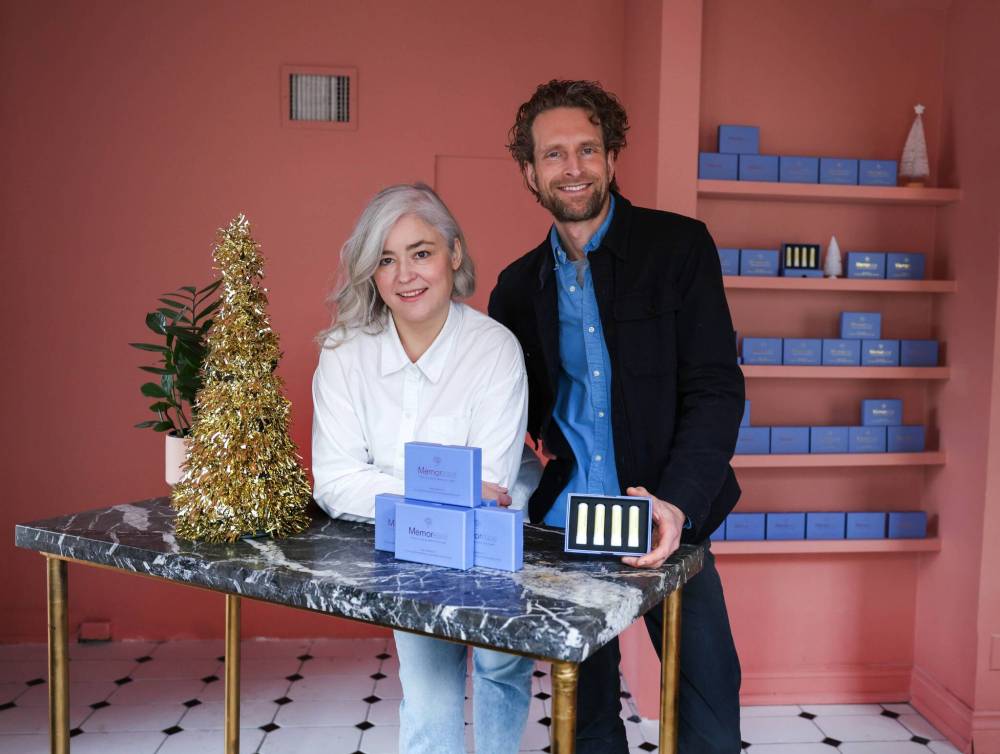
Ruth Bonneville / Free Press
Dominika Dratwa and Jon Askholm, co-founders of Memorease, have included four scents in the olfactory training kit that lasts eight to 12 months.
“We just kind of got on this mission to get the word out,” said Jon Askholm, Memorease’s co-founder.
His father died of dementia nearly eight years ago. Roughly a decade earlier, the elder began to lose his sense of smell.
Dominika Dratwa, Askholm’s partner, watched the health decline and found it “devastating.” She owns Verde Candle Bar, an Academy Road site where customers make candles by choosing and blending scents.
“I did a deeper dive into how … your sense of smell affects your well-being and your memory,” Dratwa said.
She came across articles and research papers studying olfactory training. Some found test subjects’ memories improved after consistently smelling concentrated scents.
Dratwa, 47, decided to try: “It’s so easy, so I thought, ‘Why not?’”
She believes the practice has strengthened her memory, including her word recall.
Length of time and frequency of smelling scents varies by study. Dratwa and Askholm landed on recommending 20 to 30 seconds per scent daily, twice a day, to customers. (Memorease’s website highlights studies published in Behavioural Neuroscience and Laryngoscope, among others.)
Each $49 kit should last eight months to a year, Dratwa said.
“We’re promoting it as a lifestyle change,” Askholm added. “I don’t think this is a cure for dementia, but I can only wonder: what would have happened if my dad had been doing something like this over that decade or two of his life? What would have been different?”
Companies like Memorease are worthwhile endeavours; they need to be considered within the proper context, said David Vance, a University of Alabama at Birmingham psychology professor.
Vance and colleagues published a systematic review titled “Does Olfactory Training Improve Brain Function and Cognition?” in Neuropsychology Review last year.
The paper considered 18 studies on olfactory training impacting brain health. It concluded there’s evidence of olfactory training improving brain function, but the reviewed sample sizes are small.
Verbal fluency, memory and increased volume in certain brain areas (like the hippocampal and cerebellum regions) were recorded.
“We’re gonna have to do a lot more studies — and rigorous studies,” Vance said, adding the preliminary findings are “encouraging.”
Most of the 18 studies didn’t have a control group; none followed up with subjects in the long term. There wasn’t a standardized set of scents or frequencies for smelling, Vance noted.
“We don’t know if the (brain) effects will carry on,” he said. “We don’t know if it’s just the novelty of doing the intervention or if it’s actually the olfactory training itself.”
He’s studying olfactory training on older adults with HIV who may be at risk for cognitive decline. The sense is important but under-studied because it’s taken for granted, Vance said.
“There’s a lot of neural connection between olfaction and the brain,” he added. “I think it’s underutilized.”
Olfactory training appears to be an “emerging field,” Vance said.
His 37-page systemic review is among the papers Memorease’s co-founders have read. They list studies on the company’s website, memorease.care.
“I’m not surprised that olfactory stimulation is being trialled,” said Colleen Millikin, a clinical neuropsychologist and clinical health psychology assistant professor at the University of Manitoba.
She asks older adult patients being assessed for memory changes whether their sense of smell has worsened. Roughly 20 to 30 per cent say yes, Millikin estimated.
Memorease products may bring benefits, including mindfulness, which has evidence of being good for the brain. Still, it’s important to remember olfactory training isn’t a cure for age-related memory loss or neurodegenerative disease, Millikin said.

“In general, cognitive stimulation is good,” she said. “We don’t actually have anything that we can prove stops memory loss.”
The Alzheimer Society of Manitoba is always wishing for more research, said Jessica Harper, a senior manager with the organization.
“We hope that the value of smell stimulation in the management of dementia symptoms will become clearer,” Harper said, adding the Alzheimer Society encourages people who are curious to speak to health-care providers.
Dratwa and Askholm are selling Memorease kits on the company’s website and in Verde Candle Bar.
gabrielle.piche@winnipegfreepress.com
Gabrielle Piché reports on business for the Free Press. She interned at the Free Press and worked for its sister outlet, Canstar Community News, before entering the business beat in 2021. Read more about Gabrielle.
Every piece of reporting Gabrielle produces is reviewed by an editing team before it is posted online or published in print — part of the Free Press‘s tradition, since 1872, of producing reliable independent journalism. Read more about Free Press’s history and mandate, and learn how our newsroom operates.
Our newsroom depends on a growing audience of readers to power our journalism. If you are not a paid reader, please consider becoming a subscriber.
Our newsroom depends on its audience of readers to power our journalism. Thank you for your support.
Gabrielle Piché reports on business for the Free Press. She interned at the Free Press and worked for its sister outlet, Canstar Community News, before entering the business beat in 2021. Read more about Gabrielle.
Every piece of reporting Gabrielle produces is reviewed by an editing team before it is posted online or published in print — part of the Free Press‘s tradition, since 1872, of producing reliable independent journalism. Read more about Free Press’s history and mandate, and learn how our newsroom operates.
Our newsroom depends on a growing audience of readers to power our journalism. If you are not a paid reader, please consider becoming a subscriber.
Our newsroom depends on its audience of readers to power our journalism. Thank you for your support.
Advertisement Advertise With Us
Advertisement Advertise With Us
History
Updated on Tuesday, December 30, 2025 9:20 AM CST: Corrects that Colleen Millikin is assistant professor, corrects spelling of Millikin