

Choose your own portfolio
New book from veteran investor helps navigate many strategies to find long-term approach for fresh start in 2026
Advertisement
Read this article for free:
or
Already have an account? Log in here »
To continue reading, please subscribe:

Digital Subscription
One year of digital access for only $205*
- Enjoy unlimited reading on winnipegfreepress.com
- Read the E-Edition, our digital replica newspaper
- Access News Break, our award-winning app
- Play interactive puzzles
*First annual payment billed as $205.00 + GST for one year. This annual subscription will automatically renew at $233.00 + GST every 52 weeks (10% off the regular annual price of $259.35). Offer available to new and qualified returning subscribers only. Cancel any time.
To continue reading, please subscribe:
Add Free Press access to your Brandon Sun subscription for only an additional
$1 for the first 4 weeks*
- Enjoy unlimited reading on winnipegfreepress.com
- Read the E-Edition, our digital replica newspaper
- Access News Break, our award-winning app
- Play interactive puzzles
*Your next Brandon Sun subscription payment will increase by $1.00 and you will be charged $17.95 plus GST for four weeks. After four weeks, your payment will increase to $24.95 plus GST every four weeks.
Read unlimited articles for free today:
or
Already have an account? Log in here »
Hey there, time traveller!
This article was published 03/01/2026 (273 days ago), so information in it may no longer be current.
Veteran wealth adviser Cullen Roche believes in true love.
He believes in it so far as its similarities to finding the perfect investment portfolio which, incidentally, is the foundation for the title of his new book released this week.
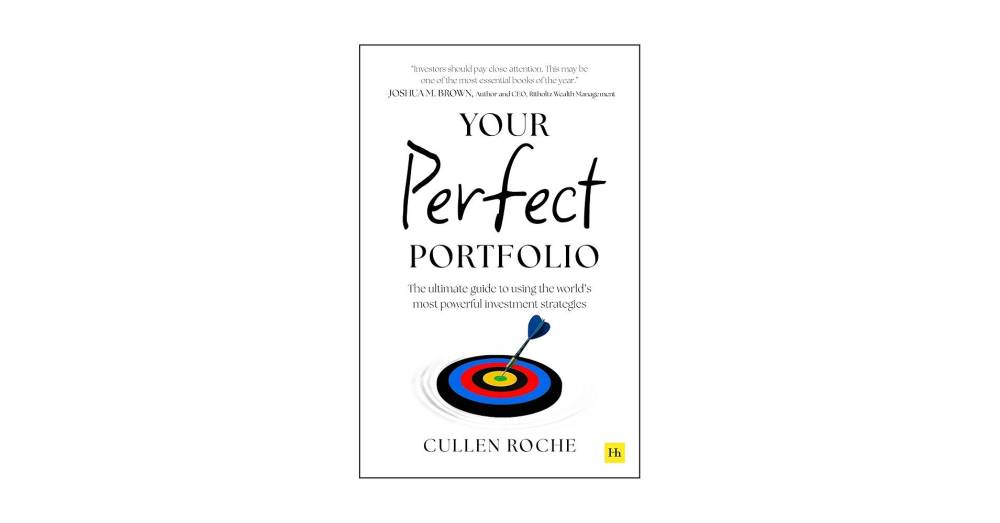
Your Perfect Portfolio: the Ultimate Guide to Using the World’s Most Powerful Investment Strategies begins with Roche discussing how finding the ideal strategy is like searching for true love. Most notably, like true love, you are able to stick with the strategy long-term, critical to building wealth successfully.

RDNE Stock / Pexels
“One of the big conclusions that I’ve come to over my career is that we spend a lot of time, especially in the investment management business, trying to build model portfolios that we can then apply in most cases for investors,” says Roche, based in San Diego, in a recent interview with the Free Press.
Everyone being different often means model portfolios can be an ill fit for a lot of people.
What makes Your Perfect Portfolio of interest to novice and even advanced investors is Roche has created an easy-to-use and understand field guide covering just about every approach to investing, which he often refers to as “saving.”
Indeed, Roche prefers average people think of themselves as savers rather than investors.
“Buying stocks and bonds … is not the same as starting a business and investing in the business,” he says.
“Rather, you’re allocating money you have saved into a thoughtful portfolio of different assets that will generate a return stream that, hopefully, will help you achieve financial goals across specific time horizons.”
You’re not investing in yourself like a business would add a new warehouse. You’re reorganizing capital to take advantage of certain assets’ qualities to grow your wealth.
This may seem subtle, even a little pernickety, but it’s helpful to frame wealth-building as a long-term journey.
“With investing, sometimes the predominant mentality is, ‘How can I generate as big of a return as possible in as short of an amount of time as possible?’ but that is a lot more like gambling.”
In the book, Roche writes about his own adventures/misadventures early on as an investor, dreaming of big returns.
He traded commodities. He emulated Warren Buffett’s value style. And what he realized is these were not suitable for him.
“The Buffett strategy is great in theory,” he says about this popular approach described in the book.
“The idea that you can buy undervalued stocks … hold them for the long term, and they’ll appreciate” makes sense, but emulating it is more difficult than it sounds, Roche says. “The most innovative thing that Buffett did is pretty hard to replicate.”
Roche adds when Buffett formed Berkshire Hathaway with partner Charlie Munger, a notable early acquisition was an insurance company.
Buffett recognized the premiums from life policies were essentially a cash float — interest-free loans to the operating company to buy undervalued companies over decades to come.
As Roche points out, the “secret sauce” wasn’t just that Buffett was a great and patient value investor. He built a unique investment structure more akin to a private equity fund than a traditional portfolio of publicly traded stocks.
That is one reason why Buffett often urges retail investors to purchase low-cost index funds that don’t beat the market rather than following in his footsteps.
Index funds don’t try to beat the market; they capture the market’s performance. So if the TSX Composite Index is up 10 per cent on the year, so too is the index fund that tracks it, minus a very small fee.
That’s generally sage money advice.
“Most active investors — professionals included — underperform the market after taxes and fees,” Roche says. “So the most interesting aspect of the Buffett portfolio is really that you should focus on the process and structure of your portfolio as much as on trying to pick assets to go into it.”
Another chapter in Your Perfect Portfolio focuses on what Buffett suggests. The Boglehead three-fund portfolio is inspired by another investment legend, Jack C. Vogel, founder of Vanguard Group, one of the world’s leading exchange-traded fund (ETF) providers.
A proponent of index investing, his ideas are distilled into “as simple of a portfolio as you could possibly have” with the Boglehead approach.
This approach could, for example, entail choosing three low-cost ETFs — a Canadian equity fund, a global equity fund and a total bond universe fund — with the capital equally split.
Roche acknowledges, however, not everyone is built for this set-and-forget, easy and low-cost strategy.
In turn, Your Perfect Portfolio delves into more esoteric strategies, like trend following often used by commodity traders. This is extremely risky and potentially costly, fee-wise, but it can lead to exceptional returns in certain conditions.
In the book, Roche provides a brief history on this style, as he does for many different portfolio approaches, writing about Jesse Livermore, author of How to Trade in Stocks (1940). Livermore was a legendary stock speculator — considered the pioneer of day trading — who lost about as much as he made and died by suicide shortly after the book was published.

While trend following isn’t for the faint of heart, Roche adds it can be useful when added as “a sliver into a portfolio,” zigging when other parts of the portfolio are zagging.
More broadly, Roche’s point is everyone’s different and the best strategy is one you can stick with that won’t lead you to selling at a loss.
To that end, he offers words of wisdom from financial theorist and neurologist Bill Bernstein (interviewed for the new book): “He said that the suboptimal portfolio you can stick with will generate better returns long-term than the optimal portfolio that you abandon after a few years.”
Joel Schlesinger is a Winnipeg-based freelance journalist
joelschles@gmail.com

Advertisement Advertise With Us
Advertisement Advertise With Us