

Flair reroutes strategy to lure corporate travellers — without a business class
Advertisement
Read this article for free:
or
Already have an account? Log in here »
To continue reading, please subscribe:

Digital Subscription
One year of digital access for only $205*
- Enjoy unlimited reading on winnipegfreepress.com
- Read the E-Edition, our digital replica newspaper
- Access News Break, our award-winning app
- Play interactive puzzles
*First annual payment billed as $205.00 + GST for one year. This annual subscription will automatically renew at $233.00 + GST every 52 weeks (10% off the regular annual price of $259.35). Offer available to new and qualified returning subscribers only. Cancel any time.
To continue reading, please subscribe:
Add Free Press access to your Brandon Sun subscription for only an additional
$1 for the first 4 weeks*
- Enjoy unlimited reading on winnipegfreepress.com
- Read the E-Edition, our digital replica newspaper
- Access News Break, our award-winning app
- Play interactive puzzles
*Your next Brandon Sun subscription payment will increase by $1.00 and you will be charged $17.95 plus GST for four weeks. After four weeks, your payment will increase to $24.95 plus GST every four weeks.
Read unlimited articles for free today:
or
Already have an account? Log in here »
Hey there, time traveller!
This article was published 16/01/2026 (235 days ago), so information in it may no longer be current.
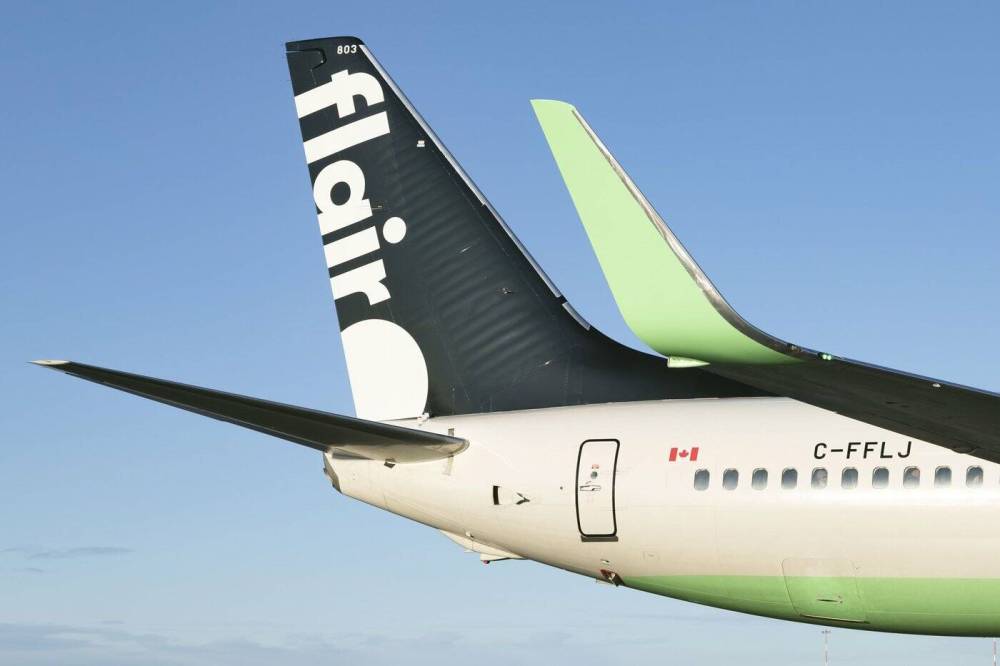
Flair Airlines is revamping its ultra-low-cost brand in a bid to attract more business travellers, despite a lack of frills on board.
In a phone interview this week, CEO Maciej Wilk said Flair is attempting a strategic shift away from a pure-play budget airline and toward what he dubbed a “value carrier.”
The goal is to attract more work travellers — mainly from small businesses — via affordable fares and by plugging into networks linked to travel agents, booking sites and hotels.

“We’re just ignoring this enormous corporate opportunity and simply abandoning this highly — potentially — profitable segment for us,” Wilk said.
“We need to consciously deviate from the textbook.”
The Edmonton-based company won’t be unfurling first-class accoutrements any time soon.
“No silverware, no free catering, no lounges, no red carpets unrolled in front of the customers,” Wilk said.
Instead, Flair is offering express treatment to all guests who pay more for the privilege of add-ons like carry-on luggage, granting them priority status at the check-in counter and gate. They will enjoy greater leeway with bag size, too.
More importantly, the airline plans to tap into one of a handful of global distribution systems, which form the digital back end of commercial air travel. Platforms such as Amadeus and Sabre connect travel agents and online agencies to airlines, hotels and car rental companies, comprising a central marketplace that can distil bookings from various providers into a single purchase.
Flair has yet to partner with one, though it hopes to within months.
“They don’t see Flair in the systems because we’re not a part of it,” Wilk said of travel agencies. “These are the gaps that we’re filling.”
Shorter layovers and more flights from Atlantic Canada — mainly to Toronto or Ontario’s Waterloo Region — also aim to broaden the carrier’s catchment area and make its one-stop cross-country trips more appealing.
The changes don’t quite amount to an overhaul.
“Of course, the fundaments of the low-cost model remain,” Wilk said. By that he means strict cost controls, a pay-for-service plan — carry-on bags, meals and seat selection all cost extra — and squeezing as many passengers as it can on board. That leaves no room for business class seating.
Wilk said Canadians’ turn away from U.S. travel has been tough for a company that staked its expansion on that market — particularly sun destinations — less than two years ago. The number of cross-border Flair flights is poised to fall 59 per cent between the first three months of 2025 and the same quarter this year, according to aviation data firm Cirium.
But its handful of routes to Mexico and the Caribbean, along with its first bundle of vacation packages mean it hasn’t lost out on sun revenue, Wilk said.
Nonetheless, the absence of loyalty points, fewer destinations and lower flight frequency — Air Canada’s fleet is more than 12 times the size of Flair’s — means C-Suite executives may not be boarding many Flair flights in the near term.
“I don’t see any CEOs flying Flair any time soon,” said Andrew D’Amours, co-founder of flight deal site Flytrippers.
Business passengers typically travel on tight schedules, he pointed out. That makes some smaller airlines less attractive.
“Because they don’t have a network of partners, they don’t have other hubs to route you through, if you’re cancelled you’re kind of stuck. Whereas Air Canada, if your flight’s cancelled … they just put you on the flight that’s two hours later.”
Flair has pointed out that its on-time percentage leads the pack. Some 74.2 per cent of its flights arrived within 15 minutes of their scheduled time last year, followed by WestJet at 73.6 per cent and Air Canada 73.3 per cent.
To Rick Erickson, an independent aviation analyst based in Calgary, Flair’s rebrand marks a “natural evolution.”
“They’re going after the small business guy who doesn’t need a huge network,” he said. Plus, the term ultra-low-cost carrier connotes “cramped,” he said. Hence the revamp as a value airline.
The push for more business clients on top of its base of budget leisure travellers comes as the line between low-cost carriers and legacy airlines blurs, with Air Canada, WestJet and Air Transat all adopting aspects of the discount model.

If it wants to attract business travellers, Flair should provide more than priority boarding, suggested Barry Prentice, director of the University of Manitoba’s Transport Institute.
“If you’re going to offer that corporate service, I think you have to match the non-price competition as well as the price competition,” he said.
“It’s a difficult switch to make.”
This report by The Canadian Press was first published Jan. 16, 2026.
Companies in this story: (TSX:AC, TSX:TRZ)
Related Articles
‘It just didn't land’: WestJet reverses move to install tight seating after backlash




Advertisement Advertise With Us
Advertisement Advertise With Us