

Canada’s gold mine (and much more)
Large land mass is rich in resources critical for AI, electrification, shifting geopolitics but mining additional profits from sector for your portfolio might be challenging
Advertisement
Read this article for free:
or
Already have an account? Log in here »
To continue reading, please subscribe:

Digital Subscription
One year of digital access for only $205*
- Enjoy unlimited reading on winnipegfreepress.com
- Read the E-Edition, our digital replica newspaper
- Access News Break, our award-winning app
- Play interactive puzzles
*First annual payment billed as $205.00 + GST for one year. This annual subscription will automatically renew at $233.00 + GST every 52 weeks (10% off the regular annual price of $259.35). Offer available to new and qualified returning subscribers only. Cancel any time.
To continue reading, please subscribe:
Add Free Press access to your Brandon Sun subscription for only an additional
$1 for the first 4 weeks*
- Enjoy unlimited reading on winnipegfreepress.com
- Read the E-Edition, our digital replica newspaper
- Access News Break, our award-winning app
- Play interactive puzzles
*Your next Brandon Sun subscription payment will increase by $1.00 and you will be charged $17.95 plus GST for four weeks. After four weeks, your payment will increase to $24.95 plus GST every four weeks.
Read unlimited articles for free today:
or
Already have an account? Log in here »
Hey there, time traveller!
This article was published 24/01/2026 (228 days ago), so information in it may no longer be current.
There’s gold in them hills, mountains and prairies … and oil, natural gas, nickel, copper, diamonds, zinc, potash, uranium and a host of other minerals expected to be in high demand in the coming decades.
Canada has one of the deepest reserves of natural resources in the world. It’s also one of the leading producers for many commodities. According to Statistics Canada, the value of those reserves in 2024 exceeded $1 trillion.
Mining alone generates more than $70 billion annually in economic activity. Canada is the No. 1 potash producer in the world and the second largest uranium producer. It’s no slouch with gold either. Natural Resources Canada data show gold mining in 2023 generated about $14 billion in economic activity, placing the nation fourth for global producers.
Liam Richards / The Canadian Press
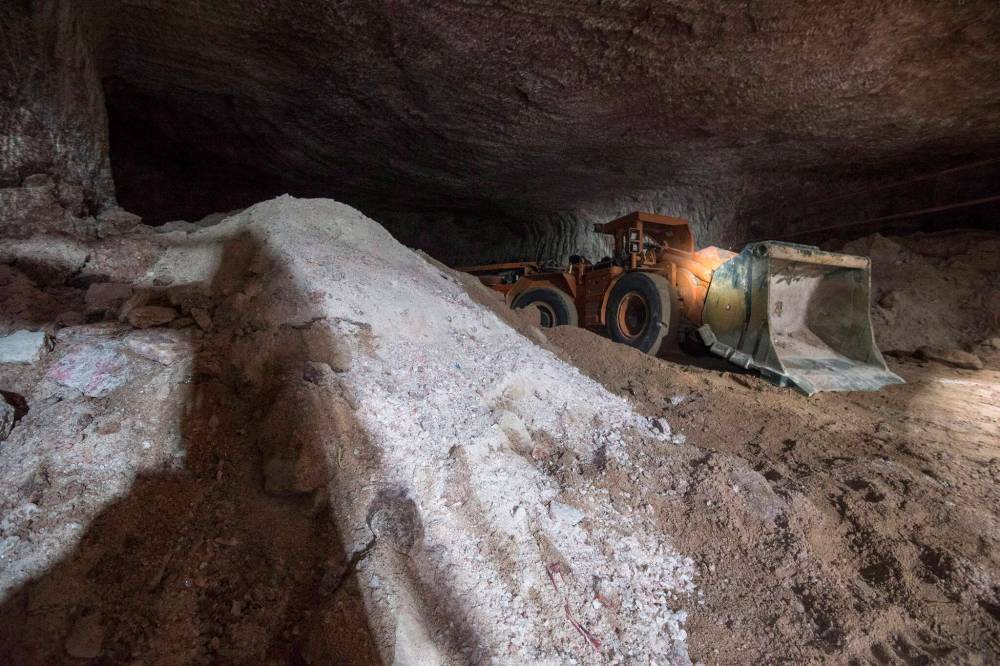
A piece of machinery sits underground at the Mosaic potash mine in Esterhazy, Sask.
Oil and gas are also worth about $70 billion annually. Canada has the third largest oil reserves globally and is the fourth largest producer. The nation is the fifth largest producer of natural gas.
There’s a lot of treasure in the land that often powers investment portfolios. About 30 per cent of the S&P TSX Composite Index is made up of companies involved in mining and oil and gas.
Yet given the wealth underground — and arguably above ground (timber and agriculture) — Canada has the makings to be an even bigger economic powerhouse than it currently is.
A recent report from the investment firm Mackenzie Investments talks up Canada’s resource promise, noting the nation is rich in critical minerals like aluminum, copper, graphite, lithium and cobalt.
It also argues the nation has long lagged behind its promise — until, potentially, now.
“We do resources very well,” says Benoit Gervais, head of the Mackenzie Investments resource team, which is behind the report. “But Canada has seen less than its fair share of investment in resources for the past 20 years.”
The reasons are many including commodity prices’ notorious volatility that makes long-term investments in mines, for example, challenging to endure.
Major investment has also lagged because of red tape, he adds. Simply, it can take more than a decade just to get to a yes or no for approval of a project, Gervais says.
To investors, the process is “very opaque,” inefficient and too lengthy, he says.
The federal and provincial governments recognize this problem and are “increasingly taking steps to address it, at least in theory,” says Cynthia Leach, assistant chief economist at RBC Economics, who co-authored a report on the potential and the challenges.
She points to the current federal government setting up the Major Project Office to streamline and speed up the approval process. The impetus is palpable, given growing demand particularly for minerals required for the energy transition, Gervais says.
Copper is also at record prices, driven by the need for electrical power and for electric vehicles and AI. The Mackenzie report points to the potential Canada has to produce more copper from reserves in British Columbia. Mackenzie refers to the province’s “copper highway” — a mix of deposits and infrastructure i.e. low-cost hydroelectric power, roads and skilled workers — to support development.
That potential in B.C. and other parts of Canada is largely untapped and a significant headwind is the years-long approval process, Gervais says.
Consultation with communities, notably First Nations, should indeed occur, along with detailed environmental impact assessments. Investment in exploration and development will remain less than optimal so long as the pathway to a potential approval can take more than a decade.
Shifting geopolitics is also challenging — at best a double-edged sword. Consider the U.S. is Canada’s largest buyer of resources, according to federal government data, which until a year ago was largely a significant upside for the resource economy.
Today, however, the Canadian government now recognizes the need to diversify because the U.S. has become a more unreliable trade partner while embracing a more abrasive foreign policy, Leach says.
The U.S. action in Venezuela (home to the world’s largest oil reserves) and U.S. President Donald Trump’s fixation on Greenland (presumed rich with critical minerals) illustrate a “great power competition for strategic minerals” with China and Russia.
It’s a situation that could benefit and/or harm Canada’s economy, she adds.
One major upside is secular tailwinds (i.e. rising energy demand) and geopolitical shifts could trigger another commodity super-cycle of record high demand last seen from the early 2000s to 2011.
For investors seeking more exposure to that, Canada has many great companies like Suncor Inc, Barrick Gold Corp. and Teck Resources Ltd. to choose from.
The choice of mutual and exchange-traded funds focused on resources is also extensive.
“Our homegrown Canadian ETF industry, for example, provides a lot of tools to play this potential trend,” says Daniel Straus, managing director of ETFs and financial products research at National Bank Capital Markets.
Investors can look to Canadian mining funds, global mining funds, gold mining funds, oil and gas funds, and even broader, actively managed resource funds — which includes Mackenzie’s Core Resources ETF launched in 2024. Like a lot of funds in the sector, it did exceedingly well in 2025.

Of course, if you already own Canadian equity funds, you really do not have to lift a finger. The resource-heavy TSX Composite gained more than 28 per cent last year. Counting dividends, the gain was closer to 33 per cent.
“For better or for worse, any Canadian investor with a significant home bias already has substantial resource exposure,” Straus says.
Many Canadians’ fortunes rise and fall with the demand for what lies beneath our land.
Joel Schlesinger is a Winnipeg-based freelance journalist
joelschles@gmail.com