Rising costs biggest takeaway for Manitoba business community: survey
Read this article for free:
or
Already have an account? Log in here »
To continue reading, please subscribe:

Digital Subscription
One year of digital access for only $205*
- Enjoy unlimited reading on winnipegfreepress.com
- Read the E-Edition, our digital replica newspaper
- Access News Break, our award-winning app
- Play interactive puzzles
*First annual payment billed as $205.00 + GST for one year. This annual subscription will automatically renew at $233.00 + GST every 52 weeks (10% off the regular annual price of $259.35). Offer available to new and qualified returning subscribers only. Cancel any time.
To continue reading, please subscribe:
Add Free Press access to your Brandon Sun subscription for only an additional
$1 for the first 4 weeks*
- Enjoy unlimited reading on winnipegfreepress.com
- Read the E-Edition, our digital replica newspaper
- Access News Break, our award-winning app
- Play interactive puzzles
*Your next Brandon Sun subscription payment will increase by $1.00 and you will be charged $17.95 plus GST for four weeks. After four weeks, your payment will increase to $24.95 plus GST every four weeks.
Read unlimited articles for free today:
or
Already have an account? Log in here »
Hey there, time traveller!
This article was published 03/02/2026 (217 days ago), so information in it may no longer be current.
A year of trade uncertainty and immigration cuts has increased costs and made it harder to hire workers, Manitoba business owners say.
The Manitoba Chambers of Commerce released its 2025 business outlook survey results on Tuesday, which polled 157 business owners and people in leadership roles across multiple sectors. It found, despite a general feeling of optimism for the future, the community was rocked last year by the impact of changing political tides.
MIKE DEAL / FREE PRESS FILES Chuck Davidson, president and CEO of Manitoba Chambers of Commerce
“I would suggest this has been an extremely difficult year for businesses in Manitoba, as all these pressures have been put on them,” chambers president and CEO Chuck Davidson said.
According to the numbers, 79 per cent said they remain concerned about the impact of trade disruptions with the U.S. and the shifting dynamics in global trade, while 76 per cent said economic uncertainty with no end in sight is impacting their financial decisions.
Out of those who said U.S. trade issues have impacted their business, most pointed to an increased cost of materials and equipment, and 41 per cent said they have experienced delivery delays.
“We hear time and time from businesses that the tariffs and the trade challenges have actually impacted that cost of doing business, I think that’s something that’s pretty evident as well,” Davidson said.
Over half of all businesses surveyed said the biggest barrier faced in 2025 was costs, including wages. Hiring and retaining staff was listed as a top issue for 42 per cent, and nearly one in four listed trade relations and economic uncertainty.
“We hear time and time from businesses that the tariffs and the trade challenges have actually impacted that cost of doing business.”
Rural business owners were more likely to report concern about the impact of trade disruption. Speakers at Tuesday’s virtual conference listed a higher percentage of rural businesses working in exports and trade negotiations involving canola and pork production with countries overseas as possible reasons.
“It shows that (rural) big businesses are not just worried or concerned, they’re actually experiencing part of the tariffs,” said Rural Manitoba Economic Development Corp. research and data manager Michael Asante.
The respondents were more ambivalent about how the provincial government has impacted their operations than they were in previous polling.
In the 2024 exit survey from the Manitoba chambers, 40 per cent said the province was doing a good job and 23 per cent said it was too early to rate its performance.
Mark Schiefelbein / The Associated Press Files Canadian Prime Minister Mark Carney and U.S. President Donald Trump at the June G7 Summit in Kananaskis, Alta. The 2025 business outlook survey says 79 per cent of Manitoba business owners are concerned about the impact of trade disruptions with the U.S.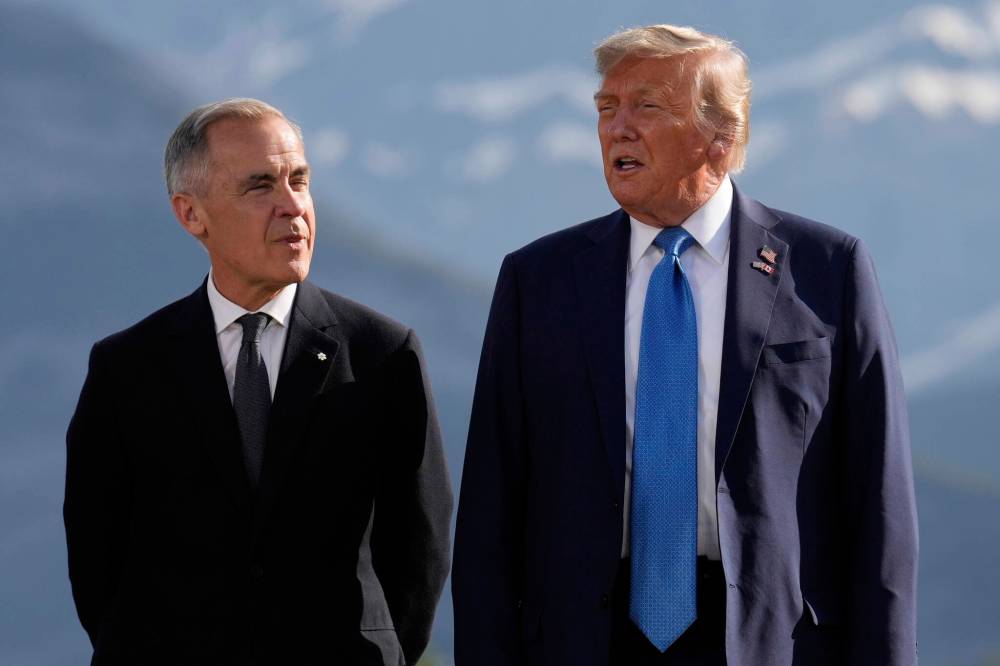
In the 2025 results, 37 per cent said they would rate the government positively and 28 per cent would rate it negatively; 32 per cent said they did not feel the government had made an impact in either direction.
“I think they’re getting a bit of an extended honeymoon (the NDP government led by Premier Wab Kinew was sworn in in October 2023) … Business is still not saying, ‘Yeah, we’re fully in,’” Davidson said.
Business owners were also split on if they believed Manitoba was competitive compared to other provinces, with 45 per cent agreeing and 50 per cent disagreeing.
That number could be improved by reducing business tax and red tape and improving public safety, survey respondents said. Two-thirds added they’d like to see Manitoba eliminate its interprovincial trade barriers.
Adrian Wyld / The Canadian Press files Thirty-seven per cent of Manitoba business owners polled said they would rate Manitoba Premier Wab Kinew’s NDP government positively, with 28 per cent rating it negatively.
Meantime, at World Trade Centre Winnipeg, training programs on how to navigate trade away from the U.S. market have proven popular, said CEO André Brin.
“I think developing that trade expertise in Manitoba will be essential as part of a solution, because one, trading to the U.S. is no longer as simple as it used to be, and two, increasing your your capacity to trade will help you to go to new markets.”
Meanwhile, the federal government’s cuts to immigration numbers and subsequent reduction in the provincial nominee program have been felt by the local business community.
Marc Gallant / FREE PRESS FILES Finding skilled labour in Manitoba has gotten worse over the past year, 41 per cent of businesses say.
Finding skilled labour in Manitoba has gotten worse over the past year, 41 per cent of businesses said. Those who said the federal government’s changes to the immigration system have had a negative impact said it reduced access to skilled workers and international students.
Davidson pointed to the closure of the Manitoba Institute of Trades and Technology announced last week as a blow to already-struggling businesses.
“When you’re looking at skilled trades, electricians and welders and manufacturing, that’s what organizations like MITT were able to push out to companies,” he said. “That’s a gap that we’re concerned (about), how you’re going to fill that.”
The three positions considered most difficult to fill were skilled trades such as electrician or welder, entry-level and general labour positions, and professional roles such as accountant and lawyer.
Nearly half of businesses said wage expectations and limited numbers of qualified applicants were having the greatest impact on their ability to recruit and retain workers. Thirty-four cent said they had increased wages or added financial incentives to job offers in the last year to help recruit workers.
malak.abas@freepress.mb.ca


Malak Abas is a city reporter at the Free Press. Born and raised in Winnipeg’s North End, she led the campus paper at the University of Manitoba before joining the Free Press in 2020. Read more about Malak.
Every piece of reporting Malak produces is reviewed by an editing team before it is posted online or published in print — part of the Free Press‘s tradition, since 1872, of producing reliable independent journalism. Read more about Free Press’s history and mandate, and learn how our newsroom operates.
Our newsroom depends on a growing audience of readers to power our journalism. If you are not a paid reader, please consider becoming a subscriber.
Our newsroom depends on its audience of readers to power our journalism. Thank you for your support.