

No closer to ‘common market’
Despite lots of talk on breaking down interprovincial trade barriers, Manitoba businesses say they have seen little action

Advertisement
Read this article for free:
or
Already have an account? Log in here »
To continue reading, please subscribe:
Digital Subscription
One year of digital access for only $1.44 a week*
- Enjoy unlimited reading on winnipegfreepress.com
- Read the E-Edition, our digital replica newspaper
- Access News Break, our award-winning app
- Play interactive puzzles
*Billed as $5.77 plus GST every four weeks. After 52 weeks, price increases to the regular rate of $19.95 plus GST every four weeks. Offer available to new and qualified returning subscribers only. Cancel any time.
To continue reading, please subscribe:
Add Free Press access to your Brandon Sun subscription for only an additional
$1 for the first 4 weeks*
- Enjoy unlimited reading on winnipegfreepress.com
- Read the E-Edition, our digital replica newspaper
- Access News Break, our award-winning app
- Play interactive puzzles
*Your next Brandon Sun subscription payment will increase by $1.00 and you will be charged $17.95 plus GST for four weeks. After four weeks, your payment will increase to $24.95 plus GST every four weeks.
Read unlimited articles for free today:
or
Already have an account? Log in here »
Hey there, time traveller!
This article was published 04/02/2026 (255 days ago), so information in it may no longer be current.
The McDonalds, for business purposes, view Canada as 13 miniature nations.
They’ve unrolled their digital health app, Bobo, across the country. Bobo connects parents with service providers such as speech pathologists and physiotherapists.
“We basically felt like if we could prove out the 13 different (Canadian) territories, we had a multinational platform that was ready to go,” said Grant McDonald, who co-founded Bobo with his wife Klaudia.

MIKE DEAL / FREE PRESS FILES
Grant McDonald, co-founder of Bobo online platform using AI to connect soon-to-be parents with local services.
He estimates staff spend hundreds of hours annually on complying with different provincial and territorial rules — including varying privacy laws, sales taxes and health-care service frameworks.
Canadian and provincial governments promised last year to break down interprovincial trade barriers. McDonald hasn’t seen change. “Right now, it’s … more talk than action,” he said.
A recent International Monetary Fund report projects Manitoba’s real GDP per worker would jump 12.2 per cent if all internal trade barriers were removed.
In June, Manitoba passed Bill 47, allowing the province to mutually recognize goods and services from other jurisdictions with similar laws.
In November, Manitoba joined fellow Canadian provinces, territories and the feds in signing an agreement to drop trade barriers on most goods.
Still, business owners haven’t felt tangible change. Bobo operates in all provinces and territories; it’s less innovative because of “administrative burdens,” McDonald said.
“Every time that we’re adhering to a different framework, we’re not focused on driving our product forward.”
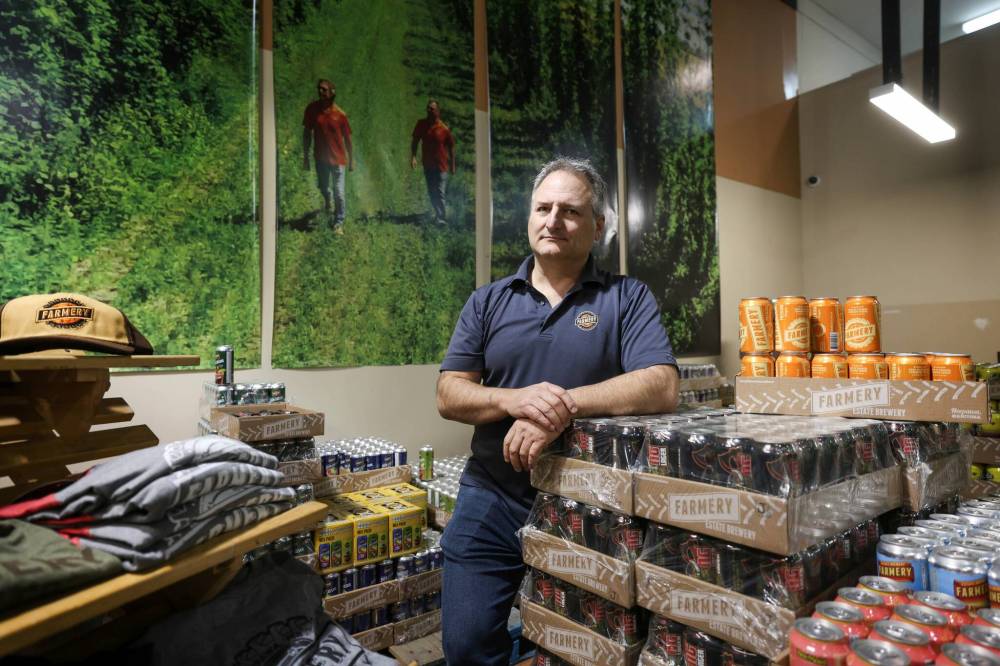
Farmery Estate Brewery wants its alcohol beverages on Ontario liquor store shelves. That hasn’t been possible yet, said co-owner Chris Warwaruk.
The company’s non-alcoholic items — its energy drinks and sodas — have landed in grocery stores in Dryden, Thunder Bay and Kenora, Ont.
“Private companies like Farmery dealing with private grocery stores, (it’s) easy to do business,” Warwaruk said. “There is no private entity that is putting up barriers. It’s the government liquor stores that are.”
Manitoba is considered one of the most progressive provinces on interprovincial trade; the Canadian Federation of Independent Business gave it an “A-” in its annual interprovincial co-operation report card last year.
Premier Wab Kinew said he discussed interprovincial trade with his counterparts last week in Ottawa.
“I think all the premiers want to be able to open up more economic opportunity,” Kinew told reporters on Jan. 30. “Knocking down internal trade barriers is one of them.”
There’s complexity, Kinew noted: each regulation has people behind them who need to be engaged with. The Canadian Food Inspection Agency, for example, has thousands of agricultural producers who’d be affected by change.
Canadian leadership must take care of people involved, Kinew said.
Meantime, the bills keep piling for companies like Bobo. Money funnels to compliance, sometimes through auditor and lawyer fees, McDonald said.
“For many companies, even in this most challenging environment we have with the United States, it is still easier — and less costly, in many instances — to continue to export and do trade to the south of us than it is east-west,” said Loren Remillard, president of the Winnipeg Chamber of Commerce.
Ruth Bonneville / Free Press files
‘There is no private entity that is putting up barriers. It’s the government liquor stores that are,’ says Chris Warwaruk of Farmery brewery.
“Our interprovincial trade barriers have made it attractive to go north-south versus east-west.”
Non-geographic, policy-related barriers within Canada can equate to about a nine per cent tariff nationally, on average, economists with the International Monetary Fund found.
Smaller provinces and northern territories face higher costs in sectors such as retail trade, health and education than larger provinces with diversified economies, the IMF notes.
Nationally, around $532 billion worth of goods and services crossed interprovincial borders in 2023. It accounted for 18 per cent of Canada’s GDP.
“In a perfect scenario, all the provinces would come together and recognize we’re one common market,” Remillard said, noting Ottawa has constitutional power over the regulation of trade and commerce.
Tom De Nardi, president of wholesaler Mondo Foods, hasn’t seen food prices drop following announcements of better interprovincial trade. Removing quotas on items such as dairy and poultry would increase competition, lowering prices, he said. (Removing quotas has been a contentious issue in Canada and a sticking point in U.S. trade negotiations.)
Some industries are working behind the scenes to harmonize nationally. Minimum standards applying to long-combination trucks in all Canadian jurisdictions have been drafted, said Aaron Dolyniuk, executive director of the Manitoba Trucking Association.
He’s on a national task force for vehicle weights and dimensions. Signage on wide loads, for example, is being examined. National standardization on signage and weights could lead to “huge” time savings, Dolyniuk said, adding he’s unsure when the drafts will be implemented.

“There’s … a big shift towards (focusing on) defence right now, which is not bad, but we can’t lose sight of our interprovincial trade issues,” Dolyniuk said.
Engineers Geoscientists Manitoba is contributing to a national member database, where provincial entities will be able to check if workers are registered and in good standing in other jurisdictions.
The database may take a couple years to finish, said Michael Gregoire, Engineers Geoscientists Manitoba’s chief executive. The time is needed to gather stakeholder feedback and incorporate bilingualism, he added.
Buying local — including through government procurement — is faster than changing interprovincial trade barriers, said McDonald.
gabrielle.piche@winnipegfreepress.com
Gabrielle Piché reports on business for the Free Press. She interned at the Free Press and worked for its sister outlet, Canstar Community News, before entering the business beat in 2021. Read more about Gabrielle.
Every piece of reporting Gabrielle produces is reviewed by an editing team before it is posted online or published in print — part of the Free Press‘s tradition, since 1872, of producing reliable independent journalism. Read more about Free Press’s history and mandate, and learn how our newsroom operates.
Our newsroom depends on a growing audience of readers to power our journalism. If you are not a paid reader, please consider becoming a subscriber.
Our newsroom depends on its audience of readers to power our journalism. Thank you for your support.
Gabrielle Piché reports on business for the Free Press. She interned at the Free Press and worked for its sister outlet, Canstar Community News, before entering the business beat in 2021. Read more about Gabrielle.
Every piece of reporting Gabrielle produces is reviewed by an editing team before it is posted online or published in print — part of the Free Press‘s tradition, since 1872, of producing reliable independent journalism. Read more about Free Press’s history and mandate, and learn how our newsroom operates.
Our newsroom depends on a growing audience of readers to power our journalism. If you are not a paid reader, please consider becoming a subscriber.
Our newsroom depends on its audience of readers to power our journalism. Thank you for your support.
Advertisement Advertise With Us
Advertisement Advertise With Us