

Building new foundations in world of trade
Advertisement
Read this article for free:
or
Already have an account? Log in here »
To continue reading, please subscribe:

Digital Subscription
One year of digital access for only $205*
- Enjoy unlimited reading on winnipegfreepress.com
- Read the E-Edition, our digital replica newspaper
- Access News Break, our award-winning app
- Play interactive puzzles
*First annual payment billed as $205.00 + GST for one year. This annual subscription will automatically renew at $233.00 + GST every 52 weeks (10% off the regular annual price of $259.35). Offer available to new and qualified returning subscribers only. Cancel any time.
To continue reading, please subscribe:
Add Free Press access to your Brandon Sun subscription for only an additional
$1 for the first 4 weeks*
- Enjoy unlimited reading on winnipegfreepress.com
- Read the E-Edition, our digital replica newspaper
- Access News Break, our award-winning app
- Play interactive puzzles
*Your next Brandon Sun subscription payment will increase by $1.00 and you will be charged $17.95 plus GST for four weeks. After four weeks, your payment will increase to $24.95 plus GST every four weeks.
Read unlimited articles for free today:
or
Already have an account? Log in here »
Hey there, time traveller!
This article was published 07/02/2026 (237 days ago), so information in it may no longer be current.
It wasn’t so much the deals that emerged that signalled a significant shift in Canada-China relations after Prime Minister Mark Carney’s meeting with People’s Republic of China President Xi Jinping last month.
It was the fact their working lunch ran long, just like the 20-minute meeting scheduled between the two world leaders in October in South Korea ran for 43 minutes, “which is quite unusual for the Chinese,” said Chris White, Beijing-based president and CEO of the Canadian Meat Advocacy Office, during a webinar this week.
“Not every world leader who has that opportunity to meet with President Xi gets both a working lunch and then that (gets) extended.”
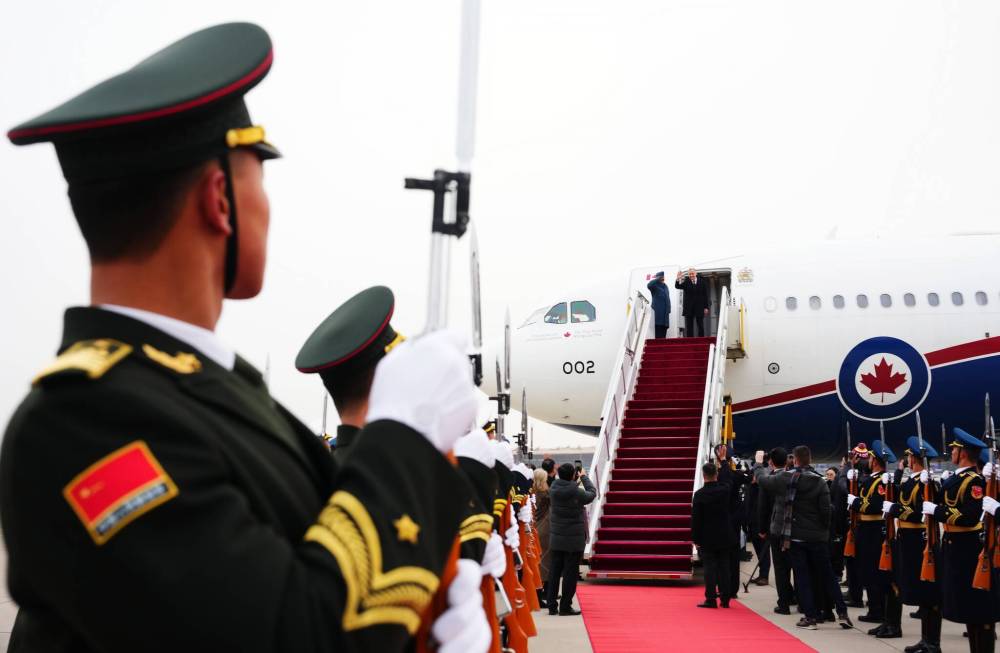
White has been the Canadian meat sector’s boots on the ground in China for less than a year, but his presence underscores a growing recognition among industry leaders that being present in key markets matters — even more so when the relationships are complicated.
He told the Canadian Agri-Food Policy Institute audience he wasn’t surprised the January meeting didn’t result in relief from the 25 per cent tariff China imposed on Canadian pork imports (as of Jan. 1). It was clear going in this meeting would be about settling the tit-for-tat dispute over EVs and canola and, because the relationship has been so strained for so long, Carney had to pick his battles.
White is OK with that, because he is seeing forward motion in Canada-China relations, rather than efforts to relitigate the past. Provided Canada delivers on its promises, there is an opportunity for more progress down the road.
“They’ve almost put Canada on probation,” he said. “They are somewhat skeptical that the reset is as significant as we might think it is.”
Plus, the Chinese are watching closely to see what emerges from the Canada-United States-Mexico Agreement review scheduled for this year and how that might affect how Canada trade deals with China going forward.
“For every meeting I’ve had in the last year with Chinese officials, they are beyond perplexed as to why the U.S. is treating Canada this way,” he said. “If the U.S. is treating Canada like this, right, what are they doing to the other countries? And then the key point: what is the leverage that China has with all of these other countries?”
Welcome to the convoluted world of trade these days, and the challenges businesses that operate in real-time face navigating it.
Businesses have always dealt with uncertainty, but this era is different, said Carlo Dade, director of international policy at the University of Calgary’s School of Public Policy.
“The issue we face is not the normal uncertainty that we have with business, the usual risk from environmental disruptions, COVID or malevolent actors that tend to be short-term or specific,” he said. “We’re seeing systematic uncertainty in global markets, uncertainty as U.S. policy.”
However, despite the political noise and daily social media announcements, Dade noted Canada-U.S. trade has increased over the past year and is currently five per cent above the 10-year average.
“There’s so many things that tie us to the U.S. — geography, gravity, sunk cost in infrastructure, sunk cost in supply chains — that the aspirational goals of government don’t match the business reality,” Dade said. “And we’ve got to keep front of mind that business trades, not the government.”

While the federal government has made export market diversification a priority, Dade questions whether Canadian business is committed to understanding what it will take to develop those markets and deliver to them.
That isn’t accomplished with ministerial trade missions or delegations that go in to solve a specific customer issue. It means being there.
Once the framework is in place, it’s up to industry to invest the time and resources to develop the customer relationships. That starts with understanding the customer beyond transactional dealings and following through with the infrastructure investments necessary to meet those market needs. Governments can’t do it all.
It’s one of the many ways the cost of doing business rises in an era of weaponized uncertainty and trade coercion.
Laura Rance is executive editor, production content lead for Glacier FarmMedia. She can be reached at lrance@farmmedia.com