

Drone application big step in crop protection
Advertisement
Read this article for free:
or
Already have an account? Log in here »
To continue reading, please subscribe:
Digital Subscription
One year of digital access for only $1.44 a week*
- Enjoy unlimited reading on winnipegfreepress.com
- Read the E-Edition, our digital replica newspaper
- Access News Break, our award-winning app
- Play interactive puzzles
*Billed as $5.77 plus GST every four weeks. After 52 weeks, price increases to the regular rate of $19.95 plus GST every four weeks. Offer available to new and qualified returning subscribers only. Cancel any time.
To continue reading, please subscribe:
Add Free Press access to your Brandon Sun subscription for only an additional
$1 for the first 4 weeks*
- Enjoy unlimited reading on winnipegfreepress.com
- Read the E-Edition, our digital replica newspaper
- Access News Break, our award-winning app
- Play interactive puzzles
*Your next Brandon Sun subscription payment will increase by $1.00 and you will be charged $17.95 plus GST for four weeks. After four weeks, your payment will increase to $24.95 plus GST every four weeks.
Read unlimited articles for free today:
or
Already have an account? Log in here »
Hey there, time traveller!
This article was published 28/02/2026 (240 days ago), so information in it may no longer be current.
It’s been a long time coming, but Health Canada is finally moving forward with a plan that would allow farmers to spray weeds using drones.
The department that oversees Canada’s Pest Management Regulatory Agency has launched a 30-day public consultation process on a proposal to regulate drone applications of pesticides similarly to manned aircraft applications.
The change, if approved, would allow manufacturers whose products are already approved for application by manned aircraft to add application by drones to their product labels without going through the costly and time-consuming process of applying for a label change.
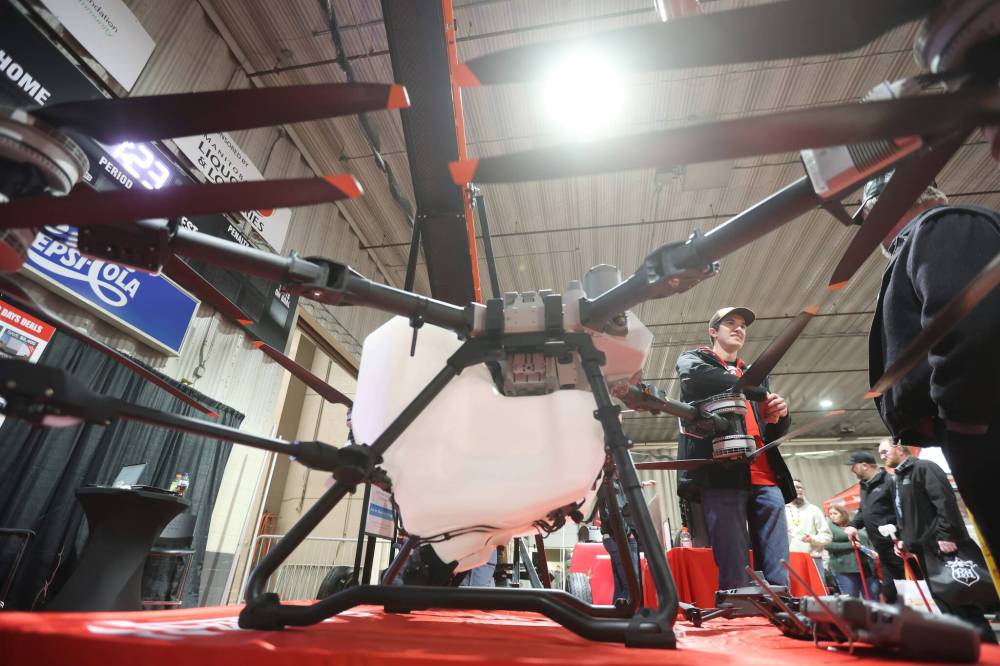
TIM SMITH / BRANDON SUN FILES
An agricultural drone on display at Manitoba Ag Days 2026 in Brandon in January.
Currently, there are no agricultural pesticide products registered for drone application largely because the current regulations require every product to go through a separate registration process providing supporting data.
Researchers have been able to obtain permits to conduct trials testing specific products and application methods, but the regulatory hesitancy to allow commercial use has been a huge source of frustration for farmers watching their counterparts in other countries reaping the benefits.
Health Canada now says in its online discussion document that reviews of global studies indicate “the existing label directions are sufficient to address the potential health and environmental risks related to the application of pesticides by RPAS (Remotely Piloted Aircraft System).”
Some risks, such as exposure to applicators using the product, are even lower because drones operate remotely.
Allowing drones to piggyback on the same label rules for aerial application would remove a regulatory barrier blocking widespread adoption of a technology many see as a gamechanger in crop protection.
Drones have been available for years and the capabilities continue to advance at lightning speed. Many farmers already use drones to monitor their fields and identify problem areas for follow up on the ground.
When it comes to controlling weeds or crop diseases, drones allow for more precise application, which allows herbicides to be used more selectively to spray patches or cover areas where reaching weeds with ground sprayers or airplanes is too difficult.
However, while many farmers will be doing a happy dance over this news, panelists on a webinar hosted by EMILI (Enterprise Machine Intelligence Learning Initiative) this week were injecting a note of caution.
There are a host of intersecting federal and provincial requirements for registration, training and certification. Drone owners and operators, whether they are operating commercially or on their own farms, require registration and licensing from Transport Canada based on the size of drone they are operating. Pesticide applicators are regulated by provincial governments.
As well, while regulators may be comfortable the same environmental and safety regulations can apply, that doesn’t mean products will perform the same when applied by drones. Products that perform well under optimal conditions may not be as predictable when applied by an inexperienced applicator on a gusty day.
Kevin Falk, a Corteva Agriscience researcher who has been working with EMILI to evaluate how products perform under different applications, predicted product manufacturers will be treading carefully and doing more research before adding drones to their product labels.
“Speaking from my research perspective, it removes a lot of the biggest barriers that we’ve had here in Canada, which is the difficulty and cost of generating real-world spray drone data,” he said.
There is still much to learn. “There’s a real risk that inconsistent application outcomes get blamed on the products rather than the application method,” he said.

But perhaps the biggest hurdle regulators and product manufacturers face is keeping up with farmers. The case for using it to spray for weeds and crop diseases is so compelling, some farmers have made no secret of the fact they aren’t prepared to wait for the rest of the industry to catch up.
Leanne Koroscil, manager of two research farms operated by EMILI, said the word that comes to mind describing the technology’s potential from a farmer’s perspective is “optimization.”
Farmers can save time and labour. More targeted spraying means they can reduce costs and environmental impacts. They can cut the number of compaction-causing passes they make over their fields with heavy equipment.
“Ultimately, I see that this is optimizing the availability of tools that a producer can use to make the best-informed management decisions they could possibly make at any given time,” she said.
Laura Rance is executive editor, production content lead for Glacier FarmMedia. She can be reached at lrance@farmmedia.com