

Latest Mideast flare-up driving crude oil, fuel prices higher
Advertisement
Read this article for free:
or
Already have an account? Log in here »
To continue reading, please subscribe:

Digital Subscription
One year of digital access for only $205*
- Enjoy unlimited reading on winnipegfreepress.com
- Read the E-Edition, our digital replica newspaper
- Access News Break, our award-winning app
- Play interactive puzzles
*First annual payment billed as $205.00 + GST for one year. This annual subscription will automatically renew at $233.00 + GST every 52 weeks (10% off the regular annual price of $259.35). Offer available to new and qualified returning subscribers only. Cancel any time.
To continue reading, please subscribe:
Add Free Press access to your Brandon Sun subscription for only an additional
$1 for the first 4 weeks*
- Enjoy unlimited reading on winnipegfreepress.com
- Read the E-Edition, our digital replica newspaper
- Access News Break, our award-winning app
- Play interactive puzzles
*Your next Brandon Sun subscription payment will increase by $1.00 and you will be charged $17.95 plus GST for four weeks. After four weeks, your payment will increase to $24.95 plus GST every four weeks.
Read unlimited articles for free today:
or
Already have an account? Log in here »
Hey there, time traveller!
This article was published 02/03/2026 (199 days ago), so information in it may no longer be current.
CALGARY – Gasoline prices at the pump are on the rise in many Canadian cities as fears around the U.S.-Israeli attacks on Iran drive up world oil prices at the same time refineries are preparing for the summer driving season.
Price-tracker Gasbuddy.com put the Canadian average at 135.7 cents a litre for regular unleaded gas late Monday afternoon, though there is a lag as it collects data from stations across the U.S. and Canada.
That’s an increase of 1.6 cents from Sunday and 4.1 cents from last week’s average.
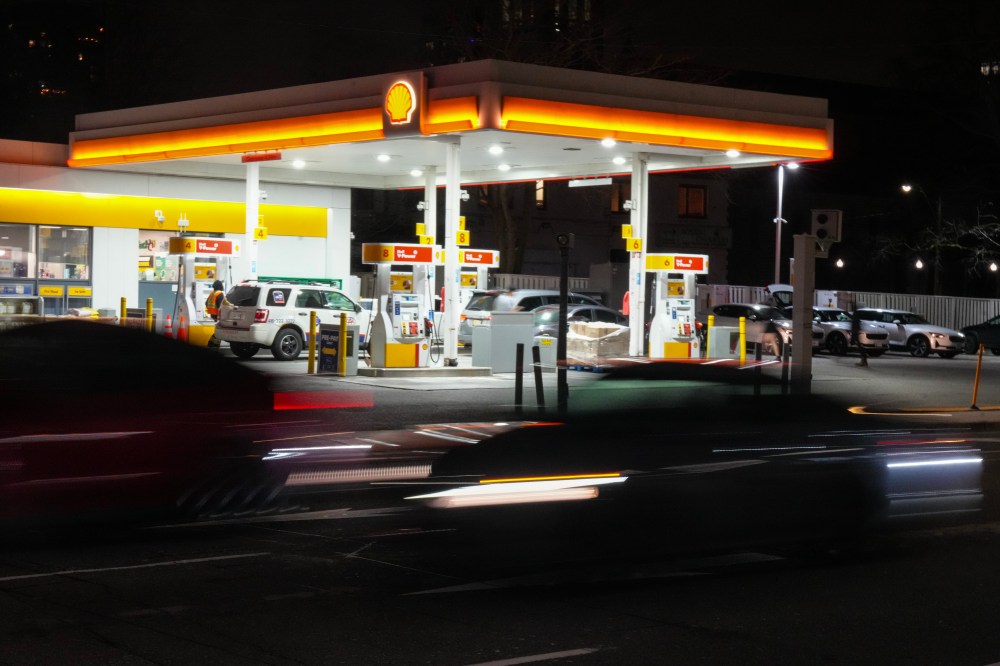
In Toronto, the average price was 134.3 cents a litre, up 4.9 cents from Sunday, while Vancouver saw an uptick of 4.5 cents, Montreal saw an increase of 1.7 cents and Calgary saw prices remain mostly steady.
The April crude contract settled at US$71.23 a barrel on Monday, an increase of more than six per cent.
“In Canada unfortunately it’s almost the same story as basically anywhere else right now,” said Gasbuddy petroleum analyst Matt McClain.
Taking into account the events of Saturday and Sunday, Gasbuddy has predicted a rise of five to 15 cents per litre by Wednesday, he said.
There shouldn’t be any actual fuel supply disruptions affecting Canada or the United States, as they produce plenty of their own oil, McClain added.
“But we are going to see some price points that may be a little inconvenient or, depending upon how this conflict plays out, potentially up to painful.”
The Canadian Fuels Association, citing data from Kalibrate Canada Inc., said crude oil represents about 41 per cent of the final pump price, with taxes, refining, distribution and marketing making up the rest.
U.S. President Donald Trump said the military operation, which began Saturday and has since embroiled several other Middle Eastern countries, is expected to last four to five weeks but has “the capability to go far longer.”
Roger McKnight, chief petroleum analyst at En-Pro International, said it’s hard to make sense of the unfolding picture and what it will mean for global oil markets.
“It’s kind of a foggy one to read because it’s like trying to read somebody’s mind,” he said.
“If you can read President Trump’s mind, then I think we’d have a clearer picture of what was going on.”
McKnight said he’s roughly expecting a three-cent bump at the pumps by Wednesday.
“The caveman mathematics on this is, for every dollar a barrel crude moves, it results in six-tenths of a cent at the pump.”
McKnight said consumers could soon face a “triple whammy” — war in the Middle East, a rise in seasonal demand heading into summer and semi-annual refinery maintenance downtime.
A focus in the current Mideast conflict is the Strait of Hormuz, a key crude oil shipping route at the southern end of the Persian Gulf thorough which 20 per cent of the world’s supply passes.
Monday’s oil price increase was within the US$5-$10 per barrel range expected by analysts based simply on the fear factor associated with the outbreak of war. And some war concerns were already reflected in the price before the conflict started.
However, long-term disruption to ship traffic in the strait could send prices even higher, and so could damage to oil infrastructure in other Gulf countries. Meanwhile, a shorter conflict in which disruptions are easily reversible could mean the current price spike won’t last.
Analysts at S&P Global Energy said the war has the potential to lead to the largest oil supply disruption in history. The firm’s data shows that on Sunday, only five oil tankers moved through the strait compared to 60 per day recently.

During the first two months of this year, almost 21 million barrels of oil and other products a day transited the vital shipping route, which is almost 40 kilometres wide at its narrowest point.
“The duration of the war is critical. If the reduction in tanker traffic continues for a week or so it will be historic,” Jim Burkhard, global head of crude oil research at S&P, said in a report.
“Beyond that it would be epochal for the oil market with prices rising to ration scarce supply and impacts in financial markets.”
This report by The Canadian Press was first published March 2, 2026.
— With files from The Associated Press.
Related Articles
Hegseth insists the Iran conflict is 'not endless' while warning more casualties are likely
Advertisement Advertise With Us
Advertisement Advertise With Us