

Key takeaways from China’s new 5-year economic blueprint and growth target
Advertisement
Read this article for free:
or
Already have an account? Log in here »
To continue reading, please subscribe:

Digital Subscription
One year of digital access for only $205*
- Enjoy unlimited reading on winnipegfreepress.com
- Read the E-Edition, our digital replica newspaper
- Access News Break, our award-winning app
- Play interactive puzzles
*First annual payment billed as $205.00 + GST for one year. This annual subscription will automatically renew at $233.00 + GST every 52 weeks (10% off the regular annual price of $259.35). Offer available to new and qualified returning subscribers only. Cancel any time.
To continue reading, please subscribe:
Add Free Press access to your Brandon Sun subscription for only an additional
$1 for the first 4 weeks*
- Enjoy unlimited reading on winnipegfreepress.com
- Read the E-Edition, our digital replica newspaper
- Access News Break, our award-winning app
- Play interactive puzzles
*Your next Brandon Sun subscription payment will increase by $1.00 and you will be charged $17.95 plus GST for four weeks. After four weeks, your payment will increase to $24.95 plus GST every four weeks.
Read unlimited articles for free today:
or
Already have an account? Log in here »
Hey there, time traveller!
This article was published 05/03/2026 (201 days ago), so information in it may no longer be current.
BEIJING (AP) — China on Thursday set its lowest economic growth target since 1991 at the opening of its annual national congress, in what some economists interpreted as a reflection of pragmatism as a weak domestic economy bites.
Beijing also released the full draft of its five-year plan up to 2030 outlining its economic and political policy priorities, with a focus on boosting self-reliance in areas like artificial intelligence, robotics and other advanced technologies as China’s rivalry with the U.S. heats up.
The weeklong congress is expected to approve the five-year plan in coming days.
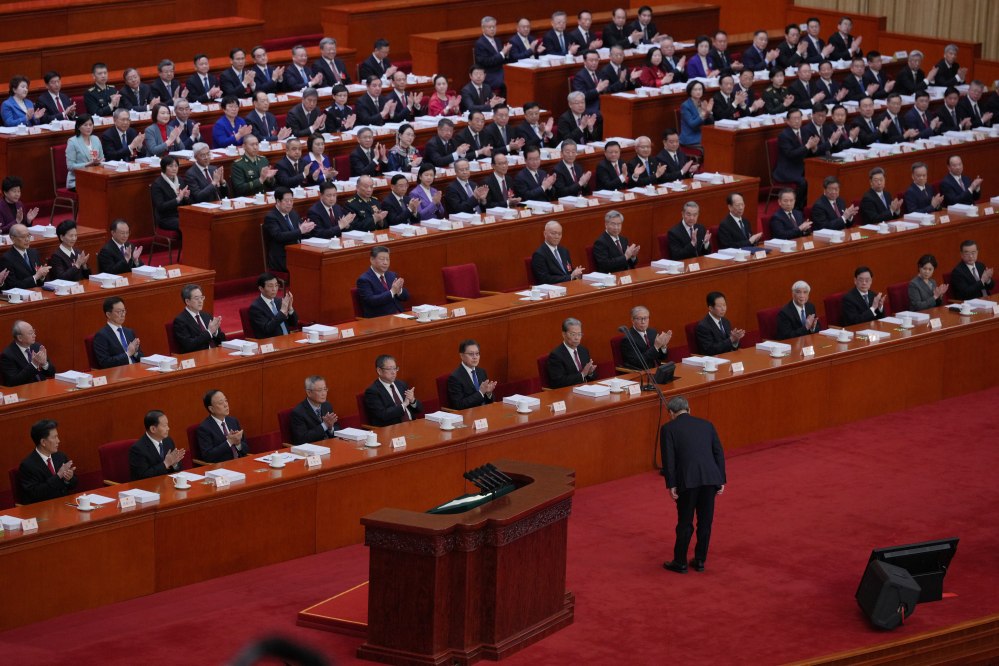
Here are the key takeaways from Chinese Premier Li Qiang’s annual government work report at the congress and China’s next five-year plan:
Lowest economic growth target since 1991
Li unveiled an economic growth target of 4.5% to 5% for 2026 — the lowest target since 1991 — and the first downgrade following an official “around 5%” target set for between 2023 and 2025.
The lower target follows a yearslong property sector slump that sent home prices tumbling, weakened domestic consumption and investment confidence and led to massive job losses.
In addressing China’s domestic economic challenges, officials pledged to stabilize the housing market by controlling new supply and reducing inventory.
Li also reiterated the importance of boosting domestic consumption, although China’s funding of 250 billion yuan ($36 billion) earmarked for consumer goods trade-in subsidies was lower than last year’s 300 billion yuan.
Record trade surplus
Despite the U.S.-China trade war, China said it had met its official 5% economic growth target last year. That was largely thanks to its record trade surplus of almost $1.2 trillion under an export boost to regions such as Europe and Latin America.
“What we achieved in 2025 was indeed hard won,” Li said in his speech. “Rarely in many years have we encountered such a grave and complex landscape.”
Taiwan
On Taiwan, the self-ruled island which Beijing has for decades claimed as its own, Li stressed that Beijing will “resolutely fight against” separatist forces.
The choice of wording of “fight against” appeared to a stronger tone compared to last year’s “resolutely oppose.”
Tech race heats up
In the full draft of its five-year plan up to 2030, Chinese leaders set out an ambition to achieve technological self-reliance to rival the U.S. The draft plan outlined goals in advancements in areas including artificial intelligence, robotics, semiconductors, biomedicine, quantum technology and aerospace.
To ensure innovation breakthroughs, Chinese officials projected an annual average growth of at least 7% in nationwide spending on research and development.
Military budget growth
Chinese leaders also pledged a 7% defense budget growth for 2026, to about 1.9 trillion yuan ($270 billion). That was slightly lower than the around 7.2% annual increase in the last three years.
In his speech, Li said that China needs to achieve “solid gains in military training and combat readiness.” That came as Xi’s purge of China’s military widened — including the removal of nine military officers from the congress last week — as China speeds up its goals of modernizing its army in the coming few years.
Encouraging births a priority
China, like many other parts of the world, is also facing a demographic crisis as its population ages and birth rate falls. Its 1.4 billion population declined for a fourth straight year last year, falling by about 3 million in 2025 from the year before.
Chinese officials on Thursday vowed to build a “fertility-friendly society” with policies aimed to address education, employment, as well as child care and health care support in the hopes of encouraging more births.

Climate targets
On climate targets, China, the world’s largest polluter, said it would continue with its renewable energy push and to reduce carbon emissions.
For the five years to 2030, Beijing has set a goal of reducing carbon emissions per unit of gross domestic product by 17%, compared to the 18% cutback target in the previous five years.
____
Chan reported from Hong Kong. AP writer Ken Moritsugu contributed from Beijing.