US stocks hold steadier as Wall Street waits for the next signal on how long war with Iran may last
Advertisement
Read this article for free:
or
Already have an account? Log in here »
To continue reading, please subscribe:

Digital Subscription
One year of digital access for only $205*
- Enjoy unlimited reading on winnipegfreepress.com
- Read the E-Edition, our digital replica newspaper
- Access News Break, our award-winning app
- Play interactive puzzles
*First annual payment billed as $205.00 + GST for one year. This annual subscription will automatically renew at $233.00 + GST every 52 weeks (10% off the regular annual price of $259.35). Offer available to new and qualified returning subscribers only. Cancel any time.
To continue reading, please subscribe:
Add Free Press access to your Brandon Sun subscription for only an additional
$1 for the first 4 weeks*
- Enjoy unlimited reading on winnipegfreepress.com
- Read the E-Edition, our digital replica newspaper
- Access News Break, our award-winning app
- Play interactive puzzles
*Your next Brandon Sun subscription payment will increase by $1.00 and you will be charged $17.95 plus GST for four weeks. After four weeks, your payment will increase to $24.95 plus GST every four weeks.
Read unlimited articles for free today:
or
Already have an account? Log in here »
Hey there, time traveller!
This article was published 09/03/2026 (212 days ago), so information in it may no longer be current.
NEW YORK (AP) — The U.S. stock market held steadier Tuesday as Wall Street waited for the next signal on when the war with Iran may end.
The S&P 500 dipped 0.2%, a day after its latest wild swings caused by extreme moves in the oil market. The Dow Jones Industrial Average fell 34 points, or 0.1%, and the Nasdaq composite edged higher by less than 0.1%.
Oil prices, meanwhile, remained sharply below their peaks hit on Monday. Such spikes have been rocking financial markets worldwide because of worries that the war could block the global flow of oil and natural gas for a long time.
The price for a barrel of Brent crude, the international standard, settled at $87.80. That’s down 11.3% from its settlement price the day before, but much of that drop happened on Monday before the U.S. stock market finished trading. That’s why it did not give much of a boost to U.S. stocks Tuesday.
Oil prices plunged Monday afternoon from a high of nearly $120 per barrel, its most expensive level since 2022, after President Donald Trump told CBS News he thinks “the war is very complete, pretty much.” That raised hopes that the war may end relatively soon, which could allow oil to flow freely again from the Middle East to customers around the world.
But Trump’s comments later Monday, after the U.S. stock market finished trading, were not as clear. And a spokesperson for Iran’s paramilitary Revolutionary Guard said that “Iran will determine when the war ends.” Iran launched new attacks Tuesday at Israel and Gulf Arab countries, keeping pressure on the Middle East in a war started by Israel and the United States.
That has Wall Street waiting for the next clue about how long the war may last.
One point where Trump remained clear was his desire to keep the Strait of Hormuz open. The war has effectively blocked the waterway off Iran’s coast, where a fifth of the world’s oil sails on a typical day. That’s been a central reason for extreme swings in oil prices recently, which have dominated other financial markets and raised worries about the global economy.
“If Iran does anything that stops the flow of Oil within the Strait of Hormuz, they will be hit by the United States of America TWENTY TIMES HARDER than they have been hit thus far,” Trump said in a posting on his social media network late Monday.

“The outlook for oil right now is about as binary as it gets,” according to Hakan Kaya, senior portfolio manager at Neuberger Berman.
“Either the Strait of Hormuz reopens and you see a massive unwind of the risk premium, or it stays shut and we are looking at the largest supply disruption in modern history. There is no middle ground, and that is why putting a number on it is almost irresponsible.”
The U.S. stock market has a history of bouncing back relatively quickly from military conflicts, as long as oil prices don’t stay too high for too long. Uncertainty about whether that may happen this time around has led to stunning swings up and down for markets worldwide, often hour-to-hour.
If oil prices do stay high for long, household budgets already stretched by high inflation could break under the pressure. Companies would see their own bills jump for fuel and to stock items on their store shelves or in their data warehouses. It all raises the possibility of a worst-case scenario for the global economy, “stagflation,” where growth stagnates and inflation remains high.
On Wall Street, Vertex Pharmaceuticals leaped 8.3% for the biggest gain in the S&P 500 after reporting encouraging trends from a trial for its treatment for a life-threatening kind of kidney disease.
West Pharmaceutical Services sank 5.7% after Eric Green said he’ll retire as CEO and chair once the board finds and hires his successor.
All told, the S&P 500 fell 14.51 points to 6,781.48. The Dow Jones Industrial Average dipped 34.29 to 47,706.51, and the Nasdaq composite added 1.16 to 22,697.10.

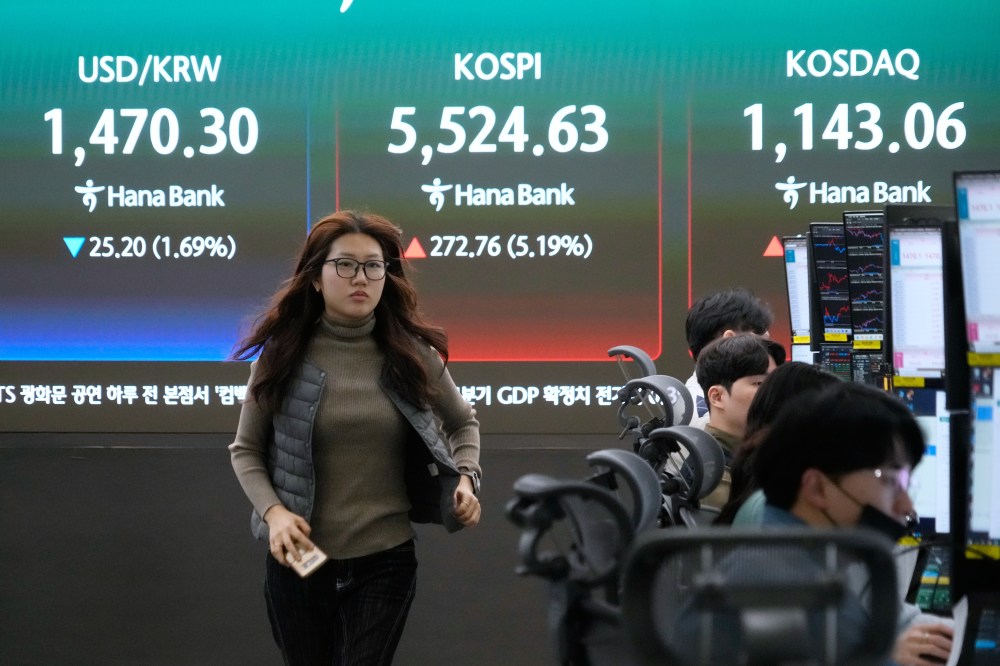
Stock markets in Asia and Europe jumped after getting their first chances to react to Trump’s comments from late Monday and the subsequent easing of oil prices. Indexes leaped 5.3% in South Korea, 2.2% in Hong Kong and 1.8% in France.
Tokyo’s Nikkei 225 rose 2.9% after the government also released revised economic data showing Japan’s economy grew faster in the final quarter of last year than initially estimated.
In the bond market, the yield on the 10-year Treasury rose to 4.15% from 4.12% late Monday.
___
AP Business Writers Yuri Kageyama and Matt Ott and AP Videographer Ayaka McGill contributed.