

Oil market watchers weighing potential impacts of prolonged Mideast war
Advertisement
Read this article for free:
or
Already have an account? Log in here »
To continue reading, please subscribe:

Digital Subscription
One year of digital access for only $205*
- Enjoy unlimited reading on winnipegfreepress.com
- Read the E-Edition, our digital replica newspaper
- Access News Break, our award-winning app
- Play interactive puzzles
*First annual payment billed as $205.00 + GST for one year. This annual subscription will automatically renew at $233.00 + GST every 52 weeks (10% off the regular annual price of $259.35). Offer available to new and qualified returning subscribers only. Cancel any time.
To continue reading, please subscribe:
Add Free Press access to your Brandon Sun subscription for only an additional
$1 for the first 4 weeks*
- Enjoy unlimited reading on winnipegfreepress.com
- Read the E-Edition, our digital replica newspaper
- Access News Break, our award-winning app
- Play interactive puzzles
*Your next Brandon Sun subscription payment will increase by $1.00 and you will be charged $17.95 plus GST for four weeks. After four weeks, your payment will increase to $24.95 plus GST every four weeks.
Read unlimited articles for free today:
or
Already have an account? Log in here »
Hey there, time traveller!
This article was published 09/03/2026 (205 days ago), so information in it may no longer be current.
CALGARY – An oil market analyst says a major hike to his commodity price forecast for the year is a given as the Middle East war stretches into its second week, but the magnitude will depend on how long crude shipments from the Persian Gulf are choked off and the extent of damage to production infrastructure.
Al Salazar, head of macro oil and gas research at Enverus, had predicted US$61-per-barrel West Texas Intermediate crude for 2026. But that was before the U.S. and Israel began their strikes against Iran just over a week ago and the war spilled over into several other countries in the region.
“It’s going to go up without question. It’s just a matter of how much it goes up,” he said Monday.
“I guarantee it’s not going to be US$61. It’s not going to be US$65. It’s not going US$70. It’s going to be something higher than that. But also, just like everybody else, we’re guessing on how long this is going to last.”
Salazar said he’s not betting on the conflict being wrapped up in the four-to-five week timeline U.S. President Donald Trump has floated.
Global crude prices surged above US$119 per barrel early Monday, but have since fallen back to around US$96 in afternoon trading. That’s still more than 40 per cent higher than where the commodity was hovering before the attacks on Iran began.
The last time oil breached the US$100 per barrel mark was when Russia invaded Ukraine in 2022.
An estimated one-fifth of global crude oil supplies moved through the Strait of Hormuz every day pre-war. The threat of Iranian attacks has all but stopped tanker traffic through the narrow waterway connecting the Persian Gulf and Gulf of Oman.
Jim Burkhard, vice-president and global head of crude oil research at S&P Global Energy, said the first week of the crisis was a transportation issue that could in theory be resolved quickly.
“But it is turning into a producibility concern as well due to storage constraints. Restarting field production of this scale will be a massive technical exercise that could last weeks or more to fully restore output,” Burkhard wrote in a report Monday.
“Downstream and other oil infrastructure damage could potentially limit the pace of recovery of oil flows also, including refined products.”
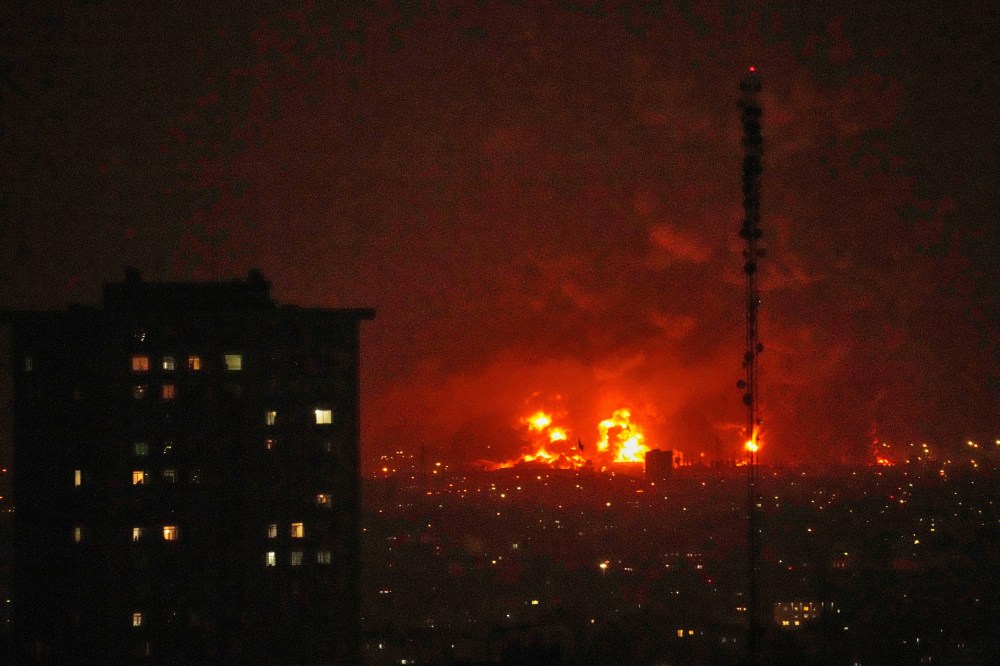
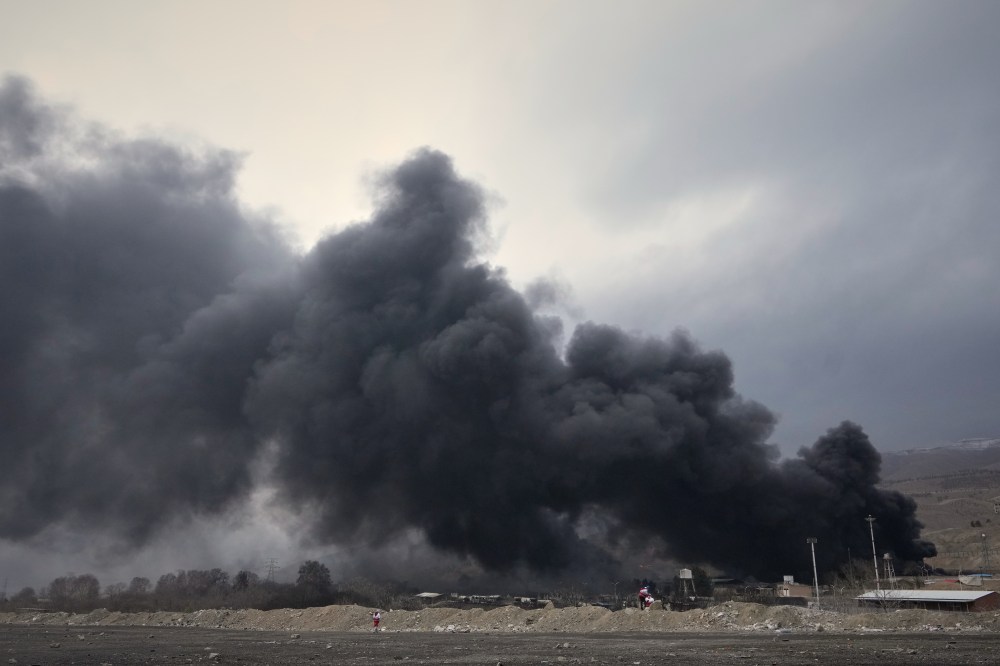
Bahrain’s national oil company declared force majeure for its shipments after an Iranian attack set its refinery complex ablaze. The legal declaration releases the company of contractual obligations because of extraordinary circumstances.
Oil depots in Tehran smouldered following overnight strikes by Israel.
A report from Capital Economics published Monday said if the conflict is limited to a matter of weeks, economies outside the region would see little impact to their gross domestic product, inflation and monetary policy.
But with a war that stretches months and causes lasting damage to Persian Gulf energy infrastructure, there could be a global recession coupled with higher interest rates, Capital Economics said.
Salazar said Canadian crude producers are capturing higher margins from the price spike, but the degree to which they’re able to ratchet up their output is limited by the pipeline space available.
Another beneficiary is the Alberta treasury. The province says every US$1 movement in the price of WTI crude amounts to a $680-million change to its bottom line.
Mere days before the war, the Alberta government forecast a $9.4-billion deficit for this year, in part due to a WTI price predicted to hover at a lacklustre US$60.50 a barrel.
The Canadian Fuels Association, citing data from Kalibrate Canada Inc., said crude oil represents about 41 per cent of the final pump price for gasoline, with taxes, refining, distribution and marketing making up the rest.
Gasbuddy.com, which crowdsources gas price data from drivers across the U.S. and Canada, pegged the average Canadian price Monday at 155.6 cents per litre, up 20 cents from a week ago.
The run-up in oil prices is “without question a drag to the overall economy,” Salazar said, noting there is only so much consumers can do to reduce their fuel use.
“Other parts of consumer spending fall to compensate for the high energy prices, because people still have to go where they have to go,” Salazar said.

The higher crude costs are also a headwind to airlines, wrote TD Cowen analyst Tom Fitzgerald in a Saturday note. U.S. jet fuel prices rose by an average of 45 per cent week-over-week for the March-to-June period, he noted.
“Barring a rapid de-escalation, we expect airlines will begin pruning (second half of 2026) schedules in the weeks ahead to help in their efforts at recapturing higher fuel prices,” Fitzgerald wrote.
“The spike in fuel prices will also add pressure to ultra-low-cost carriers which could drive further supply cuts at the low end of the market.”
This report by The Canadian Press was first published March 9, 2026.
— With files from The Associated Press.
Related Articles
Iran war puts at risk key pipelines, terminals and refineries that supply the world with oil and gas





Advertisement Advertise With Us
Advertisement Advertise With Us