

The attacked South Pars natural gas field is an energy lifeline for Iran
Advertisement
Read this article for free:
or
Already have an account? Log in here »
To continue reading, please subscribe:

Digital Subscription
One year of digital access for only $205*
- Enjoy unlimited reading on winnipegfreepress.com
- Read the E-Edition, our digital replica newspaper
- Access News Break, our award-winning app
- Play interactive puzzles
*First annual payment billed as $205.00 + GST for one year. This annual subscription will automatically renew at $233.00 + GST every 52 weeks (10% off the regular annual price of $259.35). Offer available to new and qualified returning subscribers only. Cancel any time.
To continue reading, please subscribe:
Add Free Press access to your Brandon Sun subscription for only an additional
$1 for the first 4 weeks*
- Enjoy unlimited reading on winnipegfreepress.com
- Read the E-Edition, our digital replica newspaper
- Access News Break, our award-winning app
- Play interactive puzzles
*Your next Brandon Sun subscription payment will increase by $1.00 and you will be charged $17.95 plus GST for four weeks. After four weeks, your payment will increase to $24.95 plus GST every four weeks.
Read unlimited articles for free today:
or
Already have an account? Log in here »
Hey there, time traveller!
This article was published 18/03/2026 (196 days ago), so information in it may no longer be current.
FRANKFURT, Germany (AP) — The South Pars natural gas field, which came under attack this week, is part of the world’s largest such field — and an energy lifeline for Iran.
Israel’s attack on the field prompted Iran to target energy infrastructure in other Middle East countries in response, sending new shockwaves across the region and beyond.
The Iran war has dealt a massive energy shock to the global economy by choking off most exports of crude oil and liquefied natural gas through the Strait of Hormuz. Iran has also attacked ships and key export facilities in its Persian Gulf neighbors, putting more upward pressure on energy prices, even though its Gulf neighbors — Saudi Arabia, Qatar, Oman, Iraq and the United Arab Emirates — are not taking part in the U.S.-Israeli attacks on Iran.
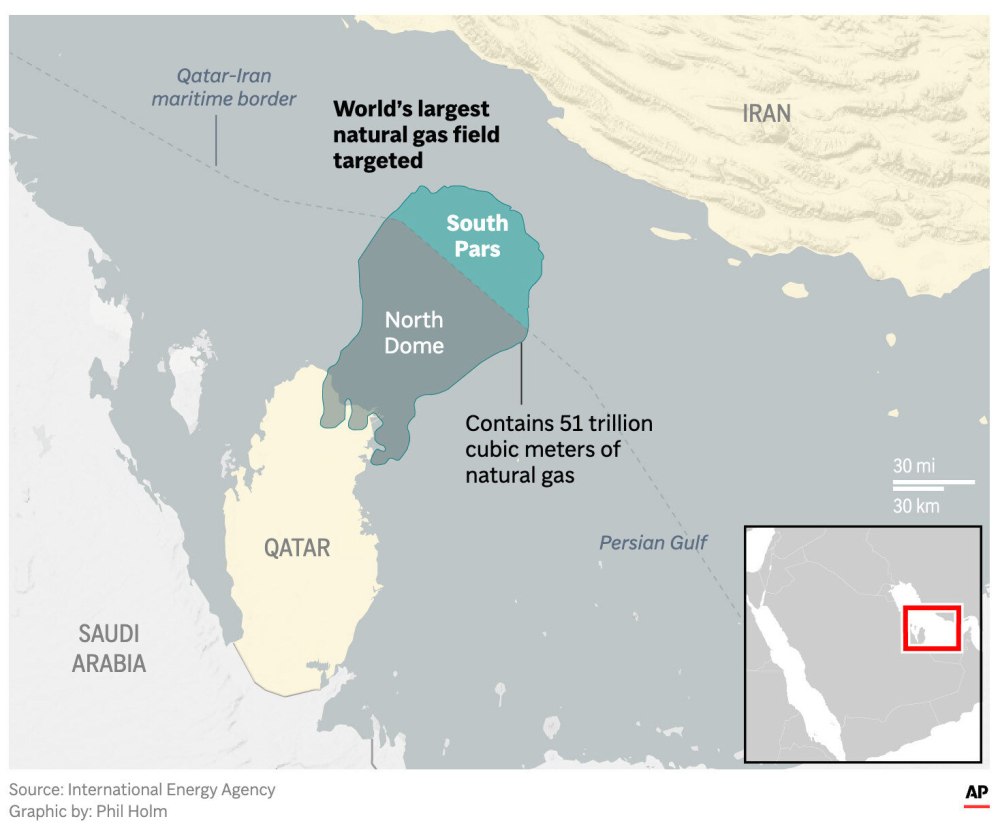
Hours after Wednesday’s attack, U.S. President Donald Trump said that Israel would not attack South Pars again, but warned on social media that if Iran continued striking Qatar’s energy infrastructure, the United States would retaliate and “massively blow up the entirety” of the field.
In the case of South Pars, the target is not Iran’s exports but its biggest source of domestic energy in a country that sometimes struggles to produce enough electricity.
The gas field under the Persian Gulf — the world’s largest — is shared by Iran and Qatar. It’s called South Pars on the Iranian side and the North Field on the Qatari side.
Here are key things to know about the South Pars field:
Iran uses a lot of natural gas, and 80% comes from South Pars
Iran relies heavily on gas to produce electricity and heat homes. It is the fourth-largest consumer of natural gas in the world, behind the U.S., China and Russia, according to the Center on Global Energy Policy at Columbia University, even though its economy is much smaller.
In contrast to other Middle East countries, it uses gas for heating due to its cold climate and much of that use is subsidized, which discourages efficient use. South Pars is the main source.
Oil and gas prices have risen on news of the attack
Although South Pars mainly supplies Iran’s domestic needs, global oil prices rose and gas prices in Europe soared on the news of the attack — mainly over fears of Iranian retaliation on Gulf energy infrastructure. The attack was “a serious escalation” due to the threat of Iranian retaliation, said Andres Cala, geopolitical analyst at energy intelligence firm Montel News.
Iran has struggled with rickety energy infrastructure and shortages
Iran has suffered power shortages because of interruptions to gas supplies, even though on paper it has huge energy reserves. In July, public buildings had to shut down when a heat wave strained the power grid.
Qatar and Iran both tap the world’s largest gas field
Yet the two countries have made starkly different uses of the same underground reserves.
Qatar, which has a much smaller population, has invested billions in developing the field as a source of liquefied natural gas, which before the war it exported from its Ras Laffan facility. There, gas is chilled to a liquid and loaded on tankers that head for customers in Asia, who turn it back into gas form. It’s a lucrative business and has made Qatar the supplier of about a fifth of the world’s LNG.

Ras Laffan shut down March 2 after an Iranian attack and then was hit again on Thursday. The extent of the damage was unclear but the shutdown and attack were raising prices for natural gas in Asia and Europe.
Thursday’s strikes were part of “a dangerous escalation” of the conflict and “a grim warning” for the LNG market, said data and analytics firm Energy Intelligence.
Iran is another story. Sanctions and lack of investment mean that Iran feeds its gas into its own pipeline system and uses it domestically for cooking, heating homes, generating electricity, and as a raw material for industry. Iran exports relatively little, about 9 billion cubic meters, compared to Qatar’s more than 120 billion cubic meters. Iran’s export customers are Turkey and Armenia, both of which could access alternative supplies.
Iran tried to develop LNG for export, but was blocked by sanctions
Iran once planned three LNG export projects on its Persian Gulf coastline, one with Total Energies and another with Shell. But sanctions over its nuclear program have blocked the projects by barring the import of the needed technology and investment. A third site at Asulayeh — near the site of the attacks — is reportedly near completion after starting construction almost 20 years ago.