

Bank of England holds interest rates and hints of increases as Iran war jolts inflation outlook
Advertisement
Read this article for free:
or
Already have an account? Log in here »
To continue reading, please subscribe:

Digital Subscription
One year of digital access for only $205*
- Enjoy unlimited reading on winnipegfreepress.com
- Read the E-Edition, our digital replica newspaper
- Access News Break, our award-winning app
- Play interactive puzzles
*First annual payment billed as $205.00 + GST for one year. This annual subscription will automatically renew at $233.00 + GST every 52 weeks (10% off the regular annual price of $259.35). Offer available to new and qualified returning subscribers only. Cancel any time.
To continue reading, please subscribe:
Add Free Press access to your Brandon Sun subscription for only an additional
$1 for the first 4 weeks*
- Enjoy unlimited reading on winnipegfreepress.com
- Read the E-Edition, our digital replica newspaper
- Access News Break, our award-winning app
- Play interactive puzzles
*Your next Brandon Sun subscription payment will increase by $1.00 and you will be charged $17.95 plus GST for four weeks. After four weeks, your payment will increase to $24.95 plus GST every four weeks.
Read unlimited articles for free today:
or
Already have an account? Log in here »
Hey there, time traveller!
This article was published 19/03/2026 (195 days ago), so information in it may no longer be current.
LONDON (AP) — The Bank of England held its main interest rate at 3.75% on Thursday as the sharp oil and gas price hikes following the start of the Iran war have stoked renewed concerns about inflation.
The decision was widely anticipated after the United States and Israel started bombing Iran less than three weeks ago. All nine members of the Monetary Policy Committee voted to keep borrowing costs on hold, the first unanimous decision for more than four years.
Until the war erupted on Feb. 28, it was a seen as nearly certainty that the Bank of England would cut interest rates as inflation in the U.K. was expected to fall towards the 2% target in the coming months. In last month’s rate-setting meeting, four of the nine rate-setters voted for a cut.
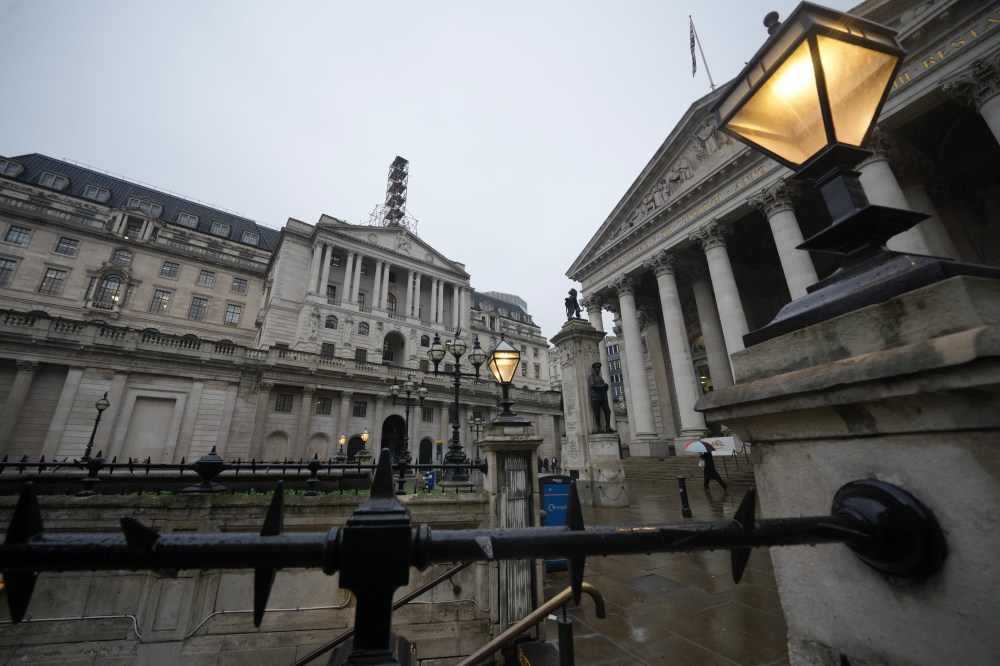
“We have held interest rates at 3.75% as we assess how events unfold,” Bank Gov. Andrew Bailey said. “Whatever happens, our job is to make sure inflation gets back to its 2% target.”
The Iran war has done much to upend the bank’s predictions as well as the wider global economic forecasts, not least in how it will affect prices.
The longer the Iran war and the associated closure of the Strait of Hormuz go on, the greater the economic pain will be. A fifth of the world’s crude oil goes through the strait.
The most tangible impact has been in oil and gas markets, with prices rising sharply higher since the start of the war. Prices have surged again Thursday after Iran, in retaliation for an Israeli attack on a key Iranian gas field, intensified its attacks on oil and gas facilities around the Gulf, including Qatar’s Ras Laffan, the largest liquefied natural gas export facility in the world.
“War in the Middle East has pushed up global energy prices,” Bailey said. “You can already see that at the petrol pump and, if it lasts, it will feed into higher household energy bills later in the year.”
With these new inflationary pressures stalking the global economy, central bankers are having to reassess their projections in 2026, both for inflation and growth. Central banks have been generally cutting rates over the past couple of years, having dealt with the previous energy price shock related to Russia’s full-blown invasion of Ukraine.

On Wednesday, the U.S. Federal Reserve also held its key interest rate and cautioned about the increasingly uncertain outlook. The European Central Bank also held rates and said the Iran war has made the outlook “significantly more uncertain.”
For the Bank of England, it’s likely to mean that inflation will not fall to its target rate of 2% as soon as expected and will lead to higher prices for the rest of the year — hardly the backdrop for further interest rate reductions anytime soon.
Following Thursday’s unanimous decision and the tough language employed by Bailey, financial markets have actually moved to price in higher U.K. interest rates this year.
“Put simply, rate hikes are now a real risk for the economy,” said Sanjay Raja, chief U.K. economist at Deutsche Bank.
Keeping interest rates higher than they otherwise would have been can help keep a lid on inflation. High interest rates weigh on the economy by making it more expensive for businesses and consumers to borrow, thereby bearing down on economic activity and consequently price pressures.