

Financial leaders pushing for new approaches amid geopolitical tensions
Advertisement
Read this article for free:
or
Already have an account? Log in here »
To continue reading, please subscribe:

Digital Subscription
One year of digital access for only $205*
- Enjoy unlimited reading on winnipegfreepress.com
- Read the E-Edition, our digital replica newspaper
- Access News Break, our award-winning app
- Play interactive puzzles
*First annual payment billed as $205.00 + GST for one year. This annual subscription will automatically renew at $233.00 + GST every 52 weeks (10% off the regular annual price of $259.35). Offer available to new and qualified returning subscribers only. Cancel any time.
To continue reading, please subscribe:
Add Free Press access to your Brandon Sun subscription for only an additional
$1 for the first 4 weeks*
- Enjoy unlimited reading on winnipegfreepress.com
- Read the E-Edition, our digital replica newspaper
- Access News Break, our award-winning app
- Play interactive puzzles
*Your next Brandon Sun subscription payment will increase by $1.00 and you will be charged $17.95 plus GST for four weeks. After four weeks, your payment will increase to $24.95 plus GST every four weeks.
Read unlimited articles for free today:
or
Already have an account? Log in here »
Hey there, time traveller!
This article was published 24/03/2026 (202 days ago), so information in it may no longer be current.
TORONTO – Rapidly shifting geopolitics is causing leaders in Canada’s financial sector to push for measures to boost resilience even if it means accepting greater risk.
National Bank chief executive Laurent Ferreira said Tuesday that the bank isn’t changing its strategy because of the war in the Middle East, but he is urging a faster response from Canada to rising threats abroad.
Speaking at the bank’s financial services conference in Montreal, he said the country should be moving quicker on reducing internal trade barriers and boosting energy supplies.
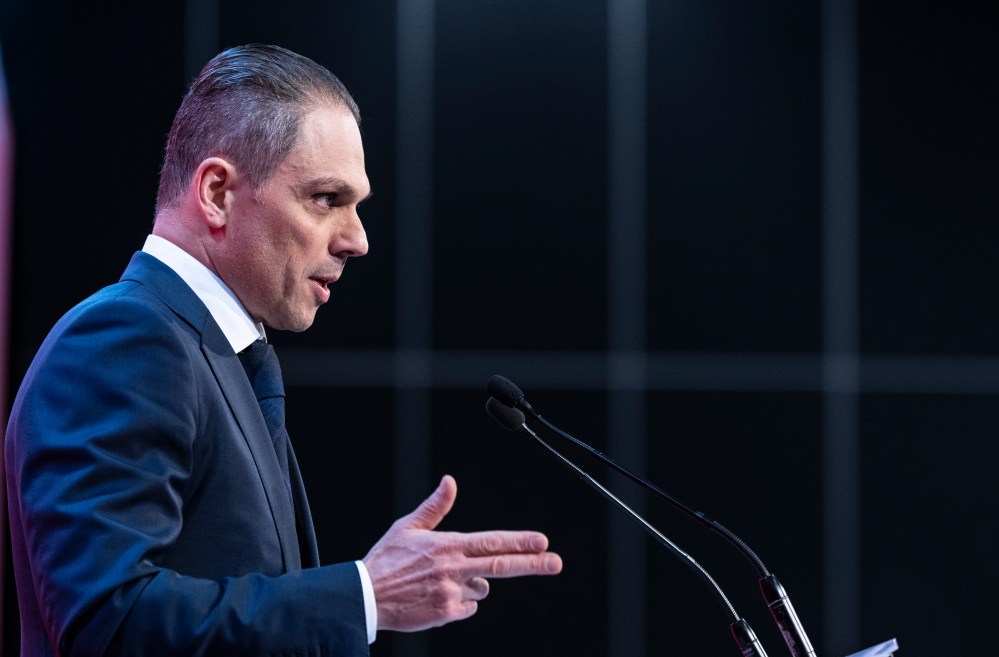
“We need to set politics aside and start thinking about our future, because the world is dangerous,” he said.
Peter Routledge, head of Canada’s banking regulator, warned at the conference that changes in the global order will mean greater risks to the financial system.
“We are in uncharted water. Our geopolitical environment has changed on us pretty dramatically, and I don’t think we’re done with that, and that is going to upset risk in our financial system,” he said.
He said the Canadian financial system is as resilient as it has ever been, but that there will be costs associated with rising risk.
“I don’t know how the costs are going to fall. I think they’re going to fall unevenly and there will be unfortunate victims that don’t survive, and that’s just the reality of risk in an environment like this.”
To improve national security and economic sovereignty, Ferreira has urged Canada to break down internal trade barriers and to boost energy exports, especially fossil fuels.
He said Canada needs to export more liquefied natural gas westward and transport more gas east to Ontario, Quebec and beyond, expressing dismay that New Brunswick recently took in an LNG shipment from Australia.
And despite the country looking to diversify trade from the United States, he said the defunct Keystone XL pipeline project that would’ve sent more Alberta crude there needs to be revived immediately.
Pipelines have faced significant opposition over both climate change and oil spill concerns, but Ferreira said there’s increasing support.
“People are talking about trade tensions. People are talking about, you know, war around the world. So I think there is a social licence that our governments right now have that they did not have in the past.”
Keith Stewart, senior energy strategist at Greenpeace Canada, said in an emailed response that the conflict with Iran has revealed the vulnerability of countries relying on oil and gas, and is pushing countries dependent on imports to accelerate a shift to renewables.
“A greener world is a safer and more affordable world, so let’s not confuse what is good for oil companies with what is good for regular people.”
Ferreira said the current political climate also means that everyone should be on board rebuilding defence capabilities, and that Canadian banks are well capitalized and ready to support government efforts.
However, he also raised concerns about rising bank oversight rules in Canada at a time when the United States is significantly pulling back.
“We’ve gone up in terms of supervision, they’ve come down.”
Routledge said the Office of the Superintendent of Financial Institutions is actively working to pare back rules where prudent, and looking to accept more risk in the system.

“We could accept a bit more risks than zero failures over the last 30 years,” he said.
Along with adjusting rules around how much capital banks have to hold for various loans, he’s also looking to accelerate the timeline for approving new players into the system from around 36 months to 12 months.
He said increased competition in financial services will ultimately make the system more resilient.
This report by The Canadian Press was first published March 24, 2026.
Companies in this story: (TSX:NA)