

‘Billy Bishop on steroids’: Porter to launch flights from revamped Montreal airport
Advertisement
Read this article for free:
or
Already have an account? Log in here »
To continue reading, please subscribe:

Digital Subscription
One year of digital access for only $205*
- Enjoy unlimited reading on winnipegfreepress.com
- Read the E-Edition, our digital replica newspaper
- Access News Break, our award-winning app
- Play interactive puzzles
*First annual payment billed as $205.00 + GST for one year. This annual subscription will automatically renew at $233.00 + GST every 52 weeks (10% off the regular annual price of $259.35). Offer available to new and qualified returning subscribers only. Cancel any time.
To continue reading, please subscribe:
Add Free Press access to your Brandon Sun subscription for only an additional
$1 for the first 4 weeks*
- Enjoy unlimited reading on winnipegfreepress.com
- Read the E-Edition, our digital replica newspaper
- Access News Break, our award-winning app
- Play interactive puzzles
*Your next Brandon Sun subscription payment will increase by $1.00 and you will be charged $17.95 plus GST for four weeks. After four weeks, your payment will increase to $24.95 plus GST every four weeks.
Read unlimited articles for free today:
or
Already have an account? Log in here »
Hey there, time traveller!
This article was published 24/03/2026 (190 days ago), so information in it may no longer be current.
LONGUEUIL –
Porter Airlines plans to launch a dozen routes this summer from the overhauled Montreal Metropolitan Airport, as Canada’s third-largest carrier seeks to gain purchase in the competitive domestic market and start putting its half-billion-dollar investment to work.
On Tuesday, the Toronto-based airline announced flights to Canadian cities including Vancouver, Calgary, Winnipeg, Toronto — at both Pearson and Billy Bishop airports — Halifax and St. John’s, N.L., out of a Montreal-area airport currently used mainly for regional service, cargo trips and flight training.
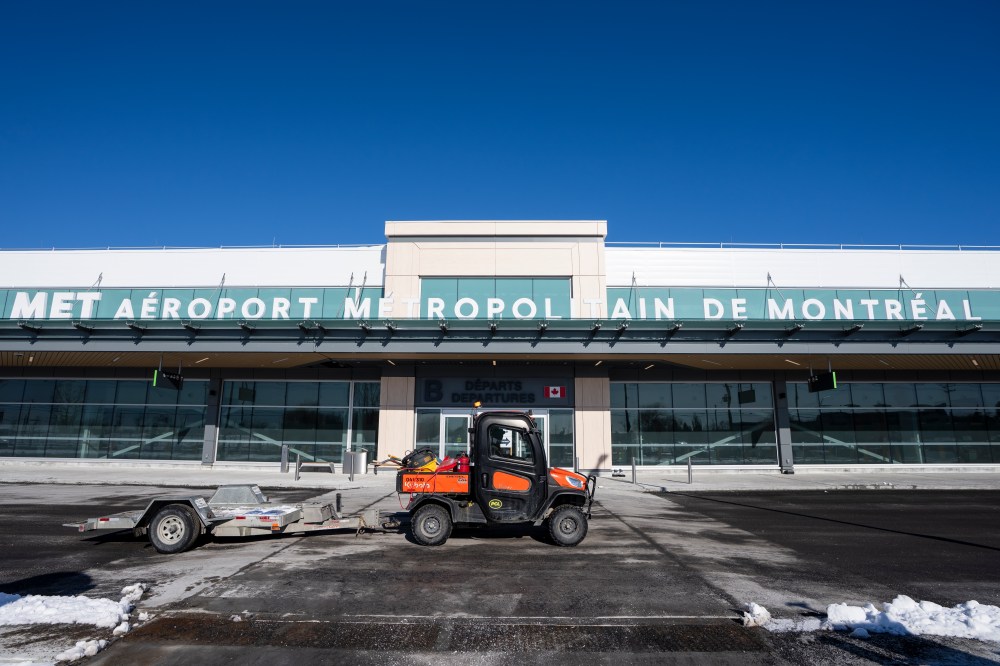
Starting June 15, Porter has scheduled 138 flights per week through the revitalized hub, which has the capacity to handle four million passengers each year. It sits on Montreal’s South Shore just a 20-minute drive from downtown in Longueuil, Que., making it a viable alternative to the Trudeau airport, which will continue to host some 15 Porter flights a day.
“I refer to this as Billy Bishop on steroids,” said Porter chief executive Michael Deluce in an interview at the new terminal, a spacious set of halls with pleather recliners and ubiquitous USB ports. It can also host Porter’s jets, unlike Billy Bishop, whose short runway permits only turboprops. Toronto’s small island airport serves as the airline’s headquarters, and could one day harbour jets as well, given Ontario Premier Doug Ford’s pledge this week to take over land currently owned by the city in order to extend the runway.
“Half of the Montreal market residential population lives closer to this airport,” Deluce said Tuesday. “People go to the airport that’s closest for them. But on top of that, this is a very convenient way for people outside of Montreal to come and visit Montreal and get to downtown.”
The CEO predicted the so-called MET, formerly known as the Saint-Hubert Airport, will rank among Canada’s 10 busiest airports within two years, and achieve the No. 7 spot within four.
The airline is banking on it. Through the jointly owned YHU Infrastructure Partners, Porter and Australian-owned Macquarie Asset Management have invested more than $400 million in the terminal — the original projection was about $200 million — plus millions more on a planned hotel at an airport that currently borders farmland.
Several hurdles persist.
One is the fact that for all its sleekness, the airport can host flights to and from domestic destinations only — no international trips allowed, due to exclusivity clauses that permit just one airport in a local area to have flights abroad.
Then there’s the soaring price of fuel due to the war in Iran that prompted Porter this week to announce fuel surcharges on bookings made via loyalty points. The sky-high cost of jet fuel has pushed up ticket costs across the globe and threatened to reduce sales.
“Obviously there is pressure on fares within the industry, but we do expect fuel prices to moderate relatively quickly,” Deluce said.
More broadly, there’s the depressed demand for Canada-U.S. travel amid a trade war triggered by President Donald Trump, a feud that kicked off as Porter was partway through a rapid fleet expansion predicated largely on cross-border traffic.
Deluce said “all of our revenue numbers are up” year-over-year, but acknowledged “some overall macro headwind” as Canadians steer clear of the United States.
Instead, Porter has launched new routes to Mexico, Costa Rica, the Bahamas and the Cayman Islands. But it has slowed its intake of Embraer E195-E2 narrow-body jets, settling on fewer than 55 for now.
The money the airline has poured into the airport revamp marks a gamble as well.
“That’s a lot of investment for Porter to operate just a domestic network,” said John Gradek, who teaches aviation management at McGill University. “The question is, is it overkill?”
Nonetheless, he called the airport beachhead a “game-changer.”
“They don’t have to worry about going through all of the hassles of the Aéroports de Montréal and the congestion and the crowding. This is their terminal to manage.”
YHU Infrastructure Partners is keeping nearly everything in-house — a rarity at most airports — from fuelling and de-icing to catering and parking. The facility includes about 3,000 parking spots. A city shuttle will run every 30 minutes between a commuter rail station 20 minutes away, just across the St. Lawrence River from downtown.

“Business people love the idea of walking to the airport in Toronto, landing in Montreal and getting a short cab ride to downtown,” said Calgary-based aviation consultant Rick Erickson, who sees the MET as a capstone on a major expansion by the airline.
The company also has a partnership with Pascan Aviation, a regional carrier headquartered at the airport, as a link to the Maritimes and all corners of Quebec.
Porter and Macquarie hope to recoup some of their investment through terminal fees charged to other carriers, said Charles Roberge, CEO of YHU Infrastructure Partners. No further deals have been announced so far.
Porter was launched in 2006 by Deluce’s father Robert — he remains the executive chairman — who used Billy Bishop Toronto City Airport as a base to offer service from the city’s downtown.
This report by The Canadian Press was first published March 24, 2026.