

Oil and gas prices won’t immediately return to normal even if the Iran war ends, the EU warns
Advertisement
Read this article for free:
or
Already have an account? Log in here »
To continue reading, please subscribe:

Digital Subscription
One year of digital access for only $205*
- Enjoy unlimited reading on winnipegfreepress.com
- Read the E-Edition, our digital replica newspaper
- Access News Break, our award-winning app
- Play interactive puzzles
*First annual payment billed as $205.00 + GST for one year. This annual subscription will automatically renew at $233.00 + GST every 52 weeks (10% off the regular annual price of $259.35). Offer available to new and qualified returning subscribers only. Cancel any time.
To continue reading, please subscribe:
Add Free Press access to your Brandon Sun subscription for only an additional
$1 for the first 4 weeks*
- Enjoy unlimited reading on winnipegfreepress.com
- Read the E-Edition, our digital replica newspaper
- Access News Break, our award-winning app
- Play interactive puzzles
*Your next Brandon Sun subscription payment will increase by $1.00 and you will be charged $17.95 plus GST for four weeks. After four weeks, your payment will increase to $24.95 plus GST every four weeks.
Read unlimited articles for free today:
or
Already have an account? Log in here »
Hey there, time traveller!
This article was published 31/03/2026 (185 days ago), so information in it may no longer be current.
NICOSIA, Cyprus (AP) — Skyrocketing oil and gas prices in Europe as a result of the ongoing Iran war won’t return to normal levels any time soon, even if peace is declared tomorrow, the European Union’s energy commissioner warned Tuesday.
Commissioner Dan Jørgensen said although there are no immediate oil and gas supply shortages in the 27-member bloc, there’s pressure on diesel and jet fuel supply as well as “increasing constraints” in global gas markets that are resulting in higher electricity prices.
“What I find extremely important is to state as clearly as I can, that even if that peace is here tomorrow, still we will not go back to normal in a foreseeable future,” Jørgensen told a news conference after a meeting of EU energy ministers.
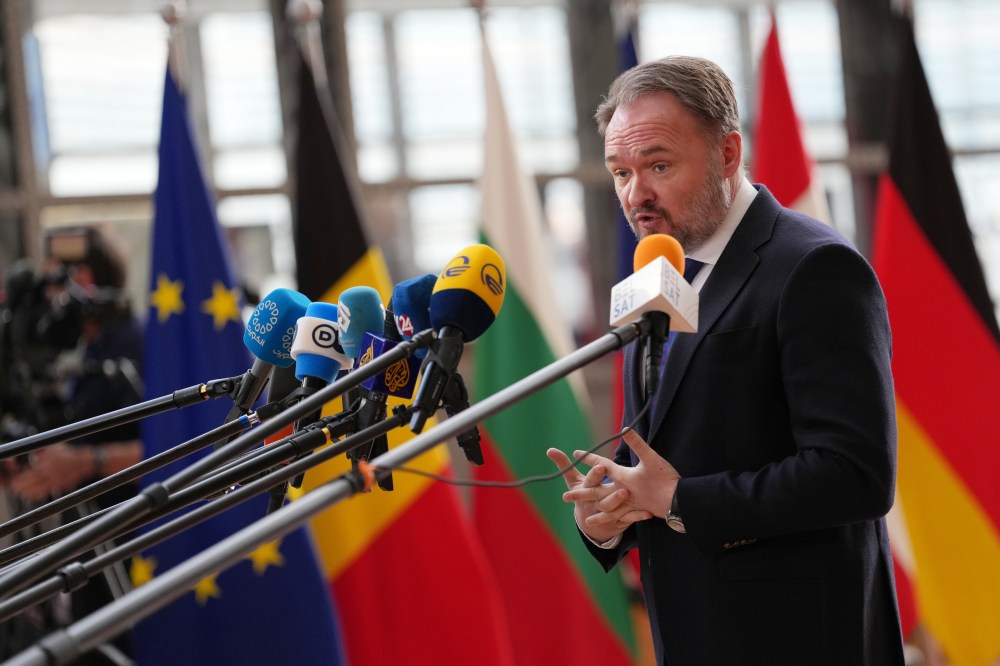
He said the EU’s executive arm is preparing a string of measures designed to help families and businesses weather the huge spike in oil prices that have resulted in about a 70% price hike for gas and 60% for oil in Europe. Since the start of the war, the EU’s bill for imported fossil fuels has jumped by 14 billion euros, according to Jørgensen.
Closely coordinated action between all EU members is necessary to “avoid fragmented national responses and disruptive signals to the markets,” he said.
The “toolbox” of measures now in the works will be unveiled “quite soon” and will include ways to make it easier for states to decouple gas prices from electricity prices, the commissioner said. He added that a tax cut on electricity, as suggested by Commission President Ursula von der Leyen is also being weighed.

Jørgensen said although he doesn’t foresee a repeat of the 2022 natural gas crisis where companies reaped huge profits from a massive gas price hike, a one-time “windfall tax” on such companies “is a possibility.”
There are now “good opportunities” for member states to financially support vulnerable groups or industries now under “extraordinary stress” and that the Commission would make “these possibilities even simpler and wider,” said Jørgensen.
Jørgensen also encouraged EU members to consider the International Energy Agency’s 10-point plan which includes work from home, reduced highway speeds, encouraging public transport and increasing car sharing.
He said the EU stands by its ban on Russian gas purchases, which is meant to reduce dependence on Russian gas and choke off funding for Russia’s war in Ukraine. Reliance on Russian gas dropped from 45% before the war to 10% now and will be reduced to zero once imports from other suppliers ramp up, especially from the U.S. The EU is looking at new energy sources from Azerbaijan, Algeria and Canada as well as smaller producers around the world.
The commissioner warned the EU should never “repeat the mistakes of the past allowing Putin to weaponize energy against us and blackmail member states.” He added that “it would be totally unacceptable” for the EU to continue buying energy that would “indirectly help finance the terrible war that Putin is conducting in Ukraine.”