

Two Southwest Airlines planes came dangerously close in Nashville and had to take evasive action
Advertisement
Read this article for free:
or
Already have an account? Log in here »
To continue reading, please subscribe:

Digital Subscription
One year of digital access for only $205*
- Enjoy unlimited reading on winnipegfreepress.com
- Read the E-Edition, our digital replica newspaper
- Access News Break, our award-winning app
- Play interactive puzzles
*First annual payment billed as $205.00 + GST for one year. This annual subscription will automatically renew at $233.00 + GST every 52 weeks (10% off the regular annual price of $259.35). Offer available to new and qualified returning subscribers only. Cancel any time.
To continue reading, please subscribe:
Add Free Press access to your Brandon Sun subscription for only an additional
$1 for the first 4 weeks*
- Enjoy unlimited reading on winnipegfreepress.com
- Read the E-Edition, our digital replica newspaper
- Access News Break, our award-winning app
- Play interactive puzzles
*Your next Brandon Sun subscription payment will increase by $1.00 and you will be charged $17.95 plus GST for four weeks. After four weeks, your payment will increase to $24.95 plus GST every four weeks.
Read unlimited articles for free today:
or
Already have an account? Log in here »
Two Southwest Airlines planes had to take evasive action to avoid colliding Saturday in Nashville, Tennessee, after an air traffic controller directed one pilot to turn into the path of the other plane.
Last year, an American Airlines jet collided with an Army Black Hawk helicopter near Washington, D.C., killing all 67 people aboard both aircraft. That crash on Jan. 29, 2025, put the spotlight on midair collisions, which are rare in commercial flights where the planes are equipped with systems to alert pilots about a potential collision.
Most of the close calls that happen every year involve small planes that don’t have those systems, but the Federal Aviation Administration couldn’t immediately provide a number for how many happen annually. There are typically several collisions involving small planes every year like the one that happened in February 2025 in Arizona that killed two people.
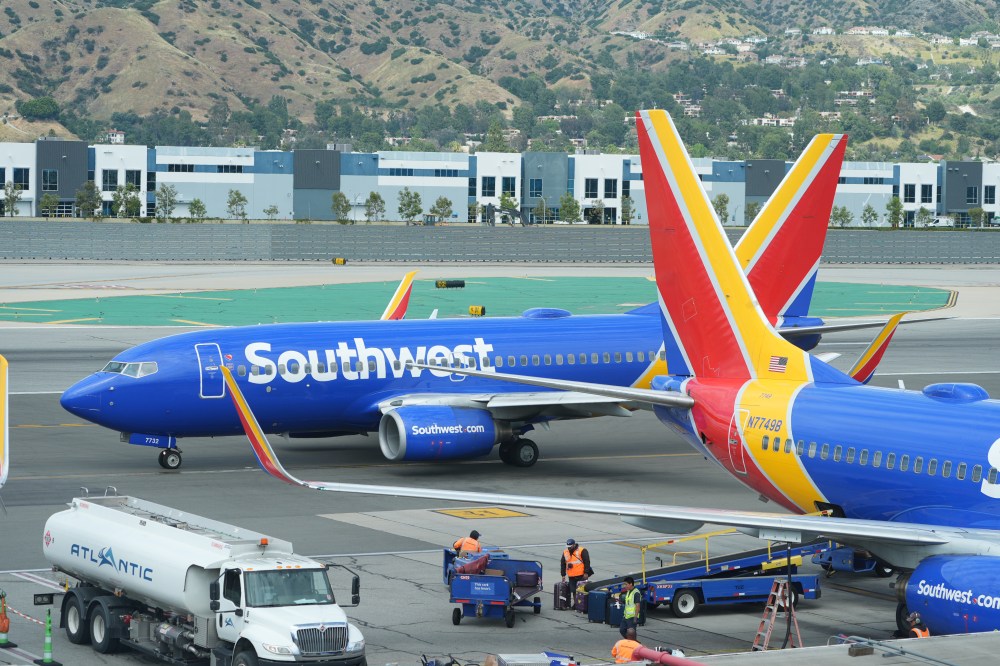
Both of the Southwest pilots involved in this incident over the weekend told the air traffic controller that they received alarms from their collision avoidance systems that directed them to take action with one plane climbing while the other descended to avoid the potential midair collision, according to audio posted by www.LiveATC.net.
Location data from these two planes show their flight paths converging after one pilot decided to abort landing and circle around to try again. The controller directed that plane to turn into the path of the other Southwest plane that had just taken off. By the time the controller recognized the threat and tried to direct the plane that had just taken off to stay below 2000 feet (609 meters), the pilot reported that he was already above that level.
That location data appears to show these planes getting as close as 500 feet (152 meters) apart with one of them flying just over the top of the other plane, according to FlightRadar24, so that would fit the official definition of a near midair collision. But it may not be clear exactly how close they planes got until after the incident is reviewed.
The Federal Aviation Administration is investigating. The agency said the pilot of Southwest flight 507 “received instructions from air traffic control that put the flight in the path of another airplane that was departing from a parallel runway. Both flight crews responded to onboard alerts.”
But the FAA did not say how close the planes got during the incident that happened around 5:30 p.m. Saturday.

Southwest Airlines spokesperson Lynn Lunsford said gusty winds at the Nashville International Airport prompted the first pilot to perform a go around. He said both pilots followed the directions from the air traffic controller and their onboard collision avoidance systems to avoid running into each other.
“Southwest appreciates the professionalism of its pilots and flight crews in responding to the event. Nothing is more important to Southwest than the safety of our customers and employees,” Lunsford said in a statement.