

New bridge helps cement Lesotho as water lifeline for South Africa’s economic hub
Advertisement
Read this article for free:
or
Already have an account? Log in here »
To continue reading, please subscribe:

Digital Subscription
One year of digital access for only $205*
- Enjoy unlimited reading on winnipegfreepress.com
- Read the E-Edition, our digital replica newspaper
- Access News Break, our award-winning app
- Play interactive puzzles
*First annual payment billed as $205.00 + GST for one year. This annual subscription will automatically renew at $233.00 + GST every 52 weeks (10% off the regular annual price of $259.35). Offer available to new and qualified returning subscribers only. Cancel any time.
To continue reading, please subscribe:
Add Free Press access to your Brandon Sun subscription for only an additional
$1 for the first 4 weeks*
- Enjoy unlimited reading on winnipegfreepress.com
- Read the E-Edition, our digital replica newspaper
- Access News Break, our award-winning app
- Play interactive puzzles
*Your next Brandon Sun subscription payment will increase by $1.00 and you will be charged $17.95 plus GST for four weeks. After four weeks, your payment will increase to $24.95 plus GST every four weeks.
Read unlimited articles for free today:
or
Already have an account? Log in here »
JOHANNESBURG (AP) — For every glass of water or a shower taken in Gauteng, South Africa’s most populous province that includes Johannesburg, there is a 60% chance the water came from its small neighbor, the mountain kingdom of Lesotho.
A newly built bridge launched this week is part of a network of constructions that will help the landlocked nation, cited by the World Bank as one of the poorest in the world, nearly double its water exports to South Africa to power one of Africa’s biggest industrial and economic hubs. It will also boost the water royalties and revenue for a country where half the population lives under the national poverty line.
The Senqu Bridge, 825 meters (2,700 feet) long and 90 meters (295 feet) high, is part of the Lesotho Highlands Water Project that will increase water exports to South Africa from 780 million cubic meters a year currently to more 1,270 billion cubic meters.
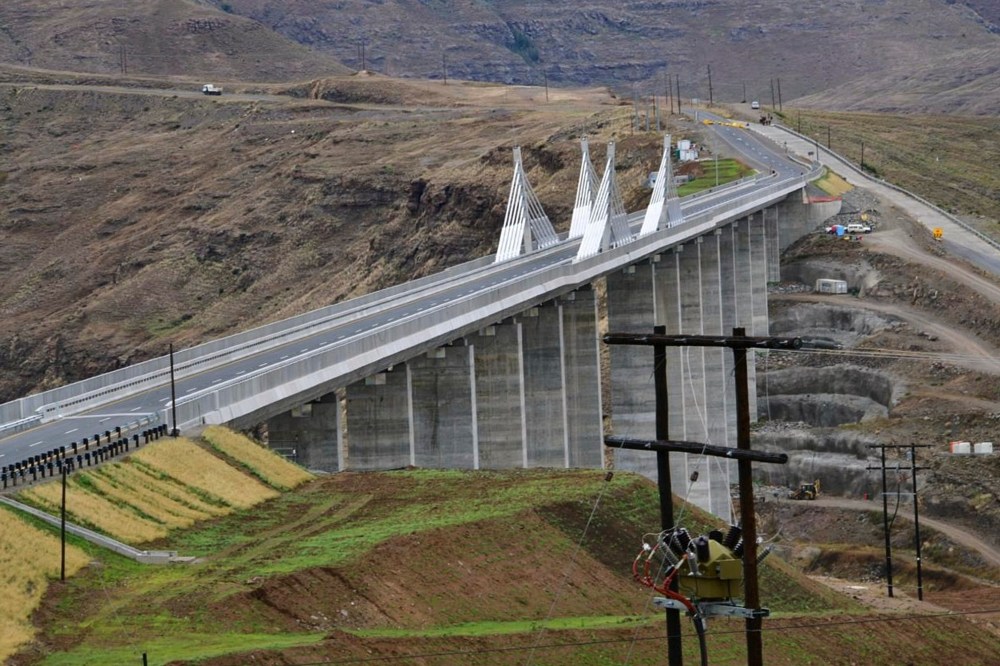
The bridge goes over the reservoir behind the Polihali Dam, ensuring continuous movement once the water levels have risen. The construction of the dam is not yet complete.
The Lesotho Highlands Water Project is one of the biggest transboundary water projects in the world and it is the largest investment South Africa has ever made outside its borders. It also boosts Lesotho’s hydropower output, advancing energy security and reducing the country’s reliance on electricity imports.
The total cost of the project is currently estimated at over 53 billion rands ($3.2 billion), with over 120 kilometers (75 miles) of tunnels that channel water from Lesotho’s mountainous regions into South Africa’s river systems. Its first phase began in 1990, as a result of a 1986 treaty between the two countries, and it is currently in its second phase that is estimated to be completed between 2028 and 2029.
The 2.4 billion-rand ($144-million) bridge, the largest of the three bridges that support water infrastructure in the northeastern part of the country, has been lauded as an engineering achievement for Lesotho, rising more than 2,500 meters (8,200 feet) above sea level.
“South Africa is a water-scarce country and the waters of Lesotho’s highlands are vital to our country’s development. We remain forever grateful to the great Basotho nation for making water resources available to us,” South Africa President Cyril Ramaphosa said during the launch of the bridge.
The construction of the bridge created about 1,200 jobs, mostly for Lesotho residents. The government last year declared a state of economic emergency after the unemployment rate hit about 30%.
“The royalties and infrastructure that flow from this project are not incidental benefits. They are central to our development finance strategy,” said Lesotho Prime Minister Sam Matekane.
Some of the construction still pending includes a 38-kilometer (23-mile) tunnel connecting the Polihali and Katse reservoirs.

“The project must deepen impact on the people, strengthen accountability in delivery and ensure that its benefits are not abstract but are felt in the daily lives of the people affected,” Matekane said.
The country’s economic woes have been worsened by trade tariffs of up to 50% imposed by the United States, the biggest importer of Lesotho’s textile and mining products. It has also been at the receiving end of massive U.S. foreign aid cuts which were funding most of its health programs.
___
For more on Africa and development: https://apnews.com/hub/africa-pulse
The Associated Press receives financial support for global health and development coverage in Africa from the Gates Foundation. The AP is solely responsible for all content. Find AP’s standards for working with philanthropies, a list of supporters and funded coverage areas at AP.org.