

Canadian and U.S. markets drift lower amid continued oil price volatility
Advertisement
Read this article for free:
or
Already have an account? Log in here »
To continue reading, please subscribe:

Digital Subscription
One year of digital access for only $205*
- Enjoy unlimited reading on winnipegfreepress.com
- Read the E-Edition, our digital replica newspaper
- Access News Break, our award-winning app
- Play interactive puzzles
*First annual payment billed as $205.00 + GST for one year. This annual subscription will automatically renew at $233.00 + GST every 52 weeks (10% off the regular annual price of $259.35). Offer available to new and qualified returning subscribers only. Cancel any time.
To continue reading, please subscribe:
Add Free Press access to your Brandon Sun subscription for only an additional
$1 for the first 4 weeks*
- Enjoy unlimited reading on winnipegfreepress.com
- Read the E-Edition, our digital replica newspaper
- Access News Break, our award-winning app
- Play interactive puzzles
*Your next Brandon Sun subscription payment will increase by $1.00 and you will be charged $17.95 plus GST for four weeks. After four weeks, your payment will increase to $24.95 plus GST every four weeks.
Read unlimited articles for free today:
or
Already have an account? Log in here »
Canadian and U.S. markets drifted lower Thursday amid continued oil price volatility and geopolitical instability.
The S&P/TSX composite index fell 42.18 points at 33,912.93.
In New York, the Dow Jones industrial average was down 179.71 points at 49,310.32. The S&P 500 index fell 29.50 points at 7,108.40, while the Nasdaq composite finished 219.06 points lower at 24,438.50.
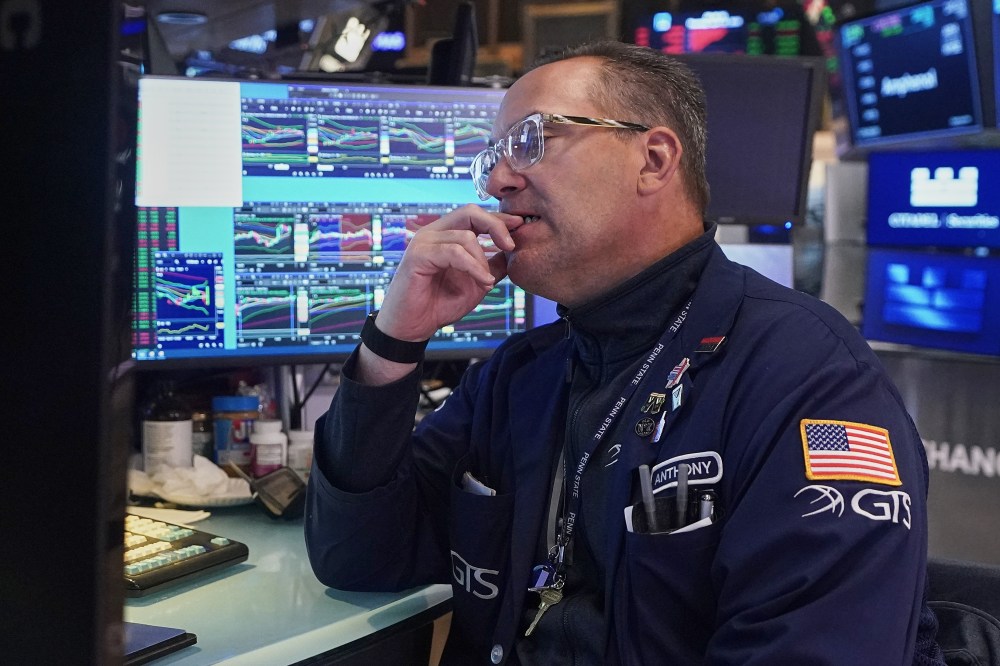
“There’s resilience in the face of all this uncertainty. You’re seeing markets showing a lot of strength,” said Adam Ludwick, director of asset allocation at NEI Investments.
“Today is a little bit of a pullback off of that, but it’s been a really strong three, four weeks.”
Equity markets have seemed relatively unfazed by the oil price shock driven by the war in the Middle East, which began in late February. A ceasefire is still in place between the United States and Iran, but oil tankers aren’t able to get through the Strait of Hormuz, a narrow waterway off Iran’s coast, to exit the Persian Gulf and deliver crude to customers.
The June crude oil contract settled up US$2.89 at US$95.85 per barrel. That’s off from the US$114 a barrel it hit earlier on in the crisis, but still 43 per cent more than its pre-war price.
The U.S. military on Thursday seized another tanker associated with the smuggling of Iranian oil, a day after Iran’s paramilitary Revolutionary Guards took control of two vessels in the strait. President Donald Trump also said he ordered the U.S. military to “shoot and kill” Iranian boats that deploy mines to gum up traffic in the strait.
“A lot of the history has shown that wars and conflicts like this don’t lead to a persistent down market,” said Ludwick.
“You could have moments of volatility. You could pullbacks which seem like they’re large in the moment. They could be 10, 15, even in some worst cases 20 per cent. But those are usually met with buying and the refocus on economic growth, on corporate earnings and the things that actually drive the market.”
Meanwhile, Lululemon Athletica Inc.’s share price slid by more than 13 per cent a day after the Vancouver-based retailer named former Nike executive Heidi O’Neill as its new CEO.
Tesla helped drag the U.S. market lower after sinking 3.6 per cent even though it reported better results for the latest quarter than analysts expected. Investors focused instead on a big jump in Tesla’s forecast for spending this year, as it builds factories to make robots and other products.
“You should expect to see a very significant increase in capital expenditures,” CEO Elon Musk told investors late Wednesday, “But I think well justified for a substantially increased future revenue stream.”
Texas Instruments helped limit Wall Street’s losses after breezing past analysts’ expectations for profit in the latest quarter. CEO Haviv Ilan said the semiconductor company is benefiting from growth led by industrial and data centre customers, and it gave forecasts for profit and revenue in the spring that cleared analysts’ estimates.
The 17.4 per cent leap for Texas Instrument’s stock was the strongest single force pushing upward on the S&P 500.
Paramount Skydance fell 4.5 per cent after Warner Bros. Discovery shareholders approved selling the business to Paramount for US$81 billion. Warner Bros. Discovery sank 1.6 per cent.

The Canadian dollar closed at 73.06 cents US compared with 73.20 cents US on Wednesday.
The June gold contract was down US$29.00 at US$4,724.00 an ounce.
This report by The Canadian Press was first published April 23, 2026.
Companies in this story: (TSX:GSPTSE, TSX:CADUSD)
– with files from The Associated Press
Related Articles
Trump orders US military to 'shoot and kill' Iranian small boats choking Strait of Hormuz
Advertisement Advertise With Us
Advertisement Advertise With Us