

U.S. economy grew 2% from January-March, recovering from federal shutdown; Iran war clouds outlook
Advertisement
Read this article for free:
or
Already have an account? Log in here »
To continue reading, please subscribe:
Digital Subscription
One year of digital access for only $1.44 a week*
- Enjoy unlimited reading on winnipegfreepress.com
- Read the E-Edition, our digital replica newspaper
- Access News Break, our award-winning app
- Play interactive puzzles
*Billed as $5.77 plus GST every four weeks. After 52 weeks, price increases to the regular rate of $19.95 plus GST every four weeks. Offer available to new and qualified returning subscribers only. Cancel any time.
To continue reading, please subscribe:
Add Free Press access to your Brandon Sun subscription for only an additional
$1 for the first 4 weeks*
- Enjoy unlimited reading on winnipegfreepress.com
- Read the E-Edition, our digital replica newspaper
- Access News Break, our award-winning app
- Play interactive puzzles
*Your next Brandon Sun subscription payment will increase by $1.00 and you will be charged $17.95 plus GST for four weeks. After four weeks, your payment will increase to $24.95 plus GST every four weeks.
Read unlimited articles for free today:
or
Already have an account? Log in here »
WASHINGTON (AP) — The U.S. economy accelerated at the start of 2026, expanding at a modest 2% pace from January through March after recovering from last fall’s 43-day federal government shutdown. But the outlook is clouded by the Iran war.
The Commerce Department reported Thursday that gross domestic product — the nation’s output of goods and services — rebounded from a lackluster 0.5% expansion the last three months of 2025. The federal government’s spending and investment grew at a 9.3% annual rate in the first quarter, adding more than half a percentage point to growth after lopping off 1.16 percentage points in fourth-quarter 2025.
Growth in consumer spending, which accounts for 70% of U.S. economic activity, slowed to 1.6% in the first quarter from 1.9% at the end of 2025. Spending on goods, including food and clothing fell slightly. Spending on services slowed.
But business investment, likely driven by spending in artificial intelligence, rose at an 8.7% pace. A weak housing market continues to weigh on the economy. Residential investment fell at an 8% annual pace — the fifth straight quarterly drop and the biggest since the end of 2022. Excluding housing, nonresidential investment surged 10.4%, biggest jump in nearly three years.
An uptick in imports, which rose at an annual rate of 21.4% from January-March, slashed more than 2.6 percentage points off first-quarter growth.
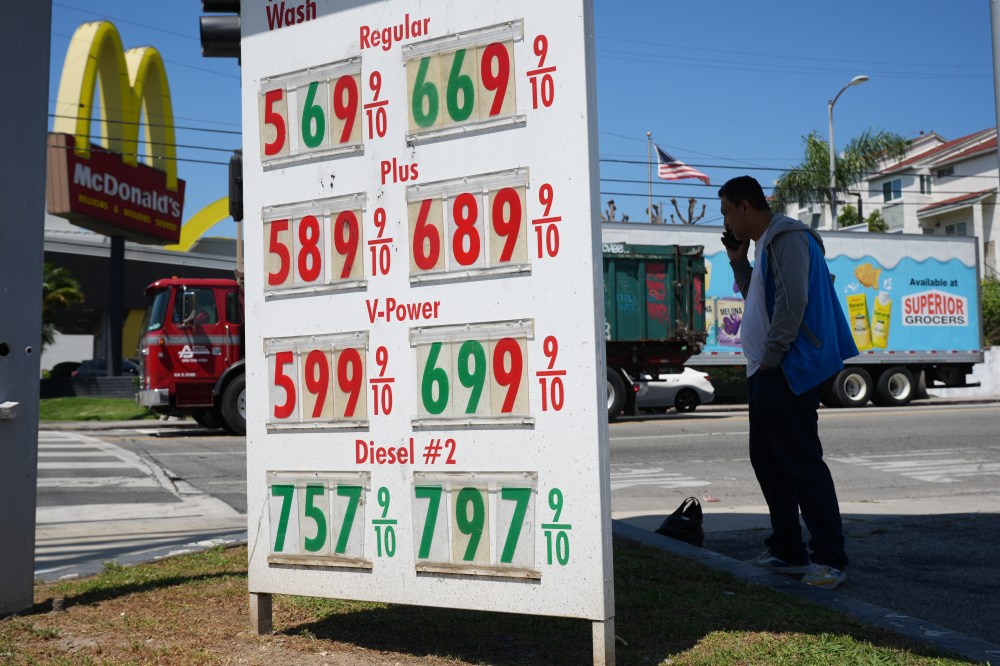
“This is a split-screen economy,” Heather Long, chief economist at the Navy Federal Credit Union, wrote. “Companies and investors involved in AI are on fire. Meanwhile, middle and moderate income households are struggling with high gas prices … Consumption is slowing as people are struggling to manage all their bills and growing more concerned about the future.’’
Still, a category within the GDP data that measures the economy’s underlying strength grew at a solid 2.5% clip, accelerating from 1.8% in fourth-quarter 2025. This category includes consumer spending and private investment, but excludes volatile items like exports, inventories and government spending.
The first quarter included about a month of the clash in Iran. Iran has blocked the Strait of Hormuz through which a fifth of the world’s oil and liquefied natural gas passes. That has driven energy prices higher, fueling inflation and hurting consumers. The Federal Reserve, announcing Wednesday that it was keeping its benchmark interest unchanged, cited “a high level of uncertainty″ arising from the conflict.

Carl Weinberg, chief economist at High Frequency Economics, did not even bother to forecast first-quarter GDP growth. “The truth is that we do not have any defensible basis for trying to project how these indicators will print,” Weinberg wrote in a commentary Monday. President Donald “Trump’s war with Iran has led to a total blockade of the Strait of Hormuz. We do not know how to model the impact of that event, as we have never seen anything quite like it.″
Thursday’s report was the first of three Commerce Department estimates.