

Venezuela’s leader to defend her country’s claim over mineral-rich Guyana region before UN court
Advertisement
Read this article for free:
or
Already have an account? Log in here »
To continue reading, please subscribe:
Digital Subscription
One year of digital access for only $1.44 a week*
- Enjoy unlimited reading on winnipegfreepress.com
- Read the E-Edition, our digital replica newspaper
- Access News Break, our award-winning app
- Play interactive puzzles
*Billed as $5.77 plus GST every four weeks. After 52 weeks, price increases to the regular rate of $19.95 plus GST every four weeks. Offer available to new and qualified returning subscribers only. Cancel any time.
To continue reading, please subscribe:
Add Free Press access to your Brandon Sun subscription for only an additional
$1 for the first 4 weeks*
- Enjoy unlimited reading on winnipegfreepress.com
- Read the E-Edition, our digital replica newspaper
- Access News Break, our award-winning app
- Play interactive puzzles
*Your next Brandon Sun subscription payment will increase by $1.00 and you will be charged $17.95 plus GST for four weeks. After four weeks, your payment will increase to $24.95 plus GST every four weeks.
Read unlimited articles for free today:
or
Already have an account? Log in here »
CARACAS (AP) — Venezuela ’s acting President Delcy Rodríguez arrived in the Netherlands on Sunday where she will defend her country’s claim to a mineral- and oil-rich region in western Guyana before the United Nations highest court in a dispute that has spanned decades.
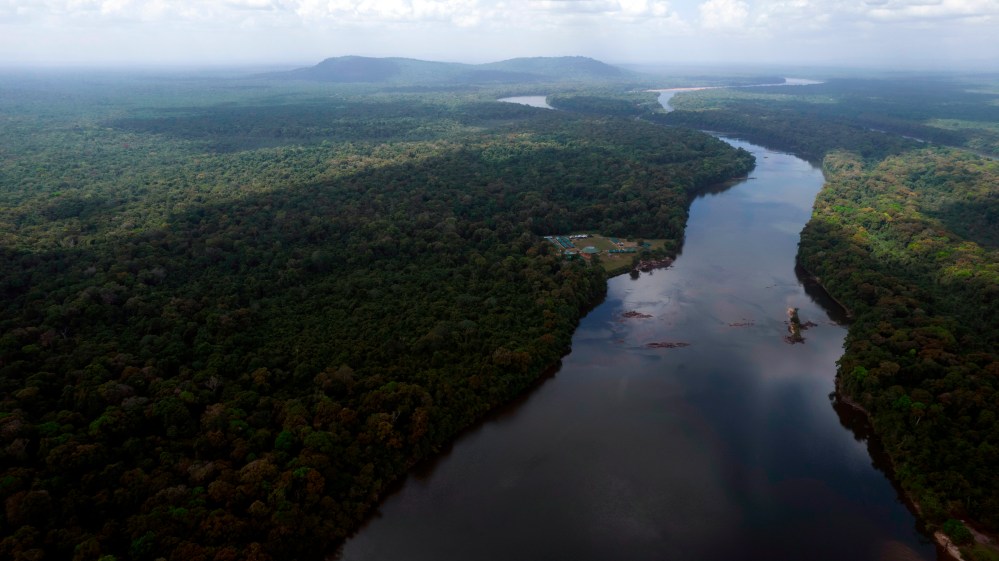
The International Court of Justice in The Hague is holding a series of hearings with the South American neighbors which both claim ownership of Essequibo — a territory of nearly 62,000 square miles rich in gold, diamonds, timber and other natural resources, located near massive offshore oil deposits.
Venezuela has considered Essequibo its own since the Spanish colonial period, when the jungle region fell within its boundaries. But an 1899 decision by arbitrators from Britain, Russia and the United States drew the border along the Essequibo River largely in favor of Guyana.
Venezuela argues that a 1966 agreement sealed in Geneva to resolve the dispute effectively nullified the 19th-century arbitration.
The final court hearing, with Rodríguez’s appearance, will take place on Monday. The court is likely to take months to issue a final and legally binding ruling in the case.
After landing at Amsterdam’s Schiphol Airport, Rodríguez — who assumed power in January following a U.S. military operation that ousted Nicolás Maduro — said her country has “demonstrated at every historical stage what our territory has meant since we were born as a Republic.”

The case of Essequibo was brought to the ICJ in 2018 by Guyana to confirm before international authorities that the 1899 ruling — and not the 1966 agreement — is the one drawing the border lines. Venezuela has warned that its participation in the hearings does not mean either consent to or recognition of the ICJ’s jurisdiction.
At the opening of the hearings, Guyanese Foreign Minister Hugh Hilton Todd told the international judges that the dispute “has been a blight on our existence as a sovereign state from the beginning” and indicated that 70% of Guyana’s territory is at stake.