

BRICS ministers fail to issue a joint statement over differences on conflict in the Middle East
Advertisement
Read this article for free:
or
Already have an account? Log in here »
To continue reading, please subscribe:

Digital Subscription
One year of digital access for only $205*
- Enjoy unlimited reading on winnipegfreepress.com
- Read the E-Edition, our digital replica newspaper
- Access News Break, our award-winning app
- Play interactive puzzles
*First annual payment billed as $205.00 + GST for one year. This annual subscription will automatically renew at $233.00 + GST every 52 weeks (10% off the regular annual price of $259.35). Offer available to new and qualified returning subscribers only. Cancel any time.
To continue reading, please subscribe:
Add Free Press access to your Brandon Sun subscription for only an additional
$1 for the first 4 weeks*
- Enjoy unlimited reading on winnipegfreepress.com
- Read the E-Edition, our digital replica newspaper
- Access News Break, our award-winning app
- Play interactive puzzles
*Your next Brandon Sun subscription payment will increase by $1.00 and you will be charged $17.95 plus GST for four weeks. After four weeks, your payment will increase to $24.95 plus GST every four weeks.
Read unlimited articles for free today:
or
Already have an account? Log in here »
NEW DELHI (AP) — A two-day meeting of foreign ministers from the BRICS nations concluded in New Delhi on Friday without a joint statement because of “differing views among some members” on the situation in the Middle East, host India said.
The differences highlighted the challenge of maintaining unity within the bloc as it seeks to expand its influence.
The Indian statement said members expressed “their respective national positions and shared a range of perspectives” on issues including sovereignty, maritime security and the protection of civilian infrastructure and civilian lives in the Middle East.
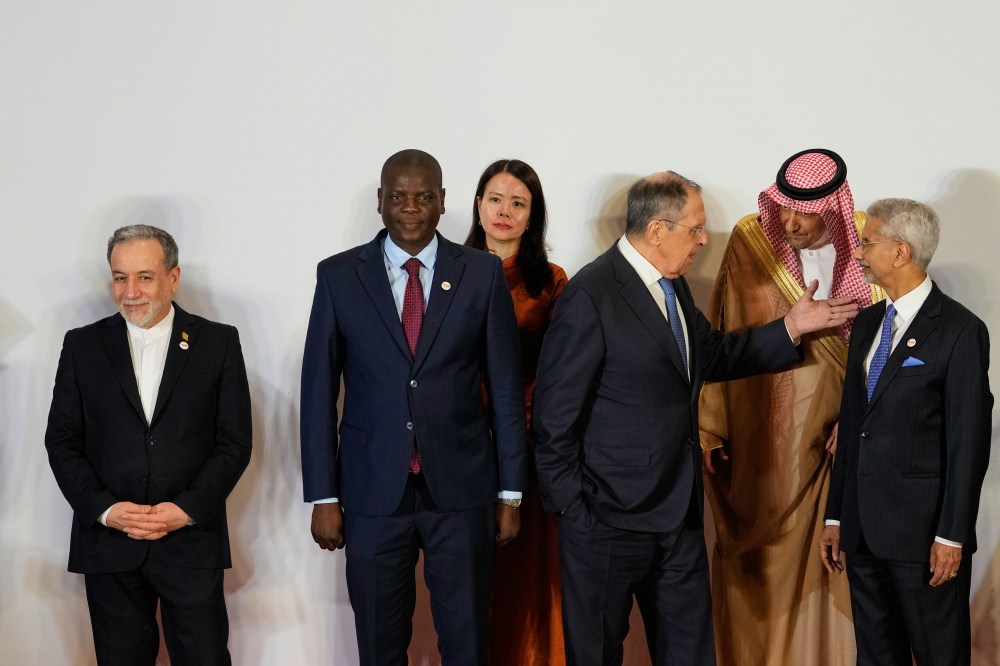
It also included a footnote saying that “a member had reservations” about parts of sections dealing with Gaza and security in the Red Sea and Bab al-Mandeb Strait.
BRICS includes Brazil, Russia, India, China, South Africa, Ethiopia, Egypt, Iran, the United Arab Emirates and Indonesia.

Divisions among member have become more visible during the Iran war, particularly between Iran and the UAE.
On Thursday, Iranian Foreign Minister Abbas Araghchi urged BRICS nations to condemn the U.S. and Israel over what he described as their “unlawful aggression.” He also called on member states to resist what he said was the politicization of international institutions.