

Mushroom producers face ‘worrying’ duties
Incoming tariffs imposed by U.S. on Canadian exports to be passed on to customers south of border: South Mill Champs

Advertisement
Read this article for free:
or
Already have an account? Log in here »
To continue reading, please subscribe:

Digital Subscription
One year of digital access for only $205*
- Enjoy unlimited reading on winnipegfreepress.com
- Read the E-Edition, our digital replica newspaper
- Access News Break, our award-winning app
- Play interactive puzzles
*First annual payment billed as $205.00 + GST for one year. This annual subscription will automatically renew at $233.00 + GST every 52 weeks (10% off the regular annual price of $259.35). Offer available to new and qualified returning subscribers only. Cancel any time.
To continue reading, please subscribe:
Add Free Press access to your Brandon Sun subscription for only an additional
$1 for the first 4 weeks*
- Enjoy unlimited reading on winnipegfreepress.com
- Read the E-Edition, our digital replica newspaper
- Access News Break, our award-winning app
- Play interactive puzzles
*Your next Brandon Sun subscription payment will increase by $1.00 and you will be charged $17.95 plus GST for four weeks. After four weeks, your payment will increase to $24.95 plus GST every four weeks.
Read unlimited articles for free today:
or
Already have an account? Log in here »
Prices may mushroom for American fungi lovers — and the company behind a Manitoba grower is contesting new duties disrupting the industry.
Loveday Mushroom Farms ships roughly 10 million pounds of mushrooms annually from its Oakbank plant to the United States. It accounts for one-fifth of the mushrooms parent company South Mill Champs grows in Canada and sells south of the border.
“We’ve got a good customer base in the U.S. and Canada,” said Lewis Macleod, South Mill Champs chief executive.
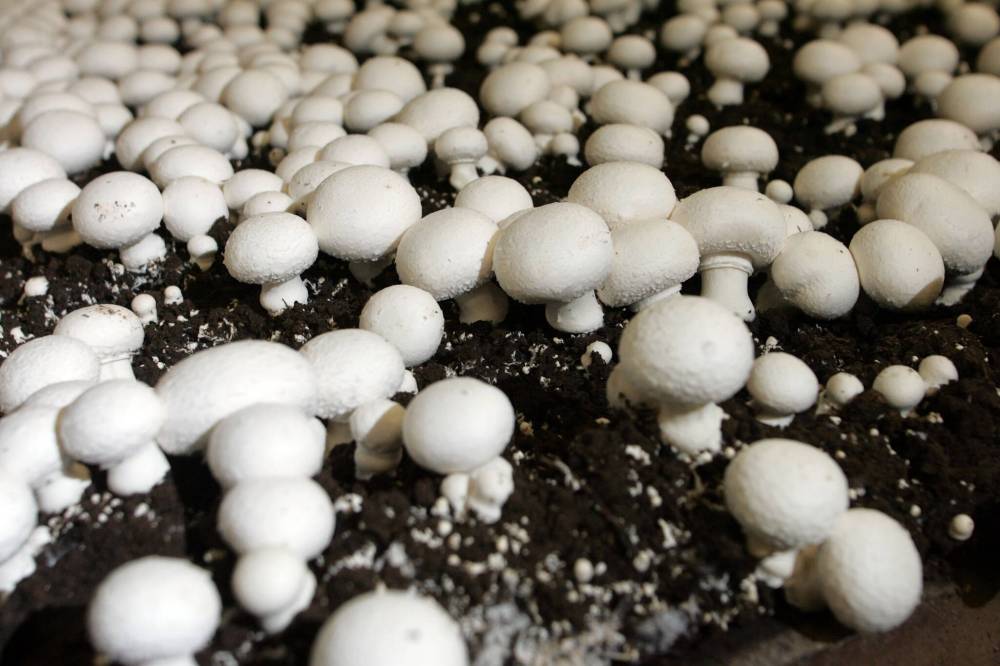
KEN GIGLIOTTI / FREE PRESS files
Mushrooms in Loveday Mushroom Farms’ growing area.
But the American base will likely be hit with higher mushroom prices: South Mill Champs plans to pass a new duty to customers, upping the cost of its portabellas and shiitakes.
Canadian imports are being taxed with countervailing duties. The U.S. Department of Commerce has launched an investigation into fresh mushrooms; its preliminary findings say Canadian producers receive unfair government subsidies.
Most imports will see a tariff of 2.84 per cent. South Mill, as of May 18, was being charged 1.62 per cent, Macleod said.
“At what point do mushroom consumers buy less mushrooms because of the impact of the increased prices?” he said. “As an industry, the downside to increased prices to consumers is decreased demand. And really, (it comes) at a time when everybody is challenged with increased costs.”
Canadian customers won’t be impacted by South Mill Champs’s increases, nor will the 300 staff at the Manitoba company be laid off, he said.
He joins others in the industry speaking out against the duties.
The preliminary findings set a “worrying” precedent for producers across Canada and the United States, Macleod said.
Businesses get tax exemptions when buying agricultural equipment. For South Mill Champs, that includes peat mixers and trolleys for mushroom picking.
These tax exemptions — which are found throughout Canada and the U.S. — are being used as the basis for the department’s levies, Macleod and national organization Mushrooms Canada have pointed out.
(A May 13 Mushrooms Canada news release says provincial sales tax exemptions, available to farmers generally, are being targeted.)
“To avoid tax pyramiding, it really is the end consumer that pays the sales tax — otherwise you’d have tax on top of tax,” Macleod said. “That’s standard policy across North America.”
A final decision on the countervailing duty will likely come later this year.
Meanwhile, the United States has a separate investigation targeting anti-dumping duties, which could be addressed this month.
It comes four years after Canada started exporting mushrooms to the United States.
Manitoba exports were valued at $22.3 million in 2025, up from $13.2 million in 2022. Last year, the province exported 3.74 million kilograms of mushrooms to the U.S., according to government figures.
Canadian growers generally have newer infrastructure than Americans — better composting, metal beds instead of wood — and that increases competition, Macleod said.
U.S.-based group Fresh Mushrooms Fair Trade Coalition submitted a complaint to the American government, saying Canadian mushrooms were unfairly subsidized. It led to the investigation.
Giorgio Mushroom Co. is a coalition member and touts itself as one of the world’s biggest mushroom producers. In a news release, it called the preliminary ruling an “important first step.”
Unfair subsidies distort competition, accelerate farm closures and increase pressure on U.S. producers, the release says.
“An unfair subsidy would be one where the subsidy is just provided for product that is sold outside of the country, but not within the country,” said Chad Lawley, a University of Manitoba agribusiness professor.

“Or on the tax treatment side, if mushrooms that were being exported face a different tax structure than mushrooms that are being consumed within Canada — I would view that as trade distorting.”
Lawley said he didn’t know the specifics of the mushroom industry.
American and Canadian producers regularly sell to each other to ensure they have enough goods for their customers. That will continue, Macleod said.
Producing mushrooms in America is usually more expensive because of wooden platform usage, as opposed to metal in Canada, said Donna Kurt, head of the Manitoba Mushroom Society.
gabrielle.piche@winnipegfreepress.com
Gabrielle Piché reports on business for the Free Press. She interned at the Free Press and worked for its sister outlet, Canstar Community News, before entering the business beat in 2021. Read more about Gabrielle.
Every piece of reporting Gabrielle produces is reviewed by an editing team before it is posted online or published in print — part of the Free Press‘s tradition, since 1872, of producing reliable independent journalism. Read more about Free Press’s history and mandate, and learn how our newsroom operates.
Our newsroom depends on a growing audience of readers to power our journalism. If you are not a paid reader, please consider becoming a subscriber.
Our newsroom depends on its audience of readers to power our journalism. Thank you for your support.
Gabrielle Piché reports on business for the Free Press. She interned at the Free Press and worked for its sister outlet, Canstar Community News, before entering the business beat in 2021. Read more about Gabrielle.
Every piece of reporting Gabrielle produces is reviewed by an editing team before it is posted online or published in print — part of the Free Press‘s tradition, since 1872, of producing reliable independent journalism. Read more about Free Press’s history and mandate, and learn how our newsroom operates.
Our newsroom depends on a growing audience of readers to power our journalism. If you are not a paid reader, please consider becoming a subscriber.
Our newsroom depends on its audience of readers to power our journalism. Thank you for your support.
Advertisement Advertise With Us
Advertisement Advertise With Us