

Awaiting next stage in biofuels balancing act

Advertisement
Read this article for free:
or
Already have an account? Log in here »
To continue reading, please subscribe:
Digital Subscription
One year of digital access for only $1.44 a week*
- Enjoy unlimited reading on winnipegfreepress.com
- Read the E-Edition, our digital replica newspaper
- Access News Break, our award-winning app
- Play interactive puzzles
*Billed as $5.77 plus GST every four weeks. After 52 weeks, price increases to the regular rate of $19.95 plus GST every four weeks. Offer available to new and qualified returning subscribers only. Cancel any time.
To continue reading, please subscribe:
Add Free Press access to your Brandon Sun subscription for only an additional
$1 for the first 4 weeks*
- Enjoy unlimited reading on winnipegfreepress.com
- Read the E-Edition, our digital replica newspaper
- Access News Break, our award-winning app
- Play interactive puzzles
*Your next Brandon Sun subscription payment will increase by $1.00 and you will be charged $17.95 plus GST for four weeks. After four weeks, your payment will increase to $24.95 plus GST every four weeks.
Read unlimited articles for free today:
or
Already have an account? Log in here »
There was a lot of mixed messaging over the role agriculture plays in climate change mitigation during the Justin Trudeau era, when the federal government was heavily focused on making the Canadian economy less dependent on carbon-based fuels.
“On the one hand, the federal government, for the last 10 years anyway, has certainly seen our crops as traditional food commodities and has treated their emissions as climate threats,” Grain Growers of Canada executive director Bruce Burrows told a recent webinar discussing Canada’s Clean Fuel Regulation (CFR).
“Yet on the other hand, under CFR, we’re celebrating these exact same crops when they’re turned into fuel, and so … it’s not food or fuel, it’s both.”
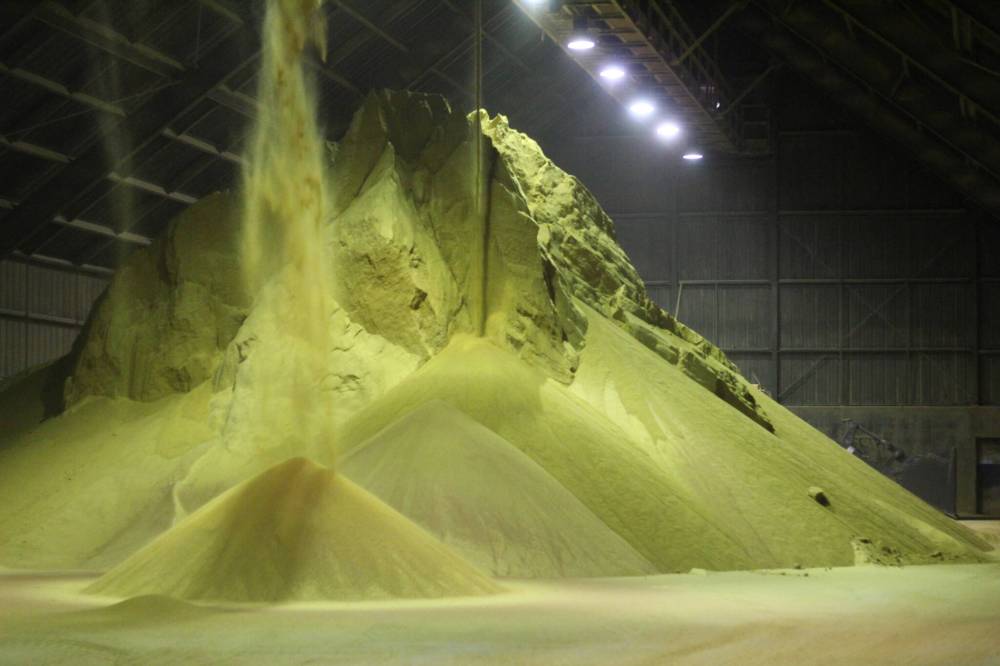
MATTHEW FRANK / THE CARILLON FILES
Piles of dried distillers grain are among the byproducts from the ethanol production process. The grain can be used as livestock feed.
The identity crisis was further complicated by Canada’s increasingly testy relationship with its next-door neighbour and largest trading partner.
The federal government’s decision to fall in line with the United States to block Chinese-made electric vehicles infuriated Canadian farmers, who by rights should be leery of electric competition cutting into their markets for biofuels. But farmers rightly predicted China would target imports of Canadian canola in retaliation.
However, new federal leadership under Prime Minister Mark Carney agreed to allow a limited number of EV imports, which pacified the Chinese enough to lift their sanctions on canola. Ottawa appears to be attempting a better balance between altruism and political survival.
Now the agricultural sector is working to get governments more focused on accelerating the growth of Canada’s domestic biofuel industry. Industry experts convening on a Canadian Agri-Food Policy Institute webinar zeroed in on gaps in CFR and the need for policies that don’t place biofuel producers at a competitive disadvantage.
Based on life-cycle analysis, biofuels potentially reduce carbon emissions by between 80 to 90 per cent, which would go a long way towards meeting reduction targets in some sectors, such as transportation. While electric vehicles reduce emissions to nearly zero, it remains unclear whether the power grid could support a wholesale switch- over, especially given the increasing demands from other power-hungry growth industries such as artificial intelligence data centres.
Canada’s Clean Fuel Regulation, now a decade-old, creates a market for biofuels by mandating fuel producers to reduce the life cycle carbon intensity of their products by 15 per cent below 2016 levels by 2030. It’s credited with significantly expanding the domestic market for biofuels, leading to major investments in canola processing capacity.
But critics say Canada’s policy hasn’t kept pace with policy developments elsewhere.
While Canadian canola producers applauded when the U.S. — Canada’s largest export customer for canola — announced this year its 45Z Clean Fuel Production Credit would apply equally to feedstocks sourced from North American producers, the fact CFR applies equally to both domestic and imported biofuels is a problem. The U.S. credit gives U.S. ethanol coming into Canada a 30-cent-per-litre advantage.
Andrea Kent, vice-president of industry and government affairs with Greenfield Global, said that discrepancy means an increasing share of the surging market growth for ethanol in Canada is being met with imports, putting existing domestic processors and future investment at risk.
“So, if you’re an importer … you’re getting a double dip. That’s becoming a really, really, critical problem,” Kent said.
The Canadian government announced in September 2025 it would be making targeted amendments to the CFR, but the sector is still waiting to see what transpires.
“When you look at CFR amendments for ethanol, they’re needed just so that a producer can have a fair shot at home. It’s not about limiting trade, it’s not about thickening the border,” Kent said.

“We currently have $1 billion in shovel-ready projects in Ontario and Quebec that are waiting for these amendments, so when you look at where there’s urgency, it’s definitely more around the ethanol side on these amendments,” she said.
“No bank is pulling the trigger right now until there’s a Canadian equalizer of some sort for ethanol in our national policy.”
Yet any move by Canada that appears to discriminate against U.S. imports could have repercussions on the trade front, potentially risking farmers’ access to their primary export market.
There’s a lot riding on Canada getting its policy right.
Laura Rance-Unger is editor emeritus for Glacier FarmMedia. She can be reached at lrance@farmmedia.com
Laura Rance is editorial director at Farm Business Communications.
Our newsroom depends on a growing audience of readers to power our journalism. If you are not a paid reader, please consider becoming a subscriber.
Our newsroom depends on its audience of readers to power our journalism. Thank you for your support.
Laura Rance is editorial director at Farm Business Communications.
Our newsroom depends on a growing audience of readers to power our journalism. If you are not a paid reader, please consider becoming a subscriber.
Our newsroom depends on its audience of readers to power our journalism. Thank you for your support.
Advertisement Advertise With Us
Advertisement Advertise With Us