

Newfoundland and Labrador offering millions for exploration to open new oil frontiers
Advertisement
Read this article for free:
or
Already have an account? Log in here »
To continue reading, please subscribe:

Digital Subscription
One year of digital access for only $205*
- Enjoy unlimited reading on winnipegfreepress.com
- Read the E-Edition, our digital replica newspaper
- Access News Break, our award-winning app
- Play interactive puzzles
*First annual payment billed as $205.00 + GST for one year. This annual subscription will automatically renew at $233.00 + GST every 52 weeks (10% off the regular annual price of $259.35). Offer available to new and qualified returning subscribers only. Cancel any time.
To continue reading, please subscribe:
Add Free Press access to your Brandon Sun subscription for only an additional
$1 for the first 4 weeks*
- Enjoy unlimited reading on winnipegfreepress.com
- Read the E-Edition, our digital replica newspaper
- Access News Break, our award-winning app
- Play interactive puzzles
*Your next Brandon Sun subscription payment will increase by $1.00 and you will be charged $17.95 plus GST for four weeks. After four weeks, your payment will increase to $24.95 plus GST every four weeks.
Read unlimited articles for free today:
or
Already have an account? Log in here »
ST. JOHN’S – Oil production is ramping up off the coast of Newfoundland and Labrador and the provincial government is offering money to companies interested in looking for more.
Premier Tony Wakeham opened an annual energy conference in St. John’s, N.L., Tuesday by announcing a call for exploration bids off the province’s east coast. There have been no takers in the past few years, but Wakeham seemed determined that this year will be different.
His government is offering up to $30 million to offset the cost of drilling a well in an area that could open a new oil frontier, he announced to the audience of roughly 75 people gathered in a St. John’s conference centre.
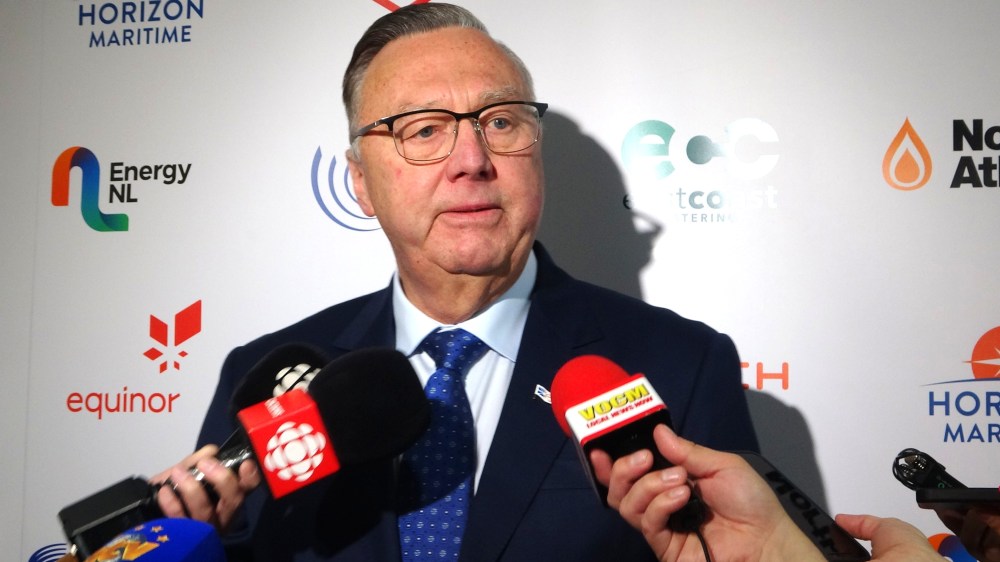
The announcement is the latest sign showing how Newfoundland and Labrador is throwing its weight behind the oil industry.
“Other politicians in other places want us to be ashamed of being an oil and gas jurisdiction,” Wakeham told the audience. “But let me tell you this: under my government, Newfoundland and Labrador apologizes to nobody.”
Wakeham and his Progressive Conservatives formed government last fall, after edging out the former Liberal government in a close provincial election. The Tories’ first budget, delivered earlier this year, includes $90 million for an offshore exploration fund, which will pay for the well subsidies, Wakeham said.
The waters off the province’s east coast are home to four offshore oil installations. Equinor’s proposed $14 billion Bay du Nord project would be the fifth. The company is expected to make a final decision about whether to proceed with the project next year.
The premier heaped praise on Liberal Prime Minister Mark Carney, describing the federal government as a “pro-oil and gas partner” for Newfoundland and Labrador.
The Carney government helped the province secure an agreement with Equinor to share the benefits from the Bay du Nord project, Wakeham added.
François-Philippe Champagne, the federal finance minister, said Bay du Nord is a “great example” of what Canada and Newfoundland and Labrador can accomplish together. He was in St. John’s at the conference for a “fireside chat.”
Bay du Nord would be about 500 kilometres away from shore — far enough that it would be subject to tariffs under a United Nations convention. The federal government will assume those responsibilities, Champagne told reporters, though he would not speculate on how much that may cost.
Officials with the Newfoundland and Labrador government have estimated the annual fees could total $1 billion by the time Bay du Nord winds down.
Meanwhile, Kerry Moreland, president of ExxonMobil Canada, said new wells and investments will ensure the Hibernia field will be pumping “well beyond” its initial expected life of 30 years. Hibernia was the province’s first oil project and it began producing in 1997.
The nearby Hebron field, which began producing in 2017, hit its highest average monthly production rate in February, at 172,000 barrels, Moreland added.
The province’s offshore oilfields produced a total of about 8.2 million barrels in October — the highest production rate since July 2021, according to Statistics Canada.

Angela Carter, a political science professor at Memorial University in St. John’s, N.L., said it was “unthinkable” for the provincial government to be pushing for an oil sector expansion as the world grappled with a rapidly changing climate.
She also attended Tuesday’s conference, and she said it was “like being in a false reality.”
Newfoundland and Labrador should be planning for the end of oil, rather than subsidizing new exploration, Carter said.
“After decades of producing oil, hoping that it was going to be a saviour of the province, we’re still in very much the same situation with a lot of inequality and a lot of poverty in our province,” she said in an interview. “We’re just doing the same thing over and over again, hoping for a different outcome.”
This report by The Canadian Press was first published June 2, 2026.