

Saint John, N.B., launches simulated electricity grid to test energy projects
Advertisement
Read this article for free:
or
Already have an account? Log in here »
To continue reading, please subscribe:

Digital Subscription
One year of digital access for only $205*
- Enjoy unlimited reading on winnipegfreepress.com
- Read the E-Edition, our digital replica newspaper
- Access News Break, our award-winning app
- Play interactive puzzles
*First annual payment billed as $205.00 + GST for one year. This annual subscription will automatically renew at $233.00 + GST every 52 weeks (10% off the regular annual price of $259.35). Offer available to new and qualified returning subscribers only. Cancel any time.
To continue reading, please subscribe:
Add Free Press access to your Brandon Sun subscription for only an additional
$1 for the first 4 weeks*
- Enjoy unlimited reading on winnipegfreepress.com
- Read the E-Edition, our digital replica newspaper
- Access News Break, our award-winning app
- Play interactive puzzles
*Your next Brandon Sun subscription payment will increase by $1.00 and you will be charged $17.95 plus GST for four weeks. After four weeks, your payment will increase to $24.95 plus GST every four weeks.
Read unlimited articles for free today:
or
Already have an account? Log in here »
SAINT JOHN – A city utility in New Brunswick has become the first in Canada to share active electricity grid data with outsiders — a move it says will help keep power bills predictable and lead to more clean energy projects.
Saint John Energy will be sharing the data on a platform that will allow companies and academics to test how potential energy projects could interact with or impact the city’s power grid.
The utility’s chief executive Ryan Mitchell said the Plug-In Lab announced Friday is a “digital twin” using data duplicated directly from the electrical grid and shared in close to real time, depending on the piece of information.

The platform could become a critical tool for policy-makers as energy providers across Canada grapple with soaring power demand driven by more electric cars and data centres weighing on aging infrastructure.
“We do not have an exclusive arrangement with one academic institution. It’s really open for any academic institution in Canada and beyond,” Mitchell said by phone Friday.
While academic institutions would be able to access Saint John Energy’s platform for free, officials from the utility said they had not decided whether private clients or corporations would be charged, saying they would evaluate this on a case-by-case basis.
A team of staff and student researchers at Concordia University has already unveiled plans to use the platform to calculate the impact of residential retrofits. According to a background document, members of the Concordia team anticipate they will be able to identify which residential upgrades could reduce greenhouse gases.
The Concordia team is also modelling how to manage devices like batteries, hot water tanks and heat pumps to reduce peak electricity demand. Finding more efficient ways to handle power during peak demand times can lead to cheaper electricity bills.
Daniel Curwin, doctorate student with the university’s electrification research group, says information from the lab will be far better than what they could find in the public domain.
“Having access to real data, the models and scenarios will be significantly more accurate than if they were just built on publicly available data,” Curwin said in a statement.
While publicly available data is usually static and historical, the insider data from Plug-In Labs will show how energy moves through the grid and can, for example, reveal energy use in a specific neighbourhood during peak demand.
Saint John Energy said in a news release that no identifiable customer information is shared and those accessing the platform work are unable to access the grid itself.
Researchers could also model the impact of adding electric vehicles to one area of the city, in another example, and simulate how infrastructure such as a transformer could be strained by the power load.
Elsewhere, New Brunswick Community College is using the Plug-In Lab to simulate how its clean energy micro grid — made up of solar panels and wind turbines — could interact with the larger city grid.
The simulation will also give Saint John Energy insight into how it can manage micro grids across its services while giving the students valuable experience with real energy data, the college said.
There are other organizations that are using digital system duplicates to simulate real power networks in Canada, such as a project by Alberta’s ATCO Electric that aims to deter wildlife threats.
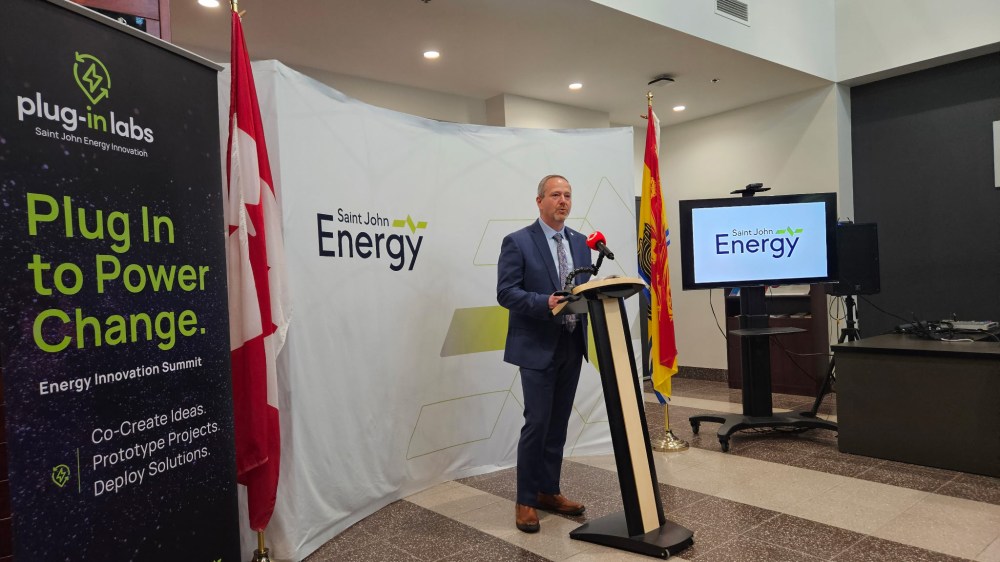
But Saint John Energy officials say no other network in Canada has created a platform that includes the digital twin made up of its own live data and opened it up to allow innovation through a supervised platform.
Devin Hanson, a planning manager at the electric utility in Medicine Hat, Alta., says a digital twin allows projects to be tested in different places and scenarios as opposed to running a physical trial in one part of the grid.
For example, instead of adding a storage battery to a city grid in one neighbourhood, the Plug-In Lab can allow engineers to simulate how it would work in different areas of the city. That enhanced ability to plan will ultimately save money, said Hanson.
“They can prioritize projects and pick the cheapest solution, therefore the rates for the utility would be the cheapest,” he told The Canadian Press.
If Saint John Energy proves its new data platform can save money for ratepayers, Hanson anticipates other Canadian utilities will start their own.

“The more utilities that pilot this and set these up, it’ll quickly advance other utilities doing it — assuming that this works out that the cost to set all this up had a net benefit overall,” he said.
It’s not the first time Saint John Energy, which operates arm’s-length from city leadership, has taken a step to improve its grid.
In 2019, the corporation was the first in the world to use a Tesla Megapack utility battery to store green power from the Burchill Wind Project. The battery allows the utility to deploy extra power during times of peak electricity demand and reduce reliance on gas power plants.
This report by The Canadian Press was first published June 5, 2026.
— By Eli Ridder in Fredericton.