

Need for farm innovation never greater

Advertisement
Read this article for free:
or
Already have an account? Log in here »
To continue reading, please subscribe:
Digital Subscription
One year of digital access for only $1.44 a week*
- Enjoy unlimited reading on winnipegfreepress.com
- Read the E-Edition, our digital replica newspaper
- Access News Break, our award-winning app
- Play interactive puzzles
*Billed as $5.77 plus GST every four weeks. After 52 weeks, price increases to the regular rate of $19.95 plus GST every four weeks. Offer available to new and qualified returning subscribers only. Cancel any time.
To continue reading, please subscribe:
Add Free Press access to your Brandon Sun subscription for only an additional
$1 for the first 4 weeks*
- Enjoy unlimited reading on winnipegfreepress.com
- Read the E-Edition, our digital replica newspaper
- Access News Break, our award-winning app
- Play interactive puzzles
*Your next Brandon Sun subscription payment will increase by $1.00 and you will be charged $17.95 plus GST for four weeks. After four weeks, your payment will increase to $24.95 plus GST every four weeks.
Read unlimited articles for free today:
or
Already have an account? Log in here »
Surging Canadian demand for organic foods is a dilemma for primary agricultural sector and policy makers.
At a time when Canada is actively trying to diversify its exports, increase its own nutritional self-sufficiency and bolster its food-processing sector, it makes sense to find ways to meet this growth head-on without compromising the much larger supply chain for conventionally grown crops.
The latest market research report conducted on behalf of the Canadian Organic Trade Association shows consumer demand for organic has grown by nearly 32 per cent to $11.88 billion over the past three years.
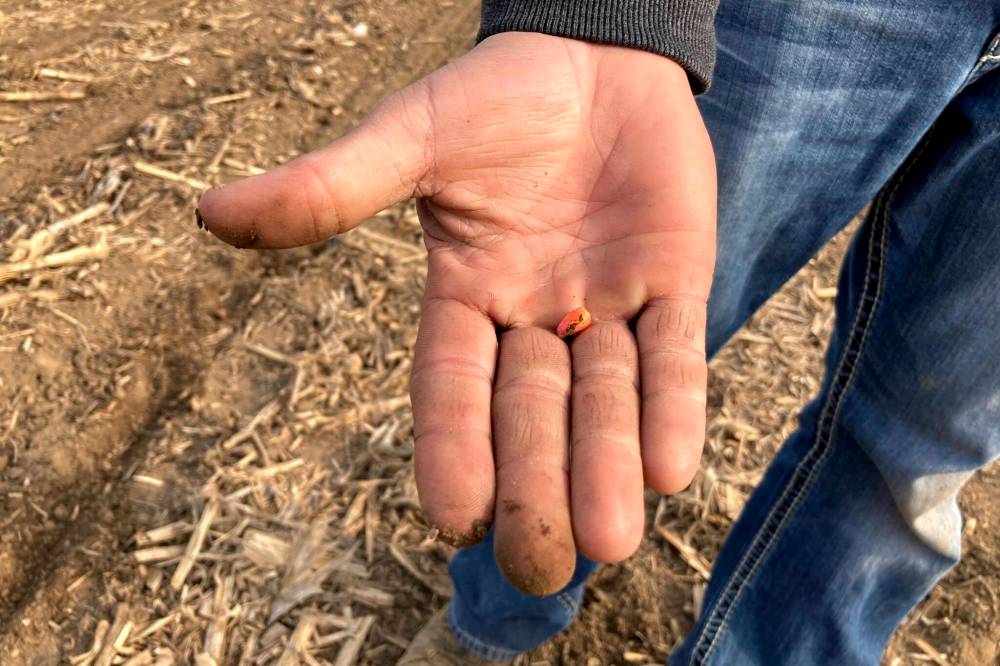
Lance Unger holds a corn seed to be planted in one of his fields near Carlisle, Ind., where he uses minimum tillage practices to improve yields.
It is also a leading exporter, with sales of $2.58 billion.
Organic products have claimed more than 90 per cent of the baby food market in Canada and nearly 64 per cent of the market for toddler and infant snacks. Three out of every four dollars spent on organic food goes to pre-packaged goods.
Granted, organic food sales are still relatively small at only four per cent of retail. However, Canadian demand is growing faster than supply due because there aren’t enough growers entering the business. That means an increasing proportion of the market expansion is being filled by imports, primarily from the U.S.
It’s time for farmers to move beyond their fear that acknowledging the organic industry for the lucrative niche it is infers there is something inherently wrong with conventional farm practices.
The reality is both production systems have challenges with sustainability.
For example, without herbicides in their arsenal, organic farmers have traditionally relied too heavily on tillage to control weeds. However, as awareness has grown about how damaging tillage is to soil health and fertility, they’ve embraced tactics such as intercropping — growing two compatible crops such as peas and oats in the same field simultaneously — or incorporating perennial crops into their rotation to keep the weeds at bay.
These are strategies conventional farmers can use to help control weeds that have developed resistance because of excessive use of herbicides.
The need for innovation in the form of new management strategies, as well as in technology, has never been greater as farmers grapple with an increasingly volatile climate and geopolitical conflicts driving up costs of production and trade uncertainty.
That’s why the federal government’s recently announced cuts to agricultural research, including an Agriculture and Agri-Food Canada program based out of Swift Current, Sask., exploring agronomic options for organic and regenerative agriculture in the dryland Prairies, are so concerning.
In all, seven research and development facilities, 665 positions and multiple programs are being eliminated across Canada.
Around the same time the COTA report was rolling off the virtual presses, federal workers were plowing the Swift Current research station’s organic and regenerative plots to repurpose them.
The organic sector is understandably up in arms. But so are general farm policy groups such as Agricultural Producers of Saskatchewan, which argues losing the Swift Current program reduces capacity in areas that support soil health, resilience and long-term productivity for all farmers.
AAFC continues to be the largest single funder of organic research in Canada under its national “science cluster” approach, which co-ordinates efforts from multiple disciplines. It remains to be seen whether some of the work formerly done at Swift Current will be picked up by other research stations or universities.
Meanwhile, the University of Manitoba is home to 34 years of continuous organic grain and forage research plots.

Researchers there are also currently immersed in a multiyear research project supported by the National Sciences and Engineering Research Council to develop farming systems that use both technological and natural solutions to reduce greenhouse gas emissions, capture carbon and adapt to climate change.
Public, philanthropic and producer support through grants, research capacity and infrastructure are essential for this kind of research as these farming systems focus on management rather than packaged solutions.
While the private sector is good at providing farmers with new tools, they are mostly aimed at making conventional monoculture approaches work better.
Changing how farmers farm to leverage the advantages of biodiversity requires research to prove something can be done and extension to show them how.
Laura Rance-Unger is editor emeritus for Glacier FarmMedia. She can be reached at lrance@farmmedia.com
Laura Rance is editorial director at Farm Business Communications.
Our newsroom depends on a growing audience of readers to power our journalism. If you are not a paid reader, please consider becoming a subscriber.
Our newsroom depends on its audience of readers to power our journalism. Thank you for your support.
Laura Rance is editorial director at Farm Business Communications.
Our newsroom depends on a growing audience of readers to power our journalism. If you are not a paid reader, please consider becoming a subscriber.
Our newsroom depends on its audience of readers to power our journalism. Thank you for your support.
Advertisement Advertise With Us
Advertisement Advertise With Us