

Manitoba opens up provincewide financial support for residents affected by storms
Advertisement
Read this article for free:
or
Already have an account? Log in here »
To continue reading, please subscribe:

Digital Subscription
One year of digital access for only $205*
- Enjoy unlimited reading on winnipegfreepress.com
- Read the E-Edition, our digital replica newspaper
- Access News Break, our award-winning app
- Play interactive puzzles
*First annual payment billed as $205.00 + GST for one year. This annual subscription will automatically renew at $233.00 + GST every 52 weeks (10% off the regular annual price of $259.35). Offer available to new and qualified returning subscribers only. Cancel any time.
To continue reading, please subscribe:
Add Free Press access to your Brandon Sun subscription for only an additional
$1 for the first 4 weeks*
- Enjoy unlimited reading on winnipegfreepress.com
- Read the E-Edition, our digital replica newspaper
- Access News Break, our award-winning app
- Play interactive puzzles
*Your next Brandon Sun subscription payment will increase by $1.00 and you will be charged $17.95 plus GST for four weeks. After four weeks, your payment will increase to $24.95 plus GST every four weeks.
Read unlimited articles for free today:
or
Already have an account? Log in here »
STONEWALL, MAN. – Manitoba Premier Wab Kinew continued his tour of flood-ravaged communities with a visit to the town of Stonewall, where he announced a provincewide disaster financial assistance program.
Kinew previously announced financial assistance would be available to residents in western Manitoba, where several rural communities declared states of emergency after floods burst riverbanks, swamping some homes and businesses last weekend.
He says monetary help will now be extended to any Manitoba residents who have been affected by this week’s wild storms that flooded basements and damaged infrastructure across the province.
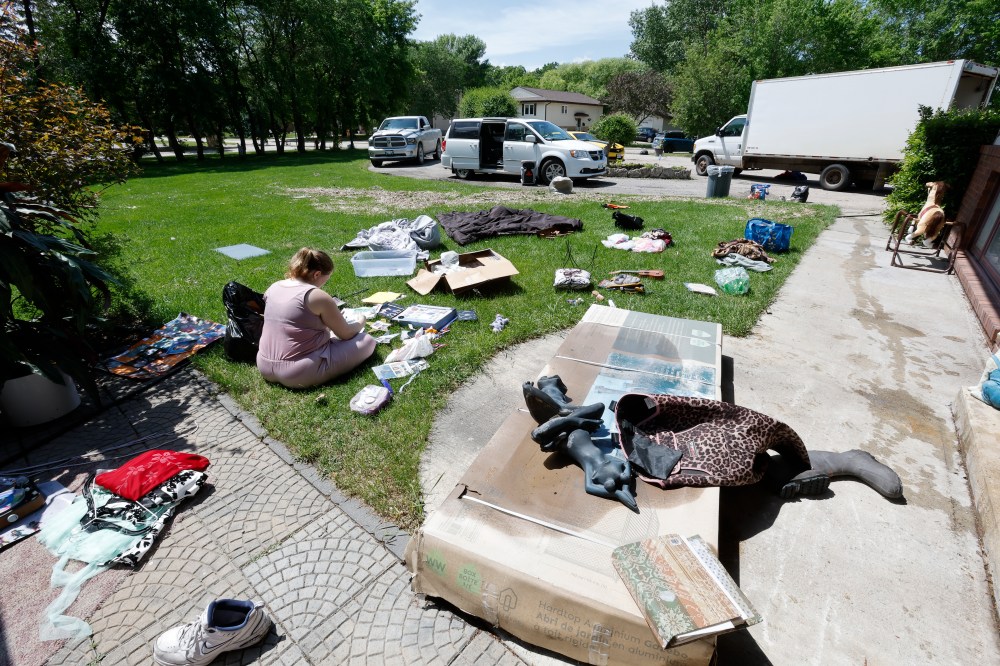
Stonewall, a town of about 5,000 just north of Winnipeg, was among the hardest hit with 255 millimetres of rain in one night.
It has advised residents to limit unnecessary water use and closed the local cemetery and Quarry Park due to overland flooding.
Kinew did not provide a dollar amount that would be compensated, saying that would become more clear as cleanup operations continue.
“No one in rural Manitoba is going to be left behind. Your provincial government is going make sure that there are the resources to help you clean up, to rebuild and to recover from these terrible storms that we’ve been seeing recently,” Kinew told reporters on Thursday while touring Stonewall.
The premier encouraged flood-affected individuals to check with their insurance providers first, as the province’s financial assistance program covers uninsurable losses and disaster-related responses.
Several municipalities are in cleanup mode after downpours this week that delivered sheets of water, tennis ball-size hail and resulted in hundreds of power outages.
Manitoba Hydro expected most storm outages should be restored by the end of Thursday.
The Crown corporation said 1,400 customers in Winnipeg remained without power.
“Some customers have been without power for an extended period of time, and the utility recognizes the difficulty this causes customers. Multiple crews are prioritizing these outages, which include power lines down in several locations, and damage in areas that is difficult to reach with heavy equipment,” Hydro said in a statement Thursday afternoon.
The utility is also monitoring an overland flooding situation near the Dorsey Converter Station in the Rural Municipality of Rosser, northwest of Winnipeg.

It said due to flooded roads and potential access issues, non-essential staff have been asked to work at other locations.
The facility, which transmits more than 70 per cent of electricity produced in the province, continues to operate, and Hydro said there is no impact on service to customers.
Flooding has prompted the province to cut several highways, including Highway 221 near Dorsey, to help relieve the pressure of water on rural communities.
In some cases, roadways buckled under the high volumes of water.
This report by The Canadian Press was first published June 11, 2026.