

Farmers just one link in long supply chain

Advertisement
Read this article for free:
or
Already have an account? Log in here »
To continue reading, please subscribe:
Digital Subscription
One year of digital access for only $1.44 a week*
- Enjoy unlimited reading on winnipegfreepress.com
- Read the E-Edition, our digital replica newspaper
- Access News Break, our award-winning app
- Play interactive puzzles
*Billed as $5.77 plus GST every four weeks. After 52 weeks, price increases to the regular rate of $19.95 plus GST every four weeks. Offer available to new and qualified returning subscribers only. Cancel any time.
To continue reading, please subscribe:
Add Free Press access to your Brandon Sun subscription for only an additional
$1 for the first 4 weeks*
- Enjoy unlimited reading on winnipegfreepress.com
- Read the E-Edition, our digital replica newspaper
- Access News Break, our award-winning app
- Play interactive puzzles
*Your next Brandon Sun subscription payment will increase by $1.00 and you will be charged $17.95 plus GST for four weeks. After four weeks, your payment will increase to $24.95 plus GST every four weeks.
Read unlimited articles for free today:
or
Already have an account? Log in here »
Farmers are hardly front and centre in newly released federal and provincial reports analyzing why food has become less affordable for many Canadians.
The word “farmers” doesn’t even appear in the Manitoba government’s Grocery Price Strategy report until Page 7.
That’s a good thing, because it signals a new level of awareness in how we collectively view the food system. The focus is shifting from front-line farmers to the largely invisible and complicated supply chain connecting field to table.
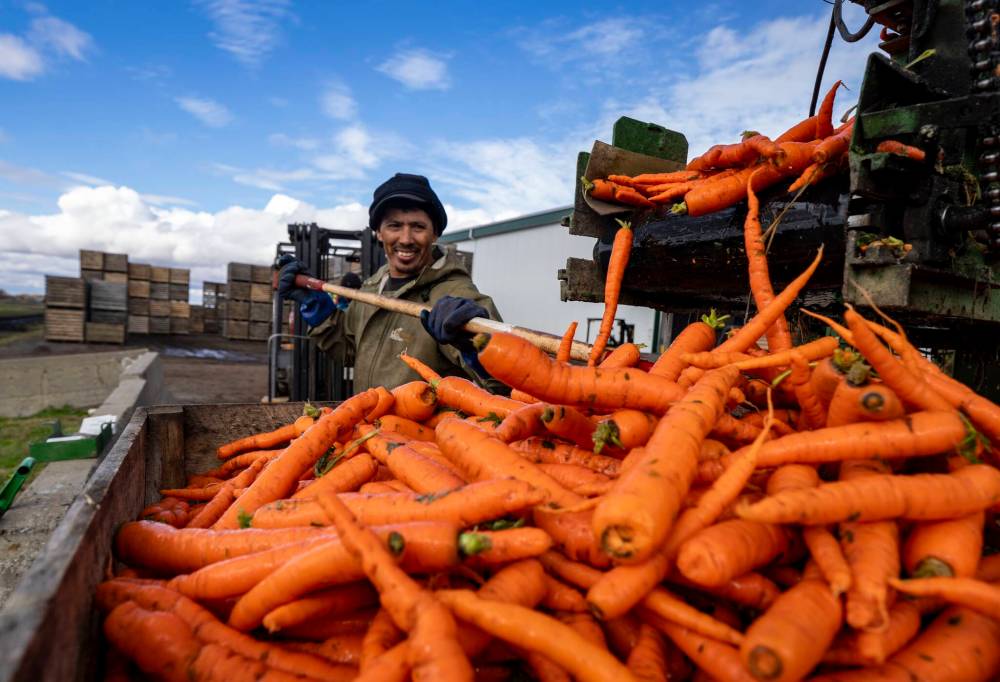
Christinne Muschi / The Canadian Press files
Carrots are harvested at fourth-generation, family-run vegetable business Mas & Fils Jardiniers in Saint-Michel, Que.
It might even change how farmers see themselves.
“Grocery prices are shaped by a complex interaction of global economic forces, domestic supply chains, production costs and market structures. While inflation and international disruptions have contributed significantly to rising food costs, concerns have also emerged regarding competition, market concentration and the growing use of data-driven pricing technologies. Understanding these drivers is essential to identifying effective policy responses,” says the Manitoba report.
On one hand, many farmers have embraced “feeding the world” as a calling. They take pride in producing affordable food. Farm organizations issue news releases every February when the average Canadian household has earned enough to eat for the whole year.
But they also get riled up whenever some pundit attributes higher bread, meat or milk prices for consumers to farmers making off like bandits. After all, the value of the wheat that goes into a loaf of bread is minuscule compared to the other costs in the transportation, processing, wholesale and retail chains.
The national food security strategy says farmers receive about 11 per cent of every dollar spent on food. Processors get 23 per cent, wholesalers nine per cent, transportation seven per cent, retailers 16 per cent, and energy and utilities six per cent. Restaurants receive about 28 per cent of consumer spending.
So, if there’s any of those bumper stickers still floating around out there boasting “Farmers feed the world” or “If you ate today, thank a farmer,” they should be peeled off with a high-pressure wand at the nearest car wash.
Sure, thank a farmer, but also thank a plant breeder, truck driver, food-processing plant worker, grocery store clerk — the list of people who get food to our tables is too long to fit on a bumper.
Of course, we need farmers. If anything, we need more of the type of entrepreneur who will put everything on the line every year to battle weeds, navigate drought and/or downpours, gamble on volatile markets, and go out in sub-zero temperatures to feed the cattle or load grain trucks.
But while these reports acknowledge the higher costs farmers are facing due to geopolitical upheaval, they fail to mention that, unlike other players in the food system, farmers have limited ability to charge more for their production to make up for it.
Yet they face constant pressure to continue increasing production.
Now would also be a good time to review the decades-old mantra that the world’s farmers must increase production by 70 per cent by 2050 to feed nine billion people. This still gets trotted out in speeches — usually in the context of encouraging producers to spend more to produce more.
Is it really up to farmers to feed the world?
As these reports underscore, production is only one piece of the puzzle when it comes to the availability and affordability of food. In fact, too much production frequently overwhelms the markets, which results in lower returns even as farmers’ production costs continue to rise.
Lower market prices may help processors keep costs down, but they don’t necessarily equate with lower food costs at the grocers.

Frankly, it’s too soon to say whether the ambitious targets laid out by governments will result in meaningful reductions to grocery bills. The critics are skeptical.
However, what they have accomplished is peeling back the layers, exposing a supply chain at risk of breaking without a rebalancing of marketplace power and a concerted effort to shore up its most vulnerable links.
We can’t claim to have a healthy food system unless all the players are, not just surviving, but thriving.
That includes farmers.
Laura Rance-Unger is editor emeritus for Glacier FarmMedia. She can be reached at lrance@farmmedia.com
Laura Rance is editorial director at Farm Business Communications.
Our newsroom depends on a growing audience of readers to power our journalism. If you are not a paid reader, please consider becoming a subscriber.
Our newsroom depends on its audience of readers to power our journalism. Thank you for your support.
Laura Rance is editorial director at Farm Business Communications.
Our newsroom depends on a growing audience of readers to power our journalism. If you are not a paid reader, please consider becoming a subscriber.
Our newsroom depends on its audience of readers to power our journalism. Thank you for your support.
Advertisement Advertise With Us
Advertisement Advertise With Us