

India’s Modi and Japan’s Takaichi expand defense and economic security ties
Advertisement
Read this article for free:
or
Already have an account? Log in here »
To continue reading, please subscribe:

Digital Subscription
One year of digital access for only $205*
- Enjoy unlimited reading on winnipegfreepress.com
- Read the E-Edition, our digital replica newspaper
- Access News Break, our award-winning app
- Play interactive puzzles
*First annual payment billed as $205.00 + GST for one year. This annual subscription will automatically renew at $233.00 + GST every 52 weeks (10% off the regular annual price of $259.35). Offer available to new and qualified returning subscribers only. Cancel any time.
To continue reading, please subscribe:
Add Free Press access to your Brandon Sun subscription for only an additional
$1 for the first 4 weeks*
- Enjoy unlimited reading on winnipegfreepress.com
- Read the E-Edition, our digital replica newspaper
- Access News Break, our award-winning app
- Play interactive puzzles
*Your next Brandon Sun subscription payment will increase by $1.00 and you will be charged $17.95 plus GST for four weeks. After four weeks, your payment will increase to $24.95 plus GST every four weeks.
Read unlimited articles for free today:
or
Already have an account? Log in here »
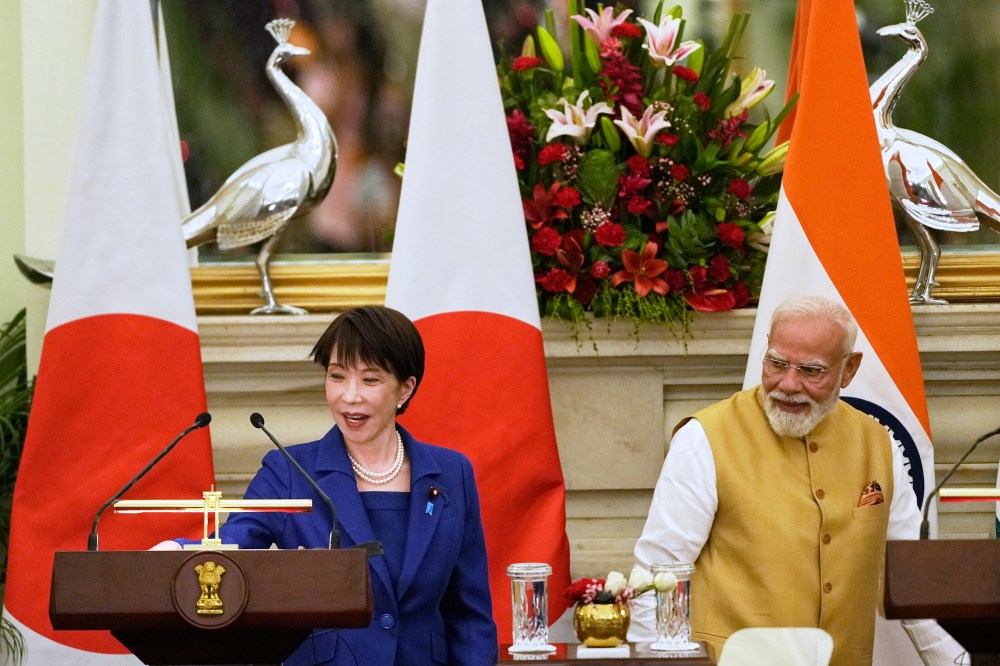
NEW DELHI (AP) — Japan and India announced a series of agreements to deepen cooperation in defense, economic and maritime security following talks Thursday between Indian Prime Minister Narendra Modi and Japanese counterpart, Sanae Takaichi.
Speaking after the meeting in New Delhi, Modi said India and Japan will collaborate on naval radio antenna systems, and adopted a joint road map on economic security. He said the leaders also agreed to strengthen cooperation in artificial intelligence, shipbuilding, biogas, semiconductors and critical technologies.
“India and Japan view economic security as a shared security interest,” he said.
Japan is among India’s largest foreign investors and has backed major infrastructure projects, including the Mumbai-Ahmedabad high-speed rail line. About 1,400 Japanese companies operate in India, nearly half of them in manufacturing.
Two-way trade reached $27.5 billion in India’s 2025-26 fiscal year, while Japanese investment totaled $3.2 billion between April and December 2025, according to Indian government data.
Takaichi was in New Delhi on a three-day visit for the 16th annual India-Japan summit. Both countries seek to strengthen their partnership in the Indo-Pacific following Modi’s trip to Tokyo last year, when Japan pledged to more than double its investment in India to more than $61 billion over the next decade.
India and Japan, along with the United States and Australia, are members of the Quad, a grouping that promotes cooperation on regional security, maritime issues and defense to counter China’s growing influence in the Indo-Pacific.

Takaichi said New Delhi and Tokyo shared a commitment to Japan’s initiative of free and open Indo-Pacific based on freedom of navigation and respect for international law. “Expansion of maritime security cooperation is especially important for regional peace and stability,” she said.
Asked about the initiative, Chinese Foreign Ministry spokesperson Guo Jiakun said Thursday that some countries promoted “freedom and openness” while pursuing “confrontation and division.” He said such an approach ran counter to the region’s desire for peace, development and cooperation.
“Asia-Pacific needs stability, not turmoil; focus on cooperation, not division,” Guo said at a regular press briefing in Beijing.
——
Associated Press writer Ken Moritsugu in Beijing, China contributed to this report.