

WestJet flight attendants approve strike mandate as ground pay takes centre stage
Advertisement
Read this article for free:
or
Already have an account? Log in here »
To continue reading, please subscribe:

Digital Subscription
One year of digital access for only $205*
- Enjoy unlimited reading on winnipegfreepress.com
- Read the E-Edition, our digital replica newspaper
- Access News Break, our award-winning app
- Play interactive puzzles
*First annual payment billed as $205.00 + GST for one year. This annual subscription will automatically renew at $233.00 + GST every 52 weeks (10% off the regular annual price of $259.35). Offer available to new and qualified returning subscribers only. Cancel any time.
To continue reading, please subscribe:
Add Free Press access to your Brandon Sun subscription for only an additional
$1 for the first 4 weeks*
- Enjoy unlimited reading on winnipegfreepress.com
- Read the E-Edition, our digital replica newspaper
- Access News Break, our award-winning app
- Play interactive puzzles
*Your next Brandon Sun subscription payment will increase by $1.00 and you will be charged $17.95 plus GST for four weeks. After four weeks, your payment will increase to $24.95 plus GST every four weeks.
Read unlimited articles for free today:
or
Already have an account? Log in here »
WestJet flight attendants have authorized a strike that could see thousands of workers walk off the job in fewer than three weeks if they are unable to reach a new deal on contract demands.
Members voted 99 per cent in favour of the strike mandate, said the union representing about 4,400 cabin crew at the Alberta-based airline. Turnout topped 97 per cent.
After a cooling-off period, cabin crew could go on strike as soon as Aug. 2 — during a long weekend in most of the country.
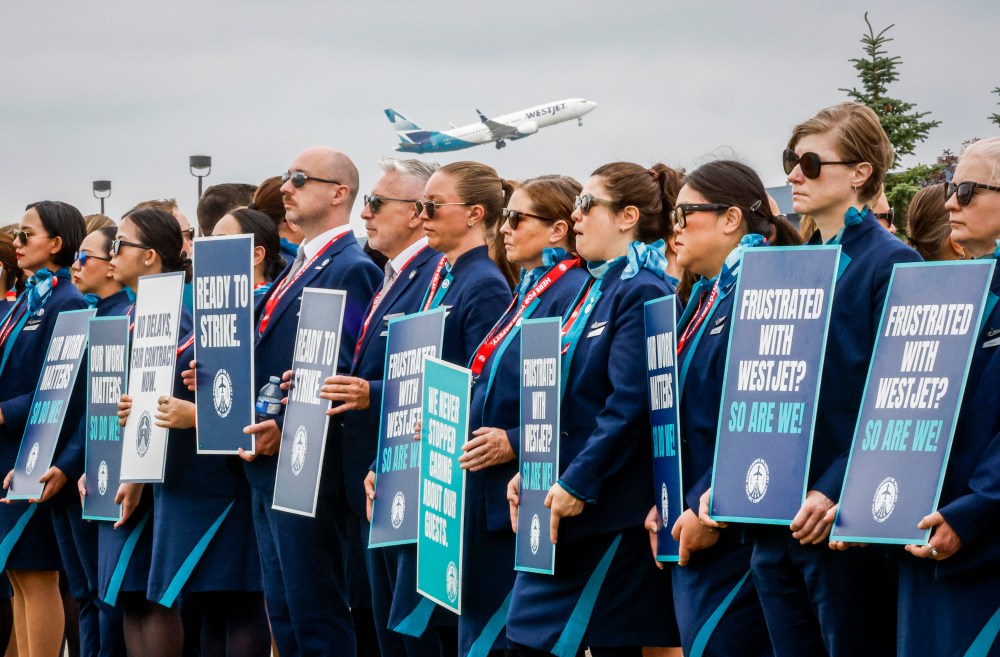
The latest move comes as a key stumbling block — compensation for work done on the ground — rears up less than a year after it sparked a work stoppage by 10,000 flight attendants at Air Canada.
“The sticking point right now for us is unpaid work and how our wage is triggered. In addition to that, it’s our actual wage rate,” said Alia Hussain, who chairs the union’s WestJet contingent, in an interview outside the Calgary airport on Wednesday.
“We believe that there is a large amount of unpaid work, which is why this remains an outstanding issue at the bargaining table.”
The comments came a day after some 250 WestJet flight attendants stood back-to-back in front of the carrier’s Calgary headquarters to send a message to management. Appearing in uniform as part of a “day of action” across the country, they held signs reading, “Ready to Strike,” “Unpaid work won’t fly” and “Frustrated with WestJet? So are we.”
The Canadian Union of Public Employees said in a release that talks have “stalled,” despite progress in some areas. Bargaining will resume Monday, Hussain said.
WestJet CEO Alexis von Hoensbroech pointed out that strike authorization is a typical step during negotiations “and does not mean a strike will occur.”
“We are steadfast in our commitment to reach a meaningful agreement with CUPE that recognizes the contribution and professionalism of our cabin crew members and keeps WestJet competitive and sustainable,” he said in a statement.
Ground pay remains a major point of contention at WestJet, after Air Canada flight attendants in February secured compensation for ground work that will climb to 70 per cent of their hourly rate for the hour before takeoff — also known as boarding pay.
WestJet’s current “credit hour” system combines flight time, ground duties, delays and other labour into a “single, higher rate of pay” that is then credited across the work day, the company says on its website.
The pay rate ranges between $28.45 and $53.61 per credit hour. At 80 credit hours a month — considered full-time work — that adds up to between $2,300 and $4,300.
While many airlines maintain this type of compensation structure, Delta Air Lines spearheaded reforms in 2022 when it became the first carrier in North America to pay flight attendants specifically for work done on the ground. American Airlines and Alaska Airlines followed suit with boarding pay of 50 per cent of regular rates.
The union has a strong incentive to push for some measure of ground pay as a way to secure the gains it won at Air Canada, said Steven Tufts, an associate professor of labour at York University.
“If CUPE fails to spread the pattern of ground pay to other airlines in Canada — that means Air Transat, that means WestJet — the one at Air Canada is put at risk,” he said.
“This is something that flight attendants have been building towards for over a decade.”
A question mark dangling over the ongoing WestJet talks is how Prime Minister Mark Carney’s government might intervene.
Hours after some Air Canada flight attendants went on strike over what they deemed unpaid work last August, Jobs Minister Patty Hajdu directed the country’s labour board to order them back on the job. The union defied the order, forcing Air Canada back to the bargaining table where the parties hashed out a tentative deal.
Members rejected it in a vote, and the impasse was eventually settled after the parties agreed to enter into binding arbitration, resulting in partial compensation for ground work.
“The real story is, what’s Carney going to do,” Tufts said.
Worker rights advocates have criticized proposed changes to the Canada Labour Code as a bid to weaken collective bargaining, he noted.

“It’s really about signalling that Canada is open for business,” Tufts said.
“That’s where I think this is a test case, and actually it could be a very important labour battle.”
The union must give 72 hours’ notice before going on strike. With the end of the conciliation phase of negotiations, a 21-day cooling-off period kicked off on July 12.
This report by The Canadian Press was first published July 15, 2026.
Companies in this story: (TSX:AC, TSX:TRZ)
Related Articles
WestJet cabin crews issue warning


Advertisement Advertise With Us
Advertisement Advertise With Us