

Kernza clicks some boxes to turn back clock

Advertisement
Read this article for free:
or
Already have an account? Log in here »
To continue reading, please subscribe:

Digital Subscription
One year of digital access for only $205*
- Enjoy unlimited reading on winnipegfreepress.com
- Read the E-Edition, our digital replica newspaper
- Access News Break, our award-winning app
- Play interactive puzzles
*First annual payment billed as $205.00 + GST for one year. This annual subscription will automatically renew at $233.00 + GST every 52 weeks (10% off the regular annual price of $259.35). Offer available to new and qualified returning subscribers only. Cancel any time.
To continue reading, please subscribe:
Add Free Press access to your Brandon Sun subscription for only an additional
$1 for the first 4 weeks*
- Enjoy unlimited reading on winnipegfreepress.com
- Read the E-Edition, our digital replica newspaper
- Access News Break, our award-winning app
- Play interactive puzzles
*Your next Brandon Sun subscription payment will increase by $1.00 and you will be charged $17.95 plus GST for four weeks. After four weeks, your payment will increase to $24.95 plus GST every four weeks.
Read unlimited articles for free today:
or
Already have an account? Log in here »
About 20 years ago, I hopped into a van with some university researchers, students and a government policy analyst to travel a long day’s drive south to the Land Institute in Kansas.
Established by Wes and Dana Jackson in the mid-1970s, the non-profit educational and research centre is trying to take modern agriculture back 10,000 years to revisit its pivot from perennial harvesting to annual cropping and reverse ecological damage.
It offers a fascinating premise — although one many would characterize as unrealistic and impractical by modern measures.
University of Manitoba
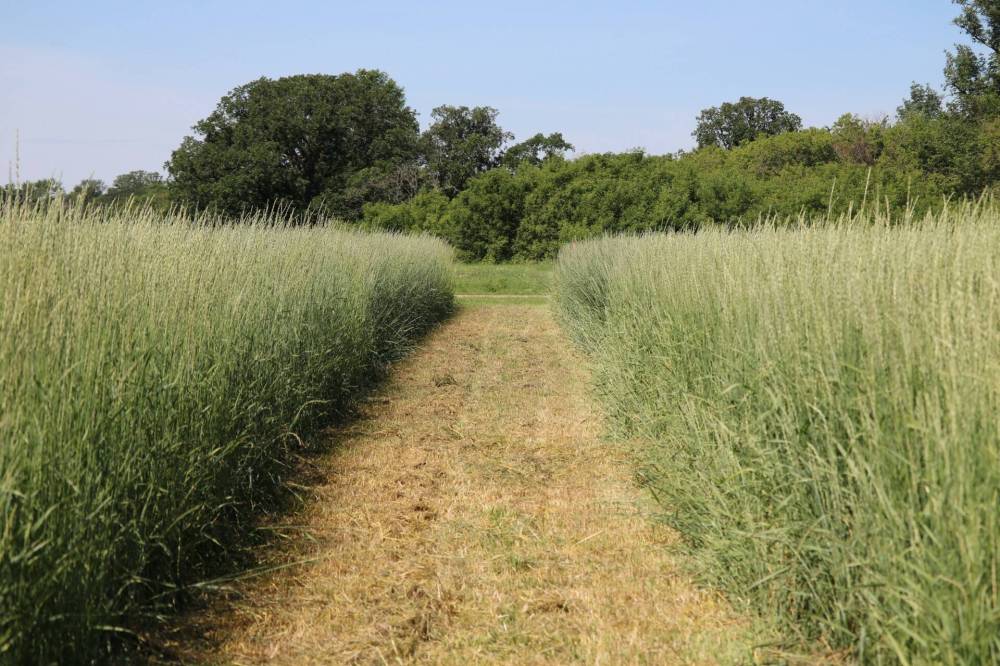
University of Manitoba research plots of Kernza, a perennial wheat that produces grain for milling into baked goods.
When plants complete their life cycle within one growing season, they put all their energy into producing viable seeds which become the nutritional powerhouses farmers harvest for food ingredients.
Perennial plants, on the other hand, pour a lot of their energy into supporting the extensive root systems that allow them to survive year after year. These plants might not even flower or produce seeds until they’ve invested a year or two into getting established.
Annual cropping created food surpluses, which in turn allowed humans to put down roots and stay in one place, setting the stage for modern civilization. More than two-thirds of the food we eat comes from annual crops of grains, oilseeds and legumes.
However, this productivity comes at a cost. Annual cropping practices deplete the soil and require massive investments in supplemental fertilizer and pesticides to control the weeds, disease and insects that thrive under monoculture.
It has turned agriculture into both a villain and victim in the global warming debate. Farming is responsible for about one-third of the world’s human-caused greenhouse gas emissions, which are in turn buffeting farmers with increasingly volatile weather.
Farming’s potential to be part of the climate change solution is fundamentally tied to the health of agricultural soils.
While farmers have reduced erosion and stemmed loss of soil carbon by reducing or eliminating tillage, that alone hasn’t been enough to substantially rebuild it. Wind and water events like those in southern Manitoba this spring are a constant reminder farmed soils remain vulnerable.
Cutting tillage in a system where farmers practise monoculture makes them more heavily dependent on herbicides, which some ecologists say are just as damaging to soil biology, if not more so. Plus, the weeds are developing resistance to chemical control, so farmers are being forced back into tillage.
The debate between the no-tillers and anti-no-tillers has been heating up lately — along with the climate.
That trip to Kansas was the spark for a University of Manitoba long-term research project exploring perennial grains for the Canadian Prairies. Plant breeder Doug Cattani was hired and has worked with soil scientist Joanne Thiessen Martens on agronomic research using Kernza, the trademarked name of a perennial forage grass native to western Asia that the Land Institute has developed into a harvestable grain crop.
Kernza has proven itself to be hardy enough to survive the oft-brutal Canadian Prairie winters.
Because it’s perennial, the soil doesn’t have to be tilled. And once the stand is established, it outcompetes the weeds, so requires no herbicides. Its roots stretch deep, not only anchoring it but feeding the diverse biological life below the surface and supporting carbon storage.
Kernza is relatively high in protein and has gluten and starch characteristics that may increase its appeal to certain consumers.
However, right now it yields only 30 to 40 per cent of typical wheat. That said, it’s resilient. In a drought year, Kernza yielded equivalent to a neighbouring conventional wheat field at a fraction of the input costs.

Fertility management remains a challenge.
Cattani says researchers have been experimenting with turning livestock out to graze the crop in the fall to provide organic fertilizer after the seed is harvested. Providing fertilizer in the fall, organic or otherwise, appears to do more to support the next year’s grain production than fertilizer applied in the spring — even at higher doses.
It’s painstakingly slow work, but there are hints of the potential becoming more tangible, if, and only if, society collectively finds a way to value this system’s benefits beyond yield as the only measure.
Turning back the clock on 10,000 years of thinking isn’t going to happen overnight.
Laura Rance-Unger is editor emeritus for Glacier FarmMedia. She can be reached at lrance@farmmedia.com.
Laura Rance is editorial director at Farm Business Communications.
Our newsroom depends on a growing audience of readers to power our journalism. If you are not a paid reader, please consider becoming a subscriber.
Our newsroom depends on its audience of readers to power our journalism. Thank you for your support.
Laura Rance is editorial director at Farm Business Communications.
Our newsroom depends on a growing audience of readers to power our journalism. If you are not a paid reader, please consider becoming a subscriber.
Our newsroom depends on its audience of readers to power our journalism. Thank you for your support.
Advertisement Advertise With Us
Advertisement Advertise With Us