

Insurance inevitably
Cost of protecting North American homes has been surging due to extreme weather brought on by climate change — it’s likely to get more expensive
Advertisement
Read this article for free:
or
Already have an account? Log in here »
To continue reading, please subscribe:

Digital Subscription
One year of digital access for only $205*
- Enjoy unlimited reading on winnipegfreepress.com
- Read the E-Edition, our digital replica newspaper
- Access News Break, our award-winning app
- Play interactive puzzles
*First annual payment billed as $205.00 + GST for one year. This annual subscription will automatically renew at $233.00 + GST every 52 weeks (10% off the regular annual price of $259.35). Offer available to new and qualified returning subscribers only. Cancel any time.
To continue reading, please subscribe:
Add Free Press access to your Brandon Sun subscription for only an additional
$1 for the first 4 weeks*
- Enjoy unlimited reading on winnipegfreepress.com
- Read the E-Edition, our digital replica newspaper
- Access News Break, our award-winning app
- Play interactive puzzles
*Your next Brandon Sun subscription payment will increase by $1.00 and you will be charged $17.95 plus GST for four weeks. After four weeks, your payment will increase to $24.95 plus GST every four weeks.
Read unlimited articles for free today:
or
Already have an account? Log in here »
Floods, hail and wildfires are increasingly common features of North American summers.
Adding to collective dismay, these natural disasters are the common denominator behind sticker price shock for homeowners seeing insurance premiums jump higher annually.
“Home insurance has steadily been rising since 2019,” says Matt Hands, vice-president of insurance at Ratehub.ca.
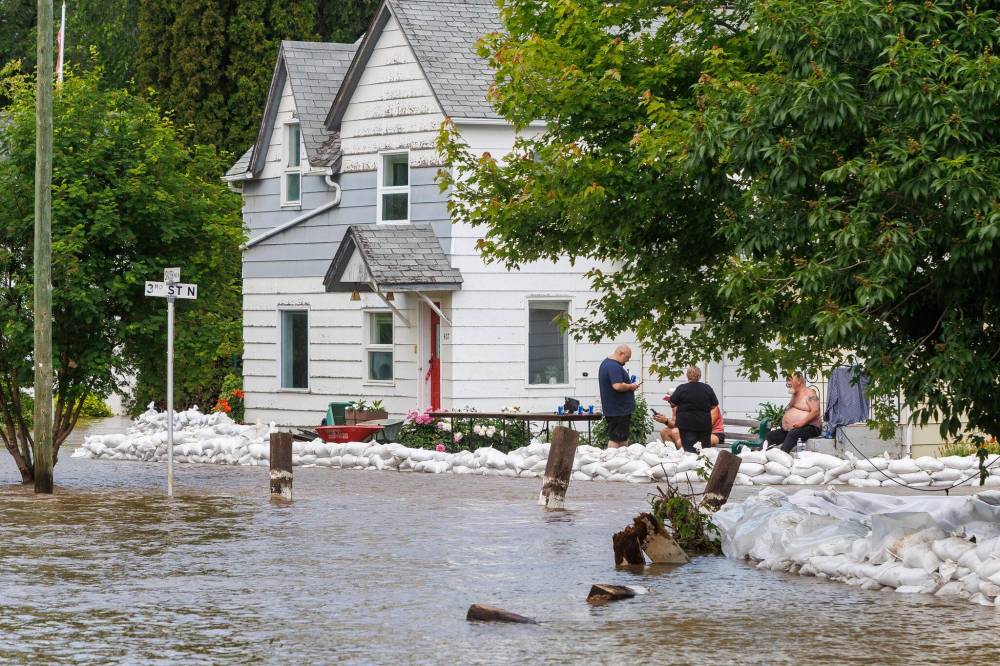
Mike Deal / Free Press files
People take a break from sandbagging to protect properties in a flooded area of Swan River on July 2.
A recent report from Statistics Canada shows home and mortgage insurance premiums have risen 45 per cent on average over the last six years. That is more than double overall inflation over that span.
Hands notes insurance costs have increased faster in Western Canada than elsewhere in Canada. It has simply experienced more catastrophic events in the last half-decade, including the 2024 Jasper wildfire.
If the insurance costs are stinging your budget, you likely haven’t seen anything yet.
As the impacts of climate change become more dire, insurers are likely to keep increasing premiums just to keep pace with escalating costs from a growing number of claims.
It’s not just extreme weather, says Rob de Pruis, national director of consumer and industry relations at Insurance Bureau of Canada (IBC). “Residential building construction costs have been soaring.”
He points to the aforementioned Statistics Canada report showing from 2019 to 2025 construction costs have increased almost 70 per cent, while home maintenance and repair costs are up close to 20 per cent.
Of course, the rise in the regularity of natural calamities partly drives those increases. The more wildfire and other extreme weather experienced, the greater the damage and ensuing costs to property. Massive disasters — like the Jasper fire that burned 30 per cent of structures in the Alberta town — lead to surges in demand for labour and materials, which accelerates inflation for both, he says.
Wildfires are the leading culprit, now an ever-present, ominous bummer of Canadians’ much-loved summer, driving prices higher.
And fires have been getting bigger and more severe over the past decade.
“They are burning more land,” de Pruis says, noting an 81 per cent increase in hectares burned in the last 10 years over the previous decade. “These events are becoming more frequent, too.”
An IBC report from this year points to how insured losses from disasters rarely exceeded $500 million annually in Canada two decades ago. But in 2025, annual costs exceeded $2.4 billion, and that’s actually the lowest sum in the last six years. The worst year on record was 2024, when total losses were about $8.6 billion.
It’s not just hot, dry summers sparking uncontrollable fires and, in turn, grinding down Canadians’ bank accounts.
It’s floods and hail as well.
In 2025, four of the five costliest disasters were not fire-related. The most expensive of which: ice storms in Ontario and Quebec, tallying $490 million. By comparison, the Manitoba and Saskatchewan fires cost $300 million, and a hail storm in Calgary incurred $190 million in damage for third spot.
Rounding out the top five were Prairie storms at $235 million, and the atmospheric river-driven storms causing floods and mudslides in British Columbia at $90 million.
While reducing greenhouse gas emissions is the principal way to decrease the deepening impacts of extreme weather, we now face an inescapable reality of a significantly hotter planet for the long term.
Society must adapt or face grim consequences of carrying on like it’s 2015.
One key adaptation is building new homes and retrofitting existing ones to be more resilient to severe weather, says Raidin Blue, senior analyst at the Pembina Institute in Toronto.
“A lot of our buildings were built decades ago, for a climate that, frankly, doesn’t exist anymore,” he says.
He authored a report from late last year citing how climate change is becoming an affordability issue, and rising home insurance is just the start.
The Pembina Institute report isn’t all gloom and doom. It also offers solutions for better construction that increase energy efficiency and make dwellings more resistant to flooding, fire and other nasty weather.
Government and insurers play a central role in increasing awareness of what should be done while offering incentives for builders and homeowners to implement these preventative, protective measures.
“The hope is governments and insurance providers develop incentives rewarding owners and builders for investing in climate adaptation for homes,” Blue says.
That is happening now, though on an ad hoc basis. The City of Calgary, for example, recently implemented a program to improve hail resilience, he notes.
Pembina Institute is working with the city to facilitate access “hail-resistant siding and roofing that’ll help homeowners reduce damage from severe storms.”
The alternative is increasingly steep costs. Blue cites how some Calgary homeowners are already experiencing negative outcomes with some insurers no longer willing to cover hail damage.
An even worse outcome already seen in more flood- and fire-prone areas is the “brown discount” homeowners experience when trying to sell their homes. Their dwellings can sell for substantially less than anticipated due to flood or fire risk because insurance coverage is too costly or their homes are uninsurable for those events, Blue says.
The burden should not fall on builders and homeowners alone. Governments must also build new and upgrade existing infrastructure to be more climate resilient, de Pruis says.

That inevitably comes with a cost for taxpayers. Yet he points to the Red River Floodway protecting Winnipeg as an example of thinking big in this respect can have long-lasting positive impacts.
Back when the mega project was proposed, it was criticized for being too costly and whether it would ever prove its worth, de Pruis adds.
“But the Red River Floodway has literally saved billions and billions of dollars in damage over the last 60 years.”
Joel Schlesinger is a Winnipeg-based freelance journalist
joelschles@gmail.com