

US stocks hit records as profits keep piling up for Palantir and others, while oil prices ease
Advertisement
Read this article for free:
or
Already have an account? Log in here »
To continue reading, please subscribe:

Digital Subscription
One year of digital access for only $205*
- Enjoy unlimited reading on winnipegfreepress.com
- Read the E-Edition, our digital replica newspaper
- Access News Break, our award-winning app
- Play interactive puzzles
*First annual payment billed as $205.00 + GST for one year. This annual subscription will automatically renew at $233.00 + GST every 52 weeks (10% off the regular annual price of $259.35). Offer available to new and qualified returning subscribers only. Cancel any time.
To continue reading, please subscribe:
Add Free Press access to your Brandon Sun subscription for only an additional
$1 for the first 4 weeks*
- Enjoy unlimited reading on winnipegfreepress.com
- Read the E-Edition, our digital replica newspaper
- Access News Break, our award-winning app
- Play interactive puzzles
*Your next Brandon Sun subscription payment will increase by $1.00 and you will be charged $17.95 plus GST for four weeks. After four weeks, your payment will increase to $24.95 plus GST every four weeks.
Read unlimited articles for free today:
or
Already have an account? Log in here »
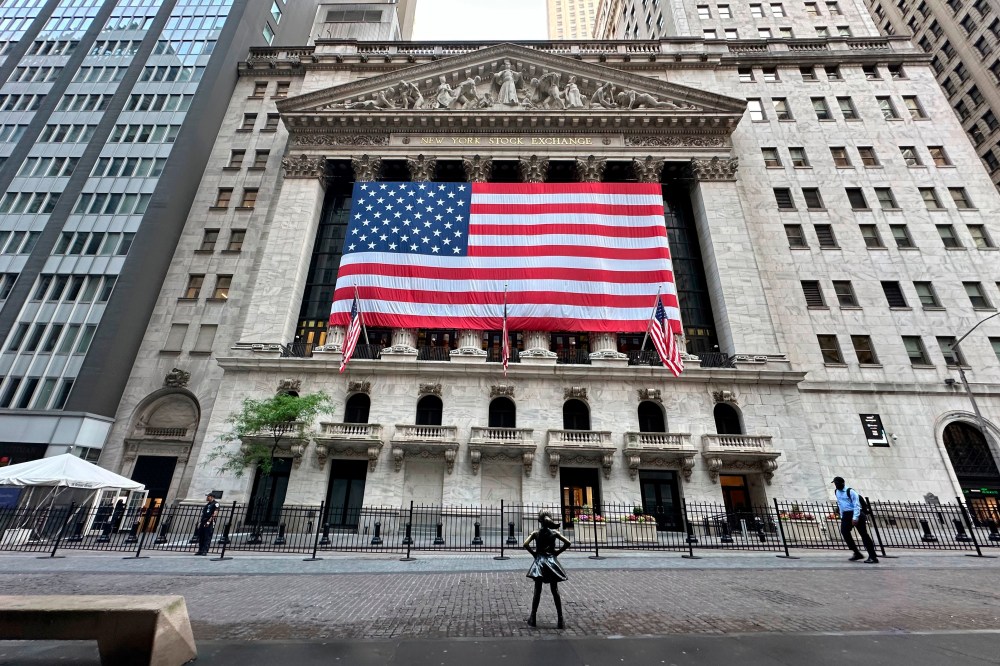
NEW YORK (AP) — The U.S. stock market rallied to records on Tuesday as profits kept piling up for companies and as oil prices eased.
The S&P 500 shot up 1.8%, and the main measure of Wall Street’s health topped its prior all-time high set a couple months ago. The Dow Jones Industrial Average added 907 points, or 1.7%, to its own record set the day before, while the Nasdaq composite jumped 2.6%.
Despite worries about high inflation, the war in Iran, frustration with the economy and a possible bubble in stock prices because of the boom in artificial-intelligence technology, Wall Street hit its latest apex and rewarded investors who remained patient because profits keep soaring for companies. Stock prices tend to follow the path of corporate earnings over the long term.
Palantir Technologies helped lead the way and surged 29.5% after CEO Alex Karp said its overall revenue leaped 93% in what he called an “otherworldly” quarter. Besides reporting a stronger profit for the spring than analysts expected, the AI company also raised its revenue forecast for the full year of 2026.
Caterpillar climbed 5.6% after the heavy-equipment maker likewise reported stronger profit and revenue than analysts expected. It was the first time Caterpillar made more than $20 billion in sales and revenue in a quarter, and CEO Joe Creed said it’s seeing strong order rates and a growing backlog across its main businesses.
Caterpillar is also benefiting from the AI boom through increased orders for turbines used to power data centers, among other things.
They’re the latest companies to deliver even better profits for the latest quarter than investors expected, following strong results from Amazon, Microsoft and others. Coming into this week, companies in the S&P 500 index were on track to deliver growth of nearly 50% in earnings per share for the spring from a year earlier, according to FactSet.
That would be the biggest such jump since 2021, when the economy was roaring back to life after cratering in the COVID-19 pandemic. With corporate profits up so much, when stock prices are still roughly where they were two months ago, stocks don’t look as expensive as they did before, according to Phil Segner, a co-portfolio manager at the Leuthold Group.
Also helping stocks on Tuesday was another drop for oil prices.
Brent crude, the international standard, sank 5.3% to $79.36 per barrel as hope once again took over from fear in the oil market. It had swung sharply between $72 and $102 through July on uncertainty about when the war with Iran would allow oil tankers to freely exit the Persian Gulf again to deliver crude around the world.
It’s jerked up and down many times as uncertainty built, receded and then built again, not only week to week but also hour to hour. Analysts warn more swings could be ahead, but the latest drop in oil prices nevertheless helped ease Wall Street’s worries about inflation. That pulled down yields in the bond market, which in turn relaxed pressure on the overall economy and on prices for stocks and other investments.
The yield on the 10-year Treasury fell to 4.62% from 4.70% Monday and from 4.75% at the end of last week. That’s a notable move for the bond market, though it remains well above its 3.97% level from before the war with Iran.
Higher yields make it more expensive for all kinds of Americans to borrow money, from homebuyers looking for a mortgage to big companies looking to build AI data centers.
Reports on the U.S. economy, meanwhile, showed it remains resilient even though inflation remains worse than anyone would like. One said U.S. employers were advertising nearly 7.4 million job openings at the end of June, a slight slowdown from May’s level but close to economists’ expectations.
In stock markets abroad, indexes rose modestly across much of Europe and Asia.
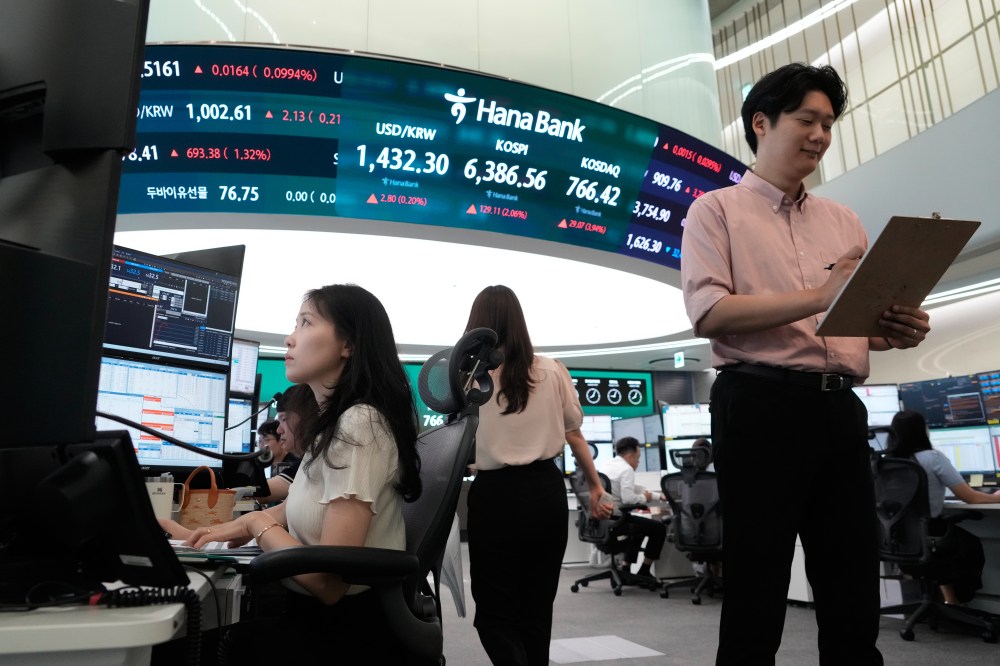
South Korea’s Kospi had a more significant move and climbed 1.6%. Seoul has seen some of the world’s sharpest swings because two companies swept up in AI mania dominate its market, Samsung Electronics and SK Hynix. The Kospi had dropped 5.1% and soared 17.9% in the prior two days.

Stocks of computer chip companies also strengthened on Wall Street, where gains of 2.6% for Nvidia, 6.6% for Broadcom and 7.6% for Micron Technology were some of the strongest forces lifting the S&P 500.
They more than offset a drop for Chipotle Mexican Group, which fell 9.7% on fears that future profits could be hurt after the chain removed jalapeños from some of its restaurants following a salmonella outbreak. Chipotle said that Minnesota health officials have no ongoing concerns with it.
All told, the S&P 500 rallied 136.02 points to 7,736.52. The Dow Jones Industrial Average jumped 907.47 to 54,085.88, and the Nasdaq composite climbed 671.10 to 26,584.99.
___
AP Business Writers Yuri Kageyama and Matt Ott contributed to this report.