

Cargojet pilots notch major wage hike, as company stresses productivity gains
Advertisement
Read this article for free:
or
Already have an account? Log in here »
To continue reading, please subscribe:

Digital Subscription
One year of digital access for only $205*
- Enjoy unlimited reading on winnipegfreepress.com
- Read the E-Edition, our digital replica newspaper
- Access News Break, our award-winning app
- Play interactive puzzles
*First annual payment billed as $205.00 + GST for one year. This annual subscription will automatically renew at $233.00 + GST every 52 weeks (10% off the regular annual price of $259.35). Offer available to new and qualified returning subscribers only. Cancel any time.
To continue reading, please subscribe:
Add Free Press access to your Brandon Sun subscription for only an additional
$1 for the first 4 weeks*
- Enjoy unlimited reading on winnipegfreepress.com
- Read the E-Edition, our digital replica newspaper
- Access News Break, our award-winning app
- Play interactive puzzles
*Your next Brandon Sun subscription payment will increase by $1.00 and you will be charged $17.95 plus GST for four weeks. After four weeks, your payment will increase to $24.95 plus GST every four weeks.
Read unlimited articles for free today:
or
Already have an account? Log in here »
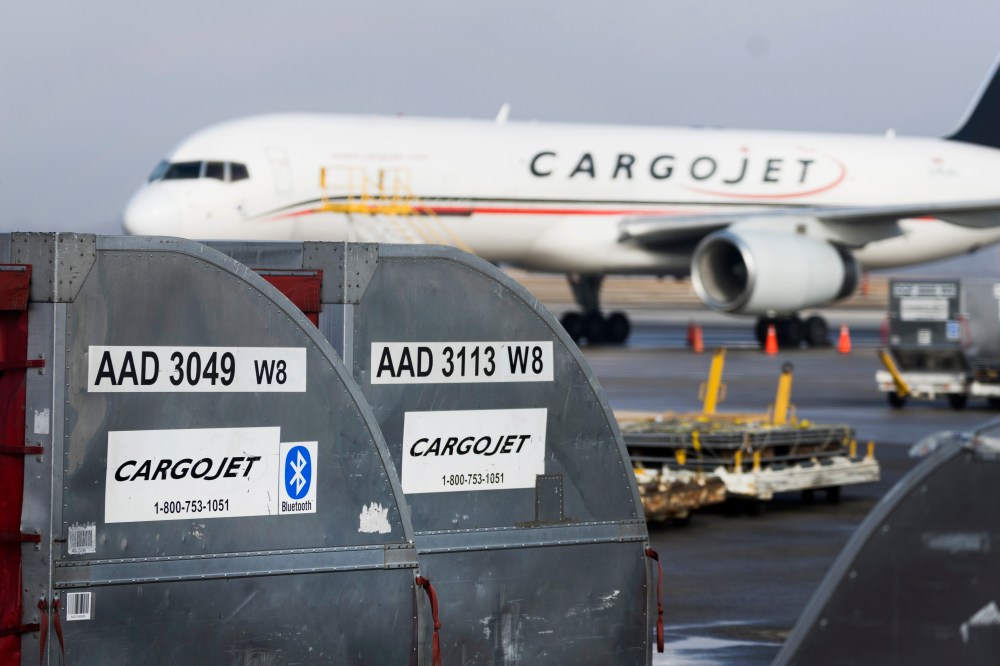
Pilots at Cargojet Inc. will see their wages rise by more than half under a new five-year contract, which the air freight company says aims to boost productivity as the firm reaches for new business in Europe, Asia and Africa.
On a conference call with analysts Tuesday, chief financial officer Aaron McKay said the collective agreement handed down by an arbitrator late last month brings its roughly 470 aviators up to industry standards.
The deal amounts to a percentage increase over current wages in the mid-40s, “equalling a 53 per cent compounded wage increase,” according to the July 27 decision by arbitrator William Kaplan. It includes a 26 per cent wage increase in the first year and five per cent annually over the next four years.
The agreement — retroactive to July 1 and expiring in 2031 — marks a major expense, as wages already comprise nearly two-thirds of total costs, analysts say. It raises flight crew costs to as much as $32 million per quarter, up from about $27 million currently, McKay confirmed. But it also includes productivity provisions that move aviators to a baseline of 16 working days per month, up from 15 before, as well as more training days.
“It also gives us opportunities to be more price-competitive with the American carriers that we constantly compete with,” said founder and chairman Ajay Virmani.
The additional day per month for each pilot amounts to thousands more crew days per year, he noted. “That productivity gives us a lot more pricing flexibility.”
As with much of its fuel costs, the cargo carrier could pass along the bigger salary expense to clients.
“Cargojet has the opportunity to push the higher wages to customers as contracts roll,” said RBC Dominion Securities analyst Walter Spracklin in a note to investors.
Cargojet’s business hinges on air delivery of e-commerce goods via its fleet of 41 planes.
The company deploys them on its domestic network, on ad hoc charter flights and on more regular charter routes for clients such as DHL, which leases the aircraft, crews, maintenance and insurance to fly freight around the globe.
Those planes have seen a sustained uptick in activity after an MD-11 wide-body freighter crashed in Kentucky in early November, prompting authorities to ground the aging aircraft. Since then, some Cargojet partners have relied more heavily on the 25-year-old company for their shipping needs, with that stopgap business secured through at least the end of the year, said CEO Pauline Dhillon.
The higher demand helped boost revenue from charter hauls by 37 per cent year-over-year to $55 million in the company’s latest quarter, partly offset by fewer charter flights between Canada and China, according to Desjardins analyst Benoit Poirier.
Revenues from domestic trips jumped eight per cent year-over-year to $111 million in the second quarter, largely due to higher fuel prices passed on to clients as well as price hikes linked to inflation, Poirier said.
International revenue from aircraft leasing fell after Cargojet redeployed planes from long-haul routes serving Asia and Europe to South American routes.
Dhillon said the company is hunting for fresh contracts abroad.
“We continue to look at opportunities throughout Europe and … East Asia as well as Africa and the Middle East,” she said.
As tariffs hamper Canadian trade with the U.S., Cargojet has looked farther afield, taking on a new partner for scheduled charter flights operating five days per week with destinations in the Caribbean and Central and South America.
In October, the company established scheduled air cargo service between Canada and Belgium’s Liège Airport, a major European freight hub, as the federal government looks to strengthen transatlantic trade links. A jump in demand for Canadian seafood helped boost Europe-bound trips, Dhillon said earlier this year.

Last quarter, the Mississauga, Ont.-based company opened a new route between Liège and Tel Aviv, deploying planes that had been sitting idle on weekends.
“We see this as an important driver of improving ROIC (return on invested capital) and revenue growth looking ahead and view positively commentary from management that the model is replicable,” Spracklin said.
On Monday evening, the company reported that net earnings swung to a $7-million profit in its latest quarter compared with a $3.2-million loss a year earlier, while second-quarter revenue rose 16 per cent to $275.8 million.
This report by The Canadian Press was first published Aug. 11, 2026.
Companies in this story: (TSX:CJT)
Advertisement Advertise With Us
Advertisement Advertise With Us