

Manitoba-made technology earns faith of investors across Canada
TetraGen Robotics raises $1.8M in seed funding

Advertisement
Read this article for free:
or
Already have an account? Log in here »
To continue reading, please subscribe:

Digital Subscription
One year of digital access for only $205*
- Enjoy unlimited reading on winnipegfreepress.com
- Read the E-Edition, our digital replica newspaper
- Access News Break, our award-winning app
- Play interactive puzzles
*First annual payment billed as $205.00 + GST for one year. This annual subscription will automatically renew at $233.00 + GST every 52 weeks (10% off the regular annual price of $259.35). Offer available to new and qualified returning subscribers only. Cancel any time.
To continue reading, please subscribe:
Add Free Press access to your Brandon Sun subscription for only an additional
$1 for the first 4 weeks*
- Enjoy unlimited reading on winnipegfreepress.com
- Read the E-Edition, our digital replica newspaper
- Access News Break, our award-winning app
- Play interactive puzzles
*Your next Brandon Sun subscription payment will increase by $1.00 and you will be charged $17.95 plus GST for four weeks. After four weeks, your payment will increase to $24.95 plus GST every four weeks.
Read unlimited articles for free today:
or
Already have an account? Log in here »
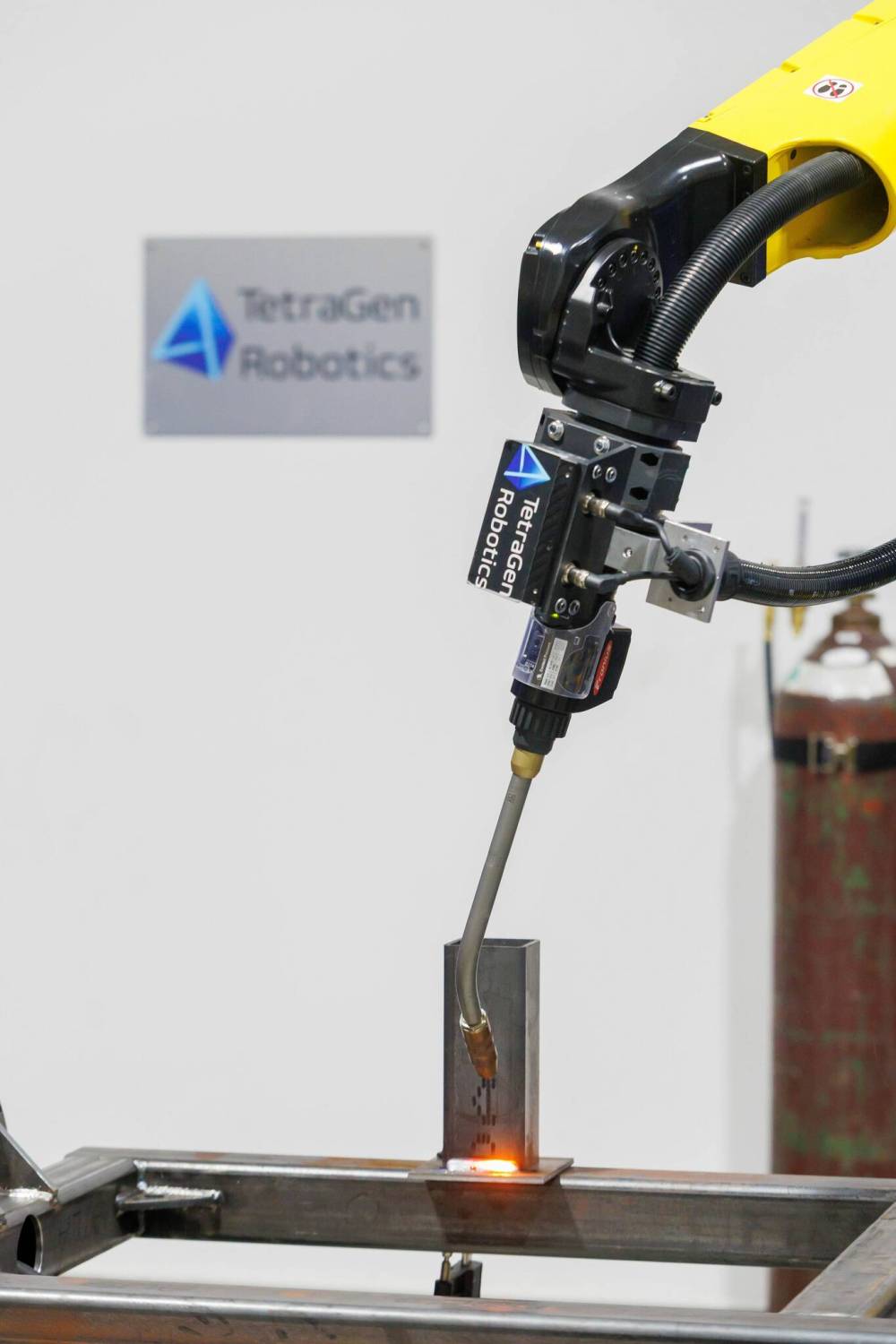
Blue light flashed as a robotic arm welded the metal in front of it.
Unlike other robots of its kind, this one uses artificial intelligence. It’s supposed to see and adjust its movements if a part it’s working on doesn’t match the standard piece.
It’s Manitoba-made technology that investors across Canada are betting on. TetraGen Robotics, the technology’s creator, announced it had raised $1.8 million in an oversubscribed seed funding round.
MIKE DEAL / FREE PRESS
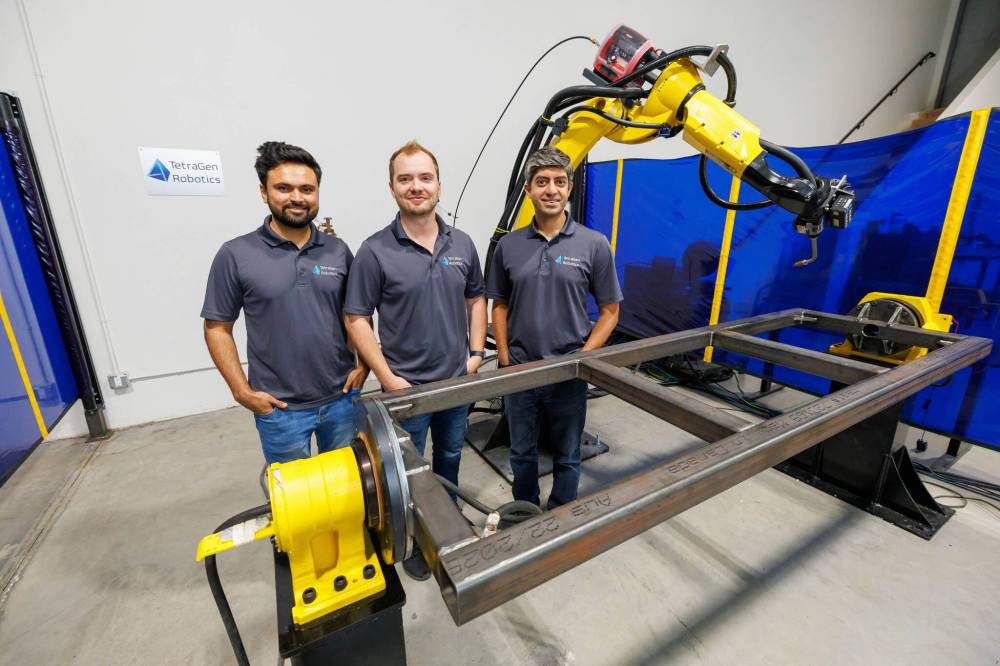
TetraGen Robotics co-founders (from left) Bhavin Dharia, lead software developer, COO Michael Newman and CEO Matt Khoshdarregi showcase their industrial robot arm.
It announced the funding Monday afternoon. Jim Richardson, from the family behind Richardson International, is among the investors listed online.
“(This is) a field that you can kind of expand (in) exponentially,” said Matt Khoshdarregi, TetraGen Robotics’ chief executive. “There are not too many options, what we provide right now.”
He stood in the company’s Navin headquarters, metres away from the robotic arm demonstrating welding.
Khoshdarregi began TetraGen Robotics in 2022. He’d been a University of Manitoba mechanical engineering professor who specialized in robotics.
He noticed manufacturing companies facing the same problems, he said. First, staff needed to program robots for a multitude of small tasks, which was time consuming. And if a part on the line deviated from the norm, the robots couldn’t adapt their own methods.
Khoshdarregi and his co-founders began working on artificial intelligence models.
The group, which includes Michael Newman and Bhavin Dharia, started by self-funding. They inked deals with local manufacturers and would probe companies about their needs.
TetraGen Robotics sold its first robot cell around two and a half years ago. Since then, the company has shipped its wares to a handful of manufacturers around Manitoba, including agricultural equipment, heavy vehicle and mining equipment makers, Khoshdarregi said.
The physical robots are made of pieces from Asia, North America and Europe. TetraGen’s team focuses on the artificial intelligence software and the robots’ vision.
Each robot has a 3D camera. It compares images it sees to a preprogrammed model of the parts, and it analyzes the different features.
MIKE DEAL / FREE PRESS
The TetraGen Robotics industrial robot arm finishes a demonstration weld.
“What it’s done is bring AI into the physical mode,” Khoshdarregi said.
Spence Manufacturing signed up for a robot a couple years ago. It wanted something to lessen inconsistencies in its cutting tool production, said Jeff Spence, the company’s owner.
“We were constricted to grow any further without being able to get this process done more rapidly and more accurately,” Spence said. “It really helped us to grow and get to that next level.”
Staff who’d done the work TetraGen’s robot has taken have moved into less monotonous and more skills-based jobs, Spence said.
“It’s a win-win all around,” he added. “And if we don’t do it, someone else will. So, in able to be competitive in the global market, you have to make these decisions.”
The robots are built for repetitive, high-volume tasks. Often, companies will hire more people because they have increased production, Khoshdarregi said.
He’s been hiring, too — three people in the last six months, with plans to add more. TetraGen Robotics is doubling its footprint, to a 6,000-sq.-ft. headquarters in the same area.
The recent funding round helps with the expansion, Khoshdarregi said. He’s aiming to grow sales across Canada and into the United States, with a hope of tens of the robot cells in production over the next two years.
He declined to say how many robots are already in production. Each one costs a few hundred thousand dollars, depending on the request.
Manufacturing firms’ artificial intelligence use is growing, noted Alan Arcand, chief economist of Canadian Manufacturers & Exporters.
MIKE DEAL / FREE PRESS
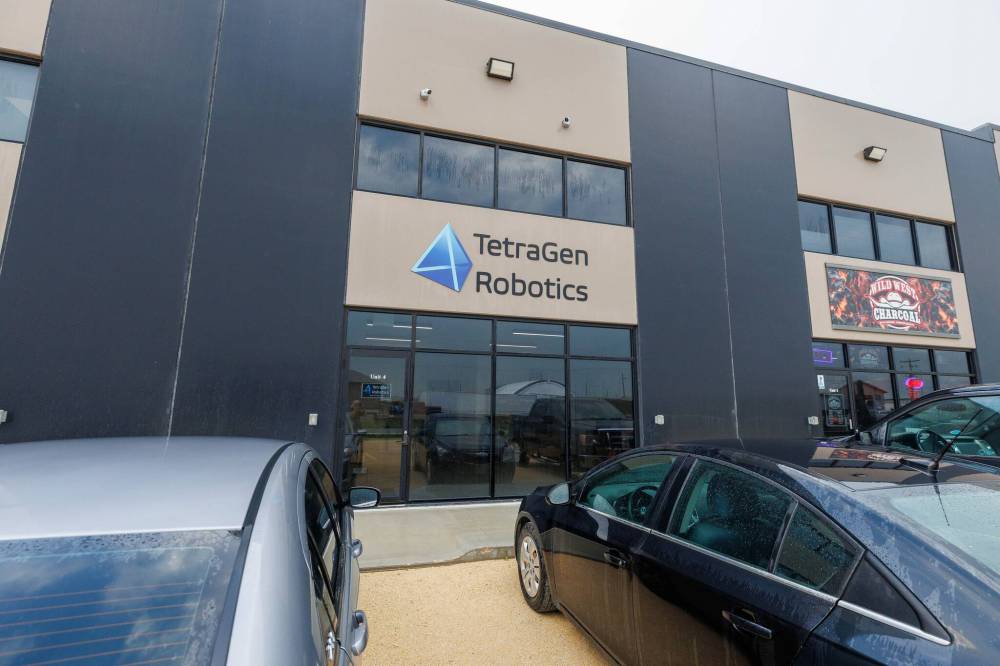
TetraGen Robotics sold its first robot cell around two and a half years ago.
Around 13 per cent of Canadian manufacturers reported using AI in the past year, a May 2025 Statistics Canada report shows. That’s up from 3.7 per cent the year prior (spanning 2023-24).

The figures likely include use in offices and manufacturing facilities.
“It’s just the early stages, so I would anticipate that adoption … will continue to grow,” Arcand said.
TetraGen Robotics announced the backing of Calgary-based StepChange Capital and British Columbia-based Emend Vision Fund, which is partnered with the Manitoba First Fund, an entity the provincial government created to draw investment.
TetraGen’s funding round lasted eight months and ended in spring, Khoshdarregi said.
gabrielle.piche@winnipegfreepress.com
Gabrielle Piché reports on business for the Free Press. She interned at the Free Press and worked for its sister outlet, Canstar Community News, before entering the business beat in 2021. Read more about Gabrielle.
Every piece of reporting Gabrielle produces is reviewed by an editing team before it is posted online or published in print — part of the Free Press‘s tradition, since 1872, of producing reliable independent journalism. Read more about Free Press’s history and mandate, and learn how our newsroom operates.
Our newsroom depends on a growing audience of readers to power our journalism. If you are not a paid reader, please consider becoming a subscriber.
Our newsroom depends on its audience of readers to power our journalism. Thank you for your support.
Gabrielle Piché reports on business for the Free Press. She interned at the Free Press and worked for its sister outlet, Canstar Community News, before entering the business beat in 2021. Read more about Gabrielle.
Every piece of reporting Gabrielle produces is reviewed by an editing team before it is posted online or published in print — part of the Free Press‘s tradition, since 1872, of producing reliable independent journalism. Read more about Free Press’s history and mandate, and learn how our newsroom operates.
Our newsroom depends on a growing audience of readers to power our journalism. If you are not a paid reader, please consider becoming a subscriber.
Our newsroom depends on its audience of readers to power our journalism. Thank you for your support.
Advertisement Advertise With Us
Advertisement Advertise With Us