

US stocks edge further from their records as oil prices keep swinging
Advertisement
Read this article for free:
or
Already have an account? Log in here »
To continue reading, please subscribe:

Digital Subscription
One year of digital access for only $205*
- Enjoy unlimited reading on winnipegfreepress.com
- Read the E-Edition, our digital replica newspaper
- Access News Break, our award-winning app
- Play interactive puzzles
*First annual payment billed as $205.00 + GST for one year. This annual subscription will automatically renew at $233.00 + GST every 52 weeks (10% off the regular annual price of $259.35). Offer available to new and qualified returning subscribers only. Cancel any time.
To continue reading, please subscribe:
Add Free Press access to your Brandon Sun subscription for only an additional
$1 for the first 4 weeks*
- Enjoy unlimited reading on winnipegfreepress.com
- Read the E-Edition, our digital replica newspaper
- Access News Break, our award-winning app
- Play interactive puzzles
*Your next Brandon Sun subscription payment will increase by $1.00 and you will be charged $17.95 plus GST for four weeks. After four weeks, your payment will increase to $24.95 plus GST every four weeks.
Read unlimited articles for free today:
or
Already have an account? Log in here »
NEW YORK (AP) — U.S. stocks slipped a bit further from their records Tuesday, while oil prices kept swinging on uncertainty about when the war with Iran will allow crude to flow freely again.
The S&P 500 fell 0.3% for a second modest drop since setting its all-time high on Friday. The Dow Jones Industrial Average dipped 184 points, or 0.3%, and the Nasdaq composite sank 0.6%.
The action was stronger in the oil market, where the price for a barrel of Brent crude briefly jumped above $90 in the morning before falling back below $87. It eventually settled at $88.91, up 1.4% from Monday.
Such erratic moves have become typical since the United States and Israel attacked Iran in late February, which led to the closure of the Strait of Hormuz and kept much of the world’s oil pent up in the Middle East. Last month alone, Brent’s price veered between $72 and $102 per barrel.
Higher oil prices make inflation worse, and they’ve sent the average cost for a gallon of regular gasoline to $4.01, according to AAA. That’s up from less than $3.14 a year ago, though it’s down from last week’s nearly $4.09.
That has Wall Street’s attention focused on Wednesday, when the U.S. government will release the latest monthly reading on inflation. Economists expect it to show inflation remains high but that it decelerated to 3.4% in July from 3.5% in June.
That could help the Federal Reserve, whose members are notably split on whether they should be raising the country’s interest rates to keep a lid on inflation. While higher rates could help slow the increases of prices on store shelves, they would also slow the overall U.S. economy by making it more expensive for U.S. households and businesses to borrow money. They would also undercut prices for stocks and other investments.
Traders are betting on a coin flip’s chance that the Fed will raise its main interest rate at its next meeting in September, according to data from CME Group. If it does, that would be the first increase in more than three years. It also could anger President Donald Trump, who has been lobbying for lower interest rates.
Treasury yields have jumped since the war with Iran because of higher oil prices and worries about inflation, sending long-term mortgage rates to their highest levels in a year.
The 10-year Treasury yield eased back Tuesday, falling to 4.69% from 4.72% late Monday. But it remains well above its 3.97% level from before the war with Iran.
On Wall Street, On Holding dropped 20.3% even though the Swiss sneaker company reported a better profit for the latest quarter than analysts expected. It gave a forecast for upcoming revenue that fell short of analysts’ expectations, while saying it does not want to slash prices to drum up more sales.
Companies broadly have been blowing past analysts’ forecasts, which Wall Street loves because stock prices tend to follow the path of corporate profits over the long term. Earnings per share for S&P 500 companies are on track to be 50% higher than a year earlier, according to FactSet, and that’s a big reason U.S. stocks have been setting records recently despite worries about expensive oil, high inflation and other challenges.

Aramark, the food company and facilities manager, rallied 8.5% after reporting stronger profit and revenue for the latest quarter than analysts expected. Cardinal Health added 1.3% after topping analysts’ profit expectations for the spring.
All told, the S&P 500 fell 24.91 points to 7,728.20. The Dow Jones Industrial dropped 184.13 to 53,791.85, and the Nasdaq composite sank 159.91 to 26,445.45.
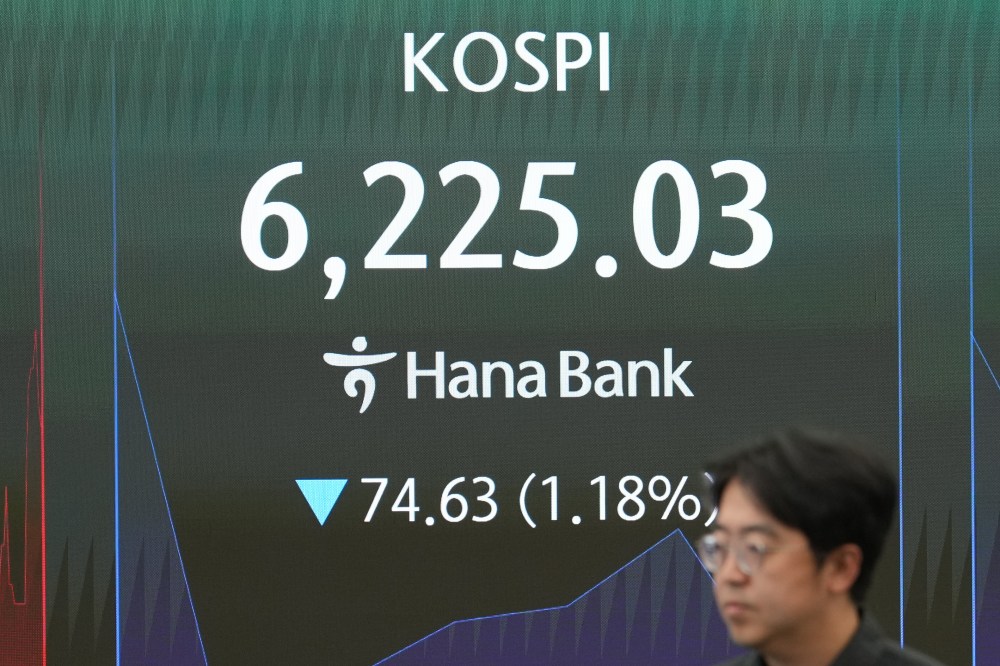
In stock markets abroad, indexes were mixed in Europe and Asia. Hong Kong’s Hang Seng fell 1.1% for one of the world’s bigger moves.
___
AP Business Writers Matt Ott and Elaine Kurtenbach contributed to this report.