

A 3-story Hoosier cabinet in Indiana celebrates an American kitchen icon
Advertisement
Read this article for free:
or
Already have an account? Log in here »
To continue reading, please subscribe:

Digital Subscription
One year of digital access for only $205*
- Enjoy unlimited reading on winnipegfreepress.com
- Read the E-Edition, our digital replica newspaper
- Access News Break, our award-winning app
- Play interactive puzzles
*First annual payment billed as $205.00 + GST for one year. This annual subscription will automatically renew at $233.00 + GST every 52 weeks (10% off the regular annual price of $259.35). Offer available to new and qualified returning subscribers only. Cancel any time.
To continue reading, please subscribe:
Add Free Press access to your Brandon Sun subscription for only an additional
$1 for the first 4 weeks*
- Enjoy unlimited reading on winnipegfreepress.com
- Read the E-Edition, our digital replica newspaper
- Access News Break, our award-winning app
- Play interactive puzzles
*Your next Brandon Sun subscription payment will increase by $1.00 and you will be charged $17.95 plus GST for four weeks. After four weeks, your payment will increase to $24.95 plus GST every four weeks.
Read unlimited articles for free today:
or
Already have an account? Log in here »
NAPPANEE, Ind. (AP) — Hoosier cabinets — the original all-in-one kitchen — were once a mainstay in early 20th-century American homes. Though they have long since fallen out of fashion, a giant, climbable replica has been unveiled outdoors in a northern Indiana town to celebrate the cabinet’s place in kitchen history.
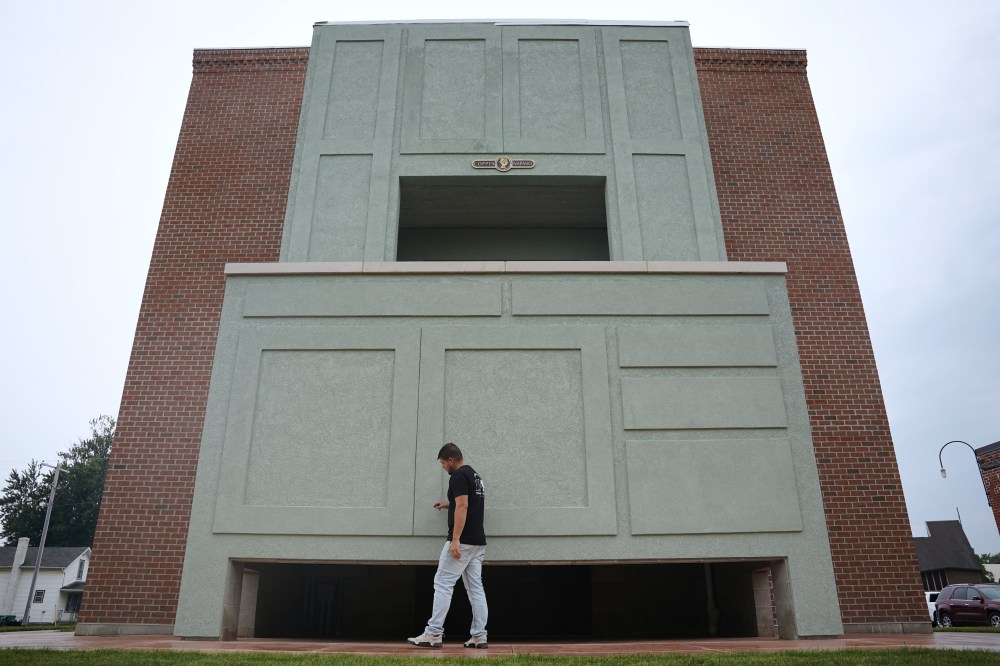
The 30-foot (9-meter) model of a Dutch Kitchenette opened to the public last month as part of the 150th anniversary celebration of Coppes Napanee, one of two companies still in existence that manufactured the popular Hoosier cabinets more than a century ago. The cabinet name was coined after its largest producer, the Hoosier Manufacturing Co.
Dubbed the world’s largest Hoosier cabinet, the replica built against a brick background is equipped with stairs leading to a loft that visitors to the town of Nappanee can look out from. It overlooks Coppes Commons, the site of the original Coppes Napanee factory that has been converted to an indoor marketplace, artisan hub and museum. The company still produces custom cabinets next door.
Wesley Mast, owner and president of Coppes Napanee, said he typically hears two types of responses when visitors first see the giant cabinet.
“There’s the one extreme where people are like, ‘Why? Why such a big cabinet?’” Mast said. “And my response is always like, ‘Why not?’
“The other response we get is like, ‘That’s so cool. Where did you get this idea? I love it.’”
Mast said the cabinet “brings us another level of attention and branding and makes this place more of a destination than just a pass-through.”
The Hoosier cabinet is a freestanding kitchen workstation and storage area that centralized and sped up food preparation. The cabinets were popular from the 1890s through the 1930s but waned after World War II as built-in, wall-to-wall cabinetry became the norm in new home construction.
A century ago, “this was the kitchen,” Mast said. “This was kind of the first piece of furniture that went into the house as a kitchen and was considered all-in-one, the kitchen itself in just one piece.”
There were 5,000 dealers of Hoosier cabinets across the country, said Mary Figueroa, curator of History at the Indiana State Museum and Historic Sites, which has four Hoosier cabinets in its collection.
Prior to the Hoosier cabinet, a kitchen area would have some shelves, a separate work table and a corner cupboard. “But this was a piece of furniture that kind of consolidated all of that, allowed women to save their steps and have everything that they could possibly need to make a meal right at their fingertips,” Figueroa said.
The Hoosier cabinet had space for storing items such as flour, sugar, spices, loaves of bread and other pantry supplies. They were nicknamed “kitchen pianos” because everything that was needed was within close range. They had built-in flour sifters and came with small cookbooks with recipes involving meats, soups, breads or desserts, among other things. Advertising for the cabinets even made the promise to “strengthen your marriage” and “make you more beautiful” because of the time and steps that it saved for women, Figueroa said.

Nappanee is located in Elkhart County, a region known as a top U.S. hub for recreational vehicle manufacturing, wood products production and home to the third-largest Amish settlement in the nation. It is about 150 miles (241 kilometers) north of Indianapolis.
And now, add Nappanee as a potential tourist attraction for the colossal cabinet.
“It’s bringing awareness,” Figueroa said. “I mean, you can’t miss it.”
___
Raby reported from Charleston, West Virginia.