

A rarefied opportunity as demand grows
Could renewed interest in strategically critical rare earth elements finally make this small but important sub-sector profitable?
Advertisement
Read this article for free:
or
Already have an account? Log in here »
To continue reading, please subscribe:

Digital Subscription
One year of digital access for only $205*
- Enjoy unlimited reading on winnipegfreepress.com
- Read the E-Edition, our digital replica newspaper
- Access News Break, our award-winning app
- Play interactive puzzles
*First annual payment billed as $205.00 + GST for one year. This annual subscription will automatically renew at $233.00 + GST every 52 weeks (10% off the regular annual price of $259.35). Offer available to new and qualified returning subscribers only. Cancel any time.
To continue reading, please subscribe:
Add Free Press access to your Brandon Sun subscription for only an additional
$1 for the first 4 weeks*
- Enjoy unlimited reading on winnipegfreepress.com
- Read the E-Edition, our digital replica newspaper
- Access News Break, our award-winning app
- Play interactive puzzles
*Your next Brandon Sun subscription payment will increase by $1.00 and you will be charged $17.95 plus GST for four weeks. After four weeks, your payment will increase to $24.95 plus GST every four weeks.
Read unlimited articles for free today:
or
Already have an account? Log in here »
Rare earth elements are among the most critical of mined resources for modern economies.
They’re essential in manufacturing specialized magnets used in a host of technologies from wind turbines and electric vehicles to hard drives, smartphones, television screens, and fibre optics. Most notably, however, rare earth minerals are increasingly vital to the defence industry.
These 17 elements — closely related chemically and usually found all together in mineral deposits — have indeed been growing in geopolitical importance as the United States, Canada and other Western nations recognize their dependence on production from China.
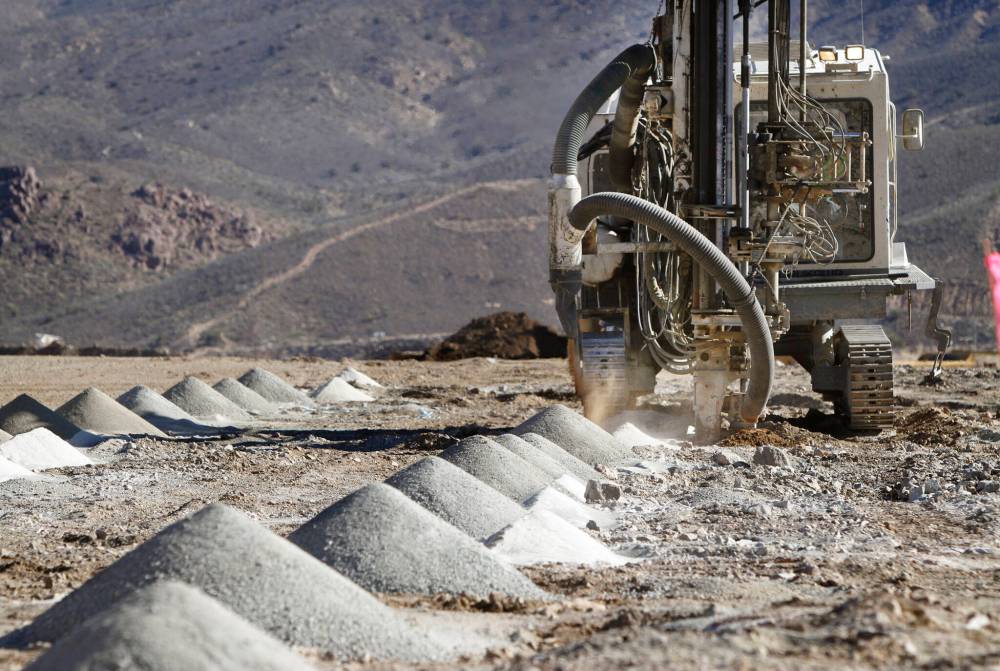
Don Bartletti / Los Angeles Times FILES
Blast holes are drilled into a mine for rare earth elements in Mountain Pass, Calif. Rare earth elements are used in the production of everthing from wind turbines and electric vehicles, to weapons of modern warfare.
It is the world’s largest producer and processor of rare earths, including the most in-demand elements neodymium and praseodymium used to manufacture very light and powerful magnets for an array of technologies, including the most advanced weapons of modern warfare.
“Defence needs are why there’s so much focus on rare earths today,” says Ben McGregor, analyst at Canadian Mining Report.
He notes the term ‘rare earths’ is somewhat misleading. These elements may not be abundant, but rare earths are not in short supply. Albeit demand is growing quickly. A recent report from exchange-traded fund (ETF) company Global X shows how global supply of these elements shrank from 500 years of current demand use in 2020 to 218 by 2025.
Still, supply is almost double that of lithium, the next most abundant hard commodity by years of supply relative to demand.
Simply, China can easily produce the rare earths the world needs. Yet geopolitics are reshaping the market as Western nations become more concerned about dependence on China, especially for defence.
NATO’s F-35 stealth fighter jets, for example, require seven rare earth elements in their manufacturing.
The reason China has largely cornered this market is not a result of it being naturally endowed with rare earth deposits. Canada, the United States, Australia and other nations have discovered deposits too. Australia already has a producer, Lynas Rare Earths, but that is the only large operation outside of China.
Growing exploration and development activity is underway in the U.S. and Canada.
What’s more, Canada’s TSX Venture Exchange is a hotbed for publicly traded junior mining and exploration rare earth companies.
To date, investing in these companies has proven high risk with generally little reward for investors, McGregor says.
“Lynas is the biggest mine in the world not in China,” and even its share price has been volatile, he notes.
Its stock has peaked at various points in the last five years, including an all-time high in April before dropping 40 per cent. “Smaller companies have typically fared worse,” he adds.
Canadian explorer Defense Metals Corp. (DEFN.V) — which owns the Wicheeda rare earth deposit near Prince George, B.C. — saw its share price peak last November before declining in value more than 50 per cent.
This type of volatility can crush retail investors, drawn to invest when rare earth stocks soar, largely due to speculative sentiment, only to sell at a deep loss when prices fall, says Brooke Thackray, research analyst with Global X Canada.
Rare earths “aren’t like copper and gold,” he says about two of the world’s most widely mined and profitable metals which are widely produced and have steadily growing demand.
Yet the investment thesis for rare earths may have more substance as governments recognize not only the need for domestic production but also that support to grow the industry.
“Government knows it must step up because it is a national security issue,” he adds.
To that end, the Canadian government announced last year investments in their development. Among projects receiving support is a first-of-its-kind rare earth processing plant built and operated by Ucore Rare Metals Inc. in Kingston, Ont.
The U.S. is also providing financial incentive to grow its rare earths sector, including its $12-billion initiative Project Vault to secure critical minerals supply chains.
Without these supports, domestic rare earth production is unlikely to happen, says Alex Knox, a principal at AWK Geological Consulting Ltd. in Calgary.
“One reason for that is financing; large multi-national mining companies are uninterested in investing in rare earths.”
While potentially very profitable, rare earths involve much smaller deposits relative to other critical minerals, generating substantially less revenue, says Knox, who sits on Apex Critical Metals (APXC) technical advisory board — a company exploring and developing rare earth deposits in British Columbia among other jurisdictions.
Given their relatively small scale, the ore grade (concentration of elements in a rare earth deposit) determines economic viability.
Even then, a multinational miner will likely pass because “the amount of rare earths produced from a good deposit is a small fraction of the money to be made from a much larger copper deposit,” Knox says.
In turn, companies discovering deposits must transform into miners. That requires significant capital, which they lack, and lenders are leery to back projects, Knox says. What’s more, rare earth mining is environmentally challenging, involving radioactive waste, and processing is equally “dirty,” says Thackray.
China became a rare earth powerhouse out of necessity. It is a leading manufacturer of technologies using these elements, and so the state helped develop the industry.
“The state supports exploration, mining and processing, providing the enormous capital requirements,” Knox says.
Given the geopolitical significance and growing demand, domestic rare earth production may prove profitable for long-term investors able to stomach the high risks.
Knox recommends investors look for junior miners that have found large, high-grade deposits in neodymium and praseodymium, or even scarcer heavier rare earth elements like dysprosium that are increasingly in demand.

Alternatively ETFs, like VanEck Rare Earth and Strategic Metals ETF (REMX) and Global X’s Rare Earth and Critical Minerals ETF (EART) offer risk-adjusted, diversified exposure.
Yet investor beware; it may take many years for the strategy to pay off if at all, Thackray says.
“We know that developed nations have to do this, but it’s going to take a long time.”
Joel Schlesinger is a Winnipeg-based freelance journalist
joelschles@gmail.com