Don’t buy U.S. booze if, when it’s back on Liquor Mart shelves: Kinew
Read this article for free:
or
Already have an account? Log in here »
To continue reading, please subscribe:

Digital Subscription
One year of digital access for only $205*
- Enjoy unlimited reading on winnipegfreepress.com
- Read the E-Edition, our digital replica newspaper
- Access News Break, our award-winning app
- Play interactive puzzles
*First annual payment billed as $205.00 + GST for one year. This annual subscription will automatically renew at $233.00 + GST every 52 weeks (10% off the regular annual price of $259.35). Offer available to new and qualified returning subscribers only. Cancel any time.
To continue reading, please subscribe:
Add Free Press access to your Brandon Sun subscription for only an additional
$1 for the first 4 weeks*
- Enjoy unlimited reading on winnipegfreepress.com
- Read the E-Edition, our digital replica newspaper
- Access News Break, our award-winning app
- Play interactive puzzles
*Your next Brandon Sun subscription payment will increase by $1.00 and you will be charged $17.95 plus GST for four weeks. After four weeks, your payment will increase to $24.95 plus GST every four weeks.
Read unlimited articles for free today:
or
Already have an account? Log in here »
Manitoba hasn’t agreed to put American liquor back on shelves despite Prime Minister Mark Carney’s request while his government finalizes a trade deal with the U.S. to avoid new tariffs.
Premier Wab Kinew, who is open to reversing the boycott, urged Manitobans to buy Canadian alcohol instead of U.S. products when they are sold again in Liquor Marts.
“Right now, we haven’t decided to put the booze back on the shelves,” Kinew told reporters Thursday.
“Hypothetically, let’s say there was a deal that the prime minister really, really recommended and we decided to put the booze back on the shelves. What I would say to Canadians is, ‘Leave it there.’ If we put the booze back on the shelves, don’t buy it.”
Canadian provinces removed U.S. liquor from shelves in March 2025 after U.S. President Donald Trump imposed tariffs on a wide range of goods, including steel and aluminum, and escalated tensions with annexation rhetoric.
“If we put the booze back on the shelves, don’t buy it.”
The two countries reached a tentative trade deal hours before Trump’s threatened deadline Wednesday to impose new 50 per cent tariffs on Canadian goods worth about $28 billion. Trump said he would put a three-day pause on the tariffs while negotiations continued.
Carney asked premiers to reverse their boycotts when the deal with the U.S. is finalized, Kinew and other provincial leaders have said this week.
“I wouldn’t say that he was begging us, but what is a step before begging?” Kinew said, noting he needs to hear more about the prospective deal before making a decision.
While he has not yet seen the full terms, he said Canada should “fight more” for a better deal.
He said Canada has the “upper hand” and Trump is in a position of weakness due to the “misguided” war in Iran, rising living costs and the release of federal records related to convicted pedophile Jeffrey Epstein.
“Let’s send a message that — even though the prime minister and the Government of Canada might think it’s important for us to put things back on the shelf so they can get this deal and help some of our fellow Canadians, some of their employers, some of their businesses — that we don’t like Donald Trump’s approach to trade or his way of treating Canada,” Kinew said.
“This is a situation we’re in as Canadians, so we still have agency, we can still make the choice, we can still say Crown Royal is better than Jack Daniel’s.”

In June, the province said Canadian wine and spirits accounted for nearly $21 million in year-over-year sales growth from fiscal 2024-25 to 2025-26.
Kinew said sales of U.S. alcohol could resume quickly in Manitoba when the time comes, although some products would likely remain off shelves for a few weeks until labels in English and French are printed.
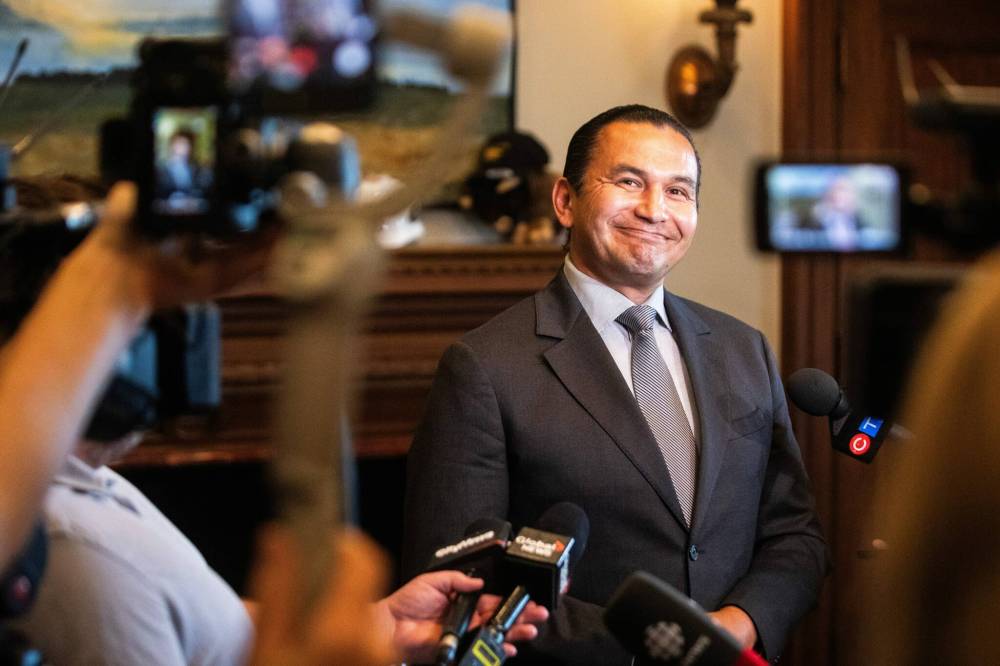
MIKAELA MACKENZIE / FREE PRESS
Premier Wab Kinew says if the province decides to put U.S. liquor back into stores, Manitobans should leave it there.
Liz Cook, who has U.S. citizenship, said she feels Canada should “stick to its guns” and keep the American products out of stores.
“I think that we should not put the liquor back on the shelves,” she said while shopping at the Liquor Mart in Grant Park Shopping Centre. “I think we should fight a little bit harder.”
She believes the boycott gives Canada a “leg up” as it continues negotiations with the U.S.
“He has to be hurting by now,” Cook said of Trump. “I mean, he’s hurting us and we haven’t done anything. We’ve always been cordial…. We’ve always partnered with them.”
“It puts so many people in a difficult position.”
Alexis Waytiuk, who designs cocktails and drink menus, she said the boycott has affected her industry, essentially kiboshing entire categories of spirits, such as bourbon whisky, which is produced exclusively in Kentucky.
“I remember when they first removed it, I was really disappointed about it,” she said.
If American booze returns to shelves, she said it should come back to stay.
“One decision has to be made,” Waytiuk said. “Because it puts so many people in a difficult position. Because that makes me think, ‘I’m going to buy American products to make cocktails at the place I work now’ … but what if they get rid of them again?”
Kinew said Carney also wants Manitoba to remove language from provincial government tenders that state a preference for Canadian or non-U.S. contracts. The province could change the language and continue to buy Canadian anyway, the premier said.
Manitoba government spending on American firms has declined 82 per cent decline year-over-year since the policy changed.
“You can see why the Trump administration is coming to Canada and asking for a deal,” Kinew said. “We are in a position of strength.”
As for a potential deal with the U.S., Kinew said Trump is erratic and could go back on his word when it comes to imposing new tariffs or adjusting existing ones.
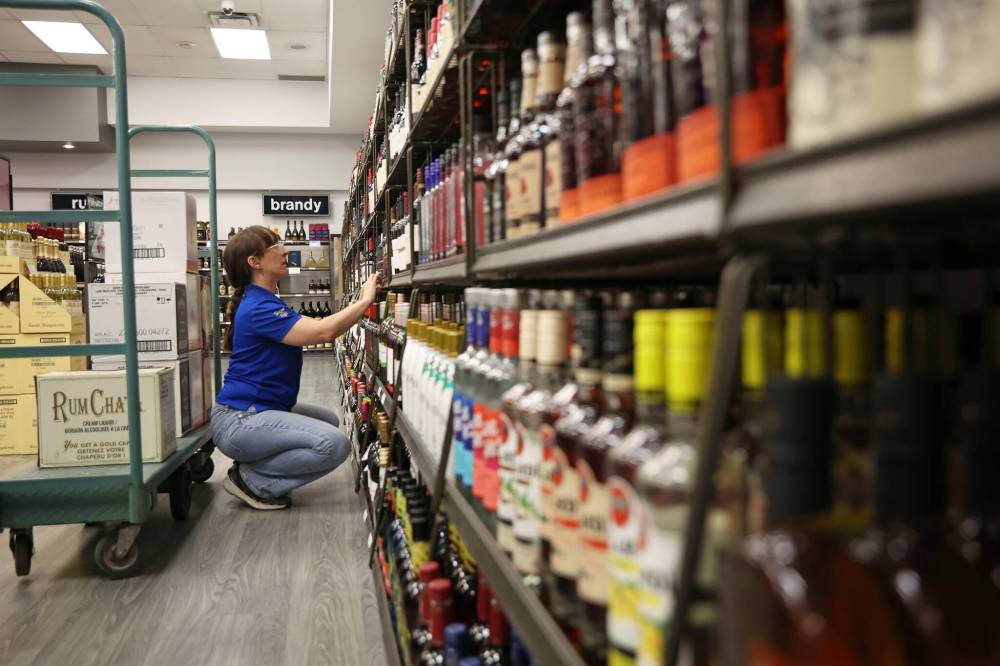
TIM SMITH / THE BRANDON SUN FILES
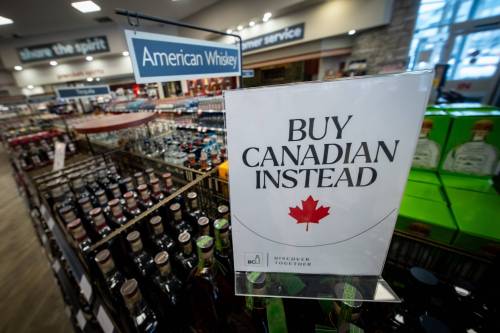
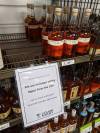
If and when U.S. booze is sold again in Liquor Marts, Manitoba Premier Wab Kinew is urging Manitobans to buy Canadian products instead.
Canada is seeking relief on existing tariffs. Kinew said he is waiting to find out how the deal could affect the rates on steel and aluminum. He called for supports for steel-industry workers, including staff at Selkirk’s Gerdau plant.
Opposition Tory Leader Obby Khan said there is more at play than American alcohol on Manitoba shelves.
“We haven’t seen the entire trade deal yet, but where premier Kinew talks about Canada should have pushed harder, my question for the premier is what has he done for Manitoba?” Khan said. “What protections has he secured for our ag industry, for our manufacturing, for our steel, for our forestry, for our exports? Premier Kinew hasn’t done anything for Manitobans other than make jokes from the sideline.”
“How many jobs, how many Manitobans, how many businesses are going to be affected by his childish attacks and humour on our prime minister and on our largest trading partner?”
He called on Kinew to sign trade deals with the U.S.
“How many jobs, how many Manitobans, how many businesses are going to be affected by his childish attacks and humour on our prime minister and on our largest trading partner?” Khan said. “I would be much more concerned about whether Manitoba products can get onto American shelves.”
Khan said his recommendation is to always support Manitoban and Canadian businesses first when buying any products, including alcohol.
— With files from Carol Sanders and Morgan Modjeski
chris.kitching@freepress.mb.ca

Chris Kitching is a general assignment reporter at the Free Press. He began his newspaper career in 2001, with stops in Winnipeg, Toronto and London, England, along the way. After returning to Winnipeg, he joined the Free Press in 2021, and now covers a little bit of everything for the newspaper. Read more about Chris.
Every piece of reporting Chris produces is reviewed by an editing team before it is posted online or published in print — part of the Free Press‘s tradition, since 1872, of producing reliable independent journalism. Read more about Free Press’s history and mandate, and learn how our newsroom operates.
Our newsroom depends on a growing audience of readers to power our journalism. If you are not a paid reader, please consider becoming a subscriber.
Our newsroom depends on its audience of readers to power our journalism. Thank you for your support.
Related Articles
Some shoppers say 'not a chance' they'll buy American booze if Ontario brings it back



History
Updated on Thursday, August 20, 2026 5:22 PM CDT: Adds details.
Updated on Friday, August 21, 2026 10:25 AM CDT: Adds video