

No more playing around, make 30 km/h school zones permanent

Advertisement
Read this article for free:
or
Already have an account? Log in here »
To continue reading, please subscribe:
Digital Subscription
One year of digital access for only $1.44 a week*
- Enjoy unlimited reading on winnipegfreepress.com
- Read the E-Edition, our digital replica newspaper
- Access News Break, our award-winning app
- Play interactive puzzles
*Billed as $5.77 plus GST every four weeks. After 52 weeks, price increases to the regular rate of $19.95 plus GST every four weeks. Offer available to new and qualified returning subscribers only. Cancel any time.
To continue reading, please subscribe:
Add Free Press access to your Brandon Sun subscription for only an additional
$1 for the first 4 weeks*
- Enjoy unlimited reading on winnipegfreepress.com
- Read the E-Edition, our digital replica newspaper
- Access News Break, our award-winning app
- Play interactive puzzles
*Your next Brandon Sun subscription payment will increase by $1.00 and you will be charged $17.95 plus GST for four weeks. After four weeks, your payment will increase to $24.95 plus GST every four weeks.
Read unlimited articles for free today:
or
Already have an account? Log in here »
Winnipeg has already decided that 30 kilometres per hour is the right speed around schools.
It’s time to stop pretending that decision should expire every summer.
The city’s reduced school-zone speed limits returned Tuesday, a full week before the 2026-27 school year begins. They apply on weekdays from 7 a.m. to 5:30 p.m., from Sept. 1 until July 1.
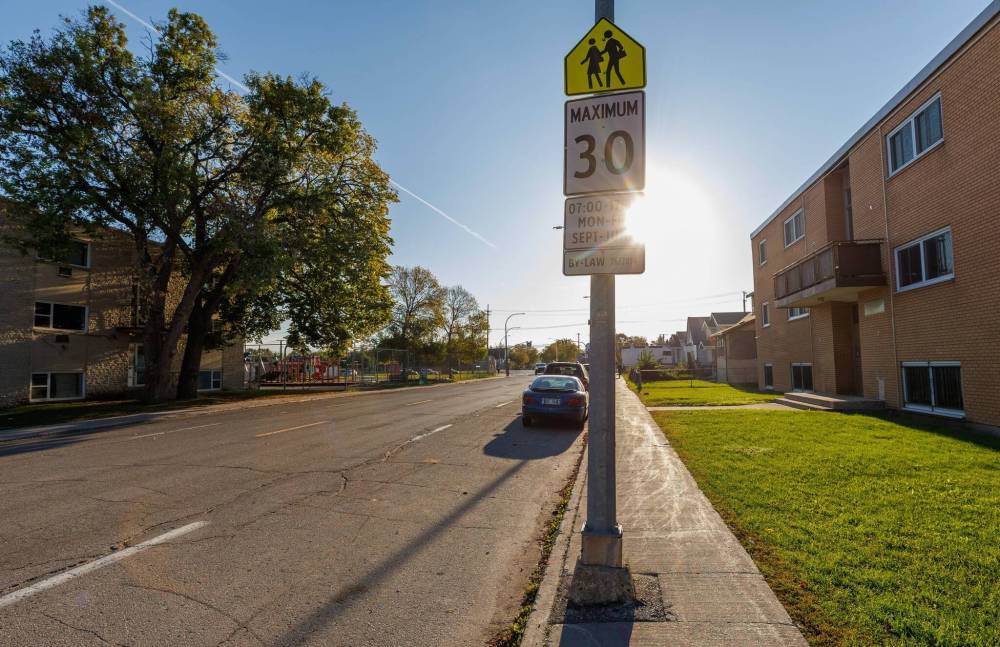
MIKE DEAL / FREE PRESS FILES
It’s time for Winnipeg to make its 30 km/h school-zone limits permanent, year-round and on weekends.
Then, for two months, they disappear.
There’s no compelling reason for that.
Children don’t stop walking, biking or playing around their neighbourhood schools when classes end. Parents still take their kids to playgrounds. Daycares remain open. Community centres continue to operate. Pedestrians still have to cross busy streets.
The roads don’t become safer because the school bell stops ringing.
It’s time for Winnipeg to make its 30 km/h school-zone limits permanent, year-round and on weekends.
The Winnipeg School Division tried last year to persuade city council to permanently reduce speeds around its elementary schools. Council declined.
It should reconsider.
Thirty kilometres an hour is not an unreasonable speed around schools. In fact, the city already considers it reasonable for 10 months of the year.
So what exactly changes on July 1?
Not the streets. Not the children. Not the cars. Not the consequences when a pedestrian is struck.
The only thing that changes is the calendar.
That’s not a particularly good basis for public-safety policy.
The argument for seasonal limits is presumably that there are fewer children around schools during the summer. Fair enough.
But schools are not sealed compounds that become deserted from July to September. Children live in these neighbourhoods. They use playgrounds and recreation facilities. They walk and cycle through school areas. Daycares operate year-round.
And even when children aren’t present, lower vehicle speeds make streets safer for pedestrians, cyclists and other vulnerable road users.
The city is taking some useful steps to improve school-zone safety.
This summer, traffic-calming curbs were installed at several school crosswalks where there are speeding problems, long crossing distances and poor visibility.
New in-street signs are being installed at 10 pedestrian crossings near schools. The city is also testing pavement markings designed to alert motorists that they are entering a school zone.
Those measures are welcome.
But they shouldn’t be substitutes for a permanent lower speed limit. Nor should the city rely primarily on automated enforcement to make motorists obey it.
There needs to be more visible police enforcement of speeding in school zones.
A police officer pulling over a speeder can do something a camera cannot. The driver gets a ticket — and demerit points.
Photo radar doesn’t work that way. It issues a fine to the registered owner of the vehicle. It does not assess demerit points against the person who was actually driving.
Speeding isn’t simply a financial offence. It’s dangerous behaviour.
A motorist who repeatedly speeds through school zones should face consequences that affect their driving record, not merely their wallet.
More police enforcement would also provide an important deterrent. Seeing a marked police cruiser in a school zone sends a very different message than receiving a ticket in the mail days or weeks later.
The goal shouldn’t be to generate revenue, it should be to change behaviour.
That means designing streets that encourage motorists to slow down, making school zones obvious, improving pedestrian crossings and enforcing the rules when drivers ignore them.
There are roughly 170 30 km/h school zones in Winnipeg. If the city believes those roads need a lower speed during the school year, it should explain why they suddenly become safe at 50 km/h in July and August.
It can’t simply be because school is out.
Children don’t understand municipal traffic regulations. They don’t know that a street was 30 km/h last month but is now 50.
They just know they have to cross it.
And when a child steps into a crosswalk, motorists need enough time and space to stop.
The city should also recognize that speed limits are only one piece of the puzzle.
It needs to replace missing or damaged signs. It needs better lighting and visibility at crossings. It should continue expanding traffic-calming measures and flashing signs.
But the foundation should be simple and consistent: 30 km/h around schools, all year long.
Some drivers will complain that it’s too slow. They’ll say they can safely drive 40 or 50.
Maybe they can. But school-zone rules aren’t designed around the abilities of the best drivers. They’re designed to protect the most vulnerable people on the road.

A six-year-old walking to school doesn’t have airbags, a seatbelt or a steel frame around them.
Winnipeg has already acknowledged that 30 km/h is the appropriate speed to protect children around schools.
It should stop treating that protection as seasonal.
Make the 30 km/h limit permanent.
tom.brodbeck@freepress.mb.ca
Tom Brodbeck is an award-winning author and columnist with over 30 years experience in print media. He joined the Free Press in 2019. Born and raised in Montreal, Tom graduated from the University of Manitoba in 1993 with a Bachelor of Arts degree in economics and commerce. Read more about Tom.
Tom provides commentary and analysis on political and related issues at the municipal, provincial and federal level. His columns are built on research and coverage of local events. The Free Press’s editing team reviews Tom’s columns before they are posted online or published in print – part of the Free Press’s tradition, since 1872, of producing reliable independent journalism. Read more about Free Press’s history and mandate, and learn how our newsroom operates.
Our newsroom depends on a growing audience of readers to power our journalism. If you are not a paid reader, please consider becoming a subscriber.
Our newsroom depends on its audience of readers to power our journalism. Thank you for your support.
Tom Brodbeck is an award-winning author and columnist with over 30 years experience in print media. He joined the Free Press in 2019. Born and raised in Montreal, Tom graduated from the University of Manitoba in 1993 with a Bachelor of Arts degree in economics and commerce. Read more about Tom.
Tom provides commentary and analysis on political and related issues at the municipal, provincial and federal level. His columns are built on research and coverage of local events. The Free Press’s editing team reviews Tom’s columns before they are posted online or published in print – part of the Free Press’s tradition, since 1872, of producing reliable independent journalism. Read more about Free Press’s history and mandate, and learn how our newsroom operates.
Our newsroom depends on a growing audience of readers to power our journalism. If you are not a paid reader, please consider becoming a subscriber.
Our newsroom depends on its audience of readers to power our journalism. Thank you for your support.
Related Articles
School zones return Tuesday as lead-footed drivers risk steep fines




Advertisement Advertise With Us
Advertisement Advertise With Us