

Financial literacy safe space
University of Manitoba student develops safe online tool for those new to digital banking
Advertisement
Read this article for free:
or
Already have an account? Log in here »
To continue reading, please subscribe:

Digital Subscription
One year of digital access for only $205*
- Enjoy unlimited reading on winnipegfreepress.com
- Read the E-Edition, our digital replica newspaper
- Access News Break, our award-winning app
- Play interactive puzzles
*First annual payment billed as $205.00 + GST for one year. This annual subscription will automatically renew at $233.00 + GST every 52 weeks (10% off the regular annual price of $259.35). Offer available to new and qualified returning subscribers only. Cancel any time.
To continue reading, please subscribe:
Add Free Press access to your Brandon Sun subscription for only an additional
$1 for the first 4 weeks*
- Enjoy unlimited reading on winnipegfreepress.com
- Read the E-Edition, our digital replica newspaper
- Access News Break, our award-winning app
- Play interactive puzzles
*Your next Brandon Sun subscription payment will increase by $1.00 and you will be charged $17.95 plus GST for four weeks. After four weeks, your payment will increase to $24.95 plus GST every four weeks.
Read unlimited articles for free today:
or
Already have an account? Log in here »
Safe spaces can seem few and far between for individuals feeling behind the curve of banking online.
It’s often a double whammy of anxiety inducement.
For one, they’re unfamiliar with the technology other Canadians take for granted. Second, using the technology involves their money, leading to the fear a misstep will lead to financial losses.
Mehran Hossain can relate.
A graduate computer science student at the University of Manitoba, he knows his way around the digital space. As well, in his native country Bangladesh, mobile banking is commonplace.
But the Canadian banking system was definitely enigmatic when he arrived a few years ago to study in Manitoba. “I felt this hesitance to do even simple things like an e-transfer or pay a bill online, and there’s not really a great way to practise these online banking skills safely.”
That experience informed his master’s thesis: a project focused on supporting digital financial literacy.
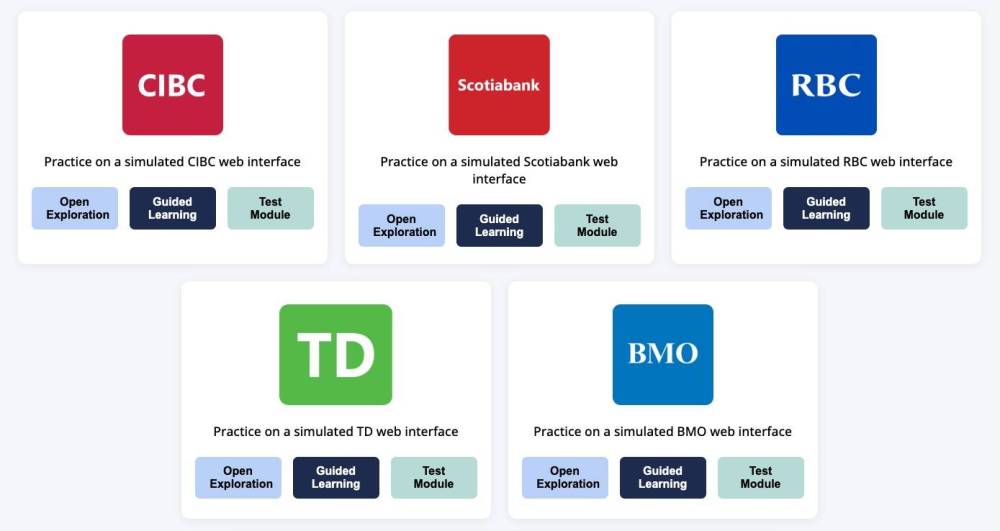
He developed BankBox, a free online tool allowing Canadians to try Canada’s five big banks’ (CIBC, Scotiabank, RBC, TD and BMO) online tools in a simulated environment.
Hossain recreated each major bank’s online banking experience — the interface clients see and use when banking digitally. It’s not the actual banks’ websites, even though BankBox allows individuals to experience how to transfer funds from one account to another, pay bills online and send e-transfers.
“For someone who might be new to the mobile and online banking universe, it’s important that the interface looks exactly the same,” he says, noting other existing practice tools do not involve simulations of actual Canadian banks’ websites.

Indeed, BankBox could prove beneficial for a small, though substantial percentage of the population.
Canadian Bankers Association (CBA) research shows 82 per cent of Canadians conduct most of their banking online. Yet the 18 per cent who aren’t represent potentially millions who could use help.
“Financial literacy is an essential skill that helps Canadians manage their money strategically and meet personal financial goals from saving targets to investing or making a large purchase,” says CBA spokesperson Ethan Teclu.
“So, too, is digital literacy at a time where society increasingly relies on internet-enabled services, online channels and contactless solutions.”
He adds the CBA has many tools aimed at boosting financial literacy, but BankBox isn’t one of them. It’s an interesting development, but unfamiliar to the association, Teclu adds.
Seniors are the most sizable and seemingly most obvious demographic in Canada that could use a boost in financial literacy regarding the digital banking experience. That said, even among individuals 80 and older, nearly eight out of 10 use online and mobile banking services, CBA statistics show.
Newcomers to Canada likely have the greatest need to get up to speed quickly on financial and digital literacy, says Louise Simbandumwe, co-director of SEED Winnipeg Inc.
“Definitely, learning about the banking system in Canada is among the largest areas of need that our community members have identified as necessary.”
SEED is a non-profit that assists newcomers and low-income Manitobans in building financial literacy and capacity, providing programming that supports employment skills development and even initiatives allowing individuals to build personal financial assets.
BankBox lets users log into their respective – albeit simulated – digital banking platform using a simulated log-in and password.
Given SEED’s financial literacy experience, Hossain reached out to leverage its network to promote an event this past week at a City of Winnipeg library where the public could try BankBox with in-person support.
“I see this (BankBox) as potentially a very beneficial tool,” Simbandumwe says, noting it offers an opportunity for hands-on learning.
“The more practical and activity-based opportunities to learn there are, the more likely it is that people will have the skills and confidence to apply what they’re learning.”
BankBox lets users log into their respective — albeit simulated — digital banking platform using a simulated log-in and password. Then, they can safely explore the many banking services and tools, transferring funds between accounts, sending e-transfers and making bill payments.
“If you get stuck, you can use hint or a video explaining a task,” Hossain says. “It’s an opportunity where people can resolve their shortcomings regarding their knowledge about digital banking independently without having to go through the potentially lengthy process of calling their bank or visiting in-person.”
BankBox stores no personal data and is not connected in any way to the financial institutions and the digital platforms it simulates.
It is accessible online (bankbox.cs.umanitoba.ca) and free to use, and Hossain says more local workshops to try BankBox, depending on interest, will likely be offered to the public in September.
Already, interest has been higher than he expected, indicating it fills a real need in the financial literacy landscape.
“We started as a very small project, but we have got a lot of attention along the way, so that gives me hope that this could be very useful to a lot of people.”
Joel Schlesinger is a Winnipeg-based freelance journalist
joelschles@gmail.com