

B.C. groups call for lower burdens, barriers in light of U.S. tariffs
Advertisement
Read this article for free:
or
Already have an account? Log in here »
To continue reading, please subscribe:

Digital Subscription
One year of digital access for only $205*
- Enjoy unlimited reading on winnipegfreepress.com
- Read the E-Edition, our digital replica newspaper
- Access News Break, our award-winning app
- Play interactive puzzles
*First annual payment billed as $205.00 + GST for one year. This annual subscription will automatically renew at $233.00 + GST every 52 weeks (10% off the regular annual price of $259.35). Offer available to new and qualified returning subscribers only. Cancel any time.
To continue reading, please subscribe:
Add Free Press access to your Brandon Sun subscription for only an additional
$1 for the first 4 weeks*
- Enjoy unlimited reading on winnipegfreepress.com
- Read the E-Edition, our digital replica newspaper
- Access News Break, our award-winning app
- Play interactive puzzles
*Your next Brandon Sun subscription payment will increase by $1.00 and you will be charged $17.95 plus GST for four weeks. After four weeks, your payment will increase to $24.95 plus GST every four weeks.
Read unlimited articles for free today:
or
Already have an account? Log in here »
VANCOUVER – Escalating trade tensions between Canada and the United States, culminating in new tariffs and threats, have galvanized British Columbia business groups in sounding the alarm on the province’s economy.
The BC Chamber of Commerce said Monday it’s convening its network of 85 groups in a bid to create a unified front in asking the British Columbia government for support programs.
President Jen Riley said B.C. is expected to see 14 per cent of its exports affected by 50 per cent tariffs from the U.S. that went into effect Saturday, after talks broke down the night before between Ottawa and Washington.
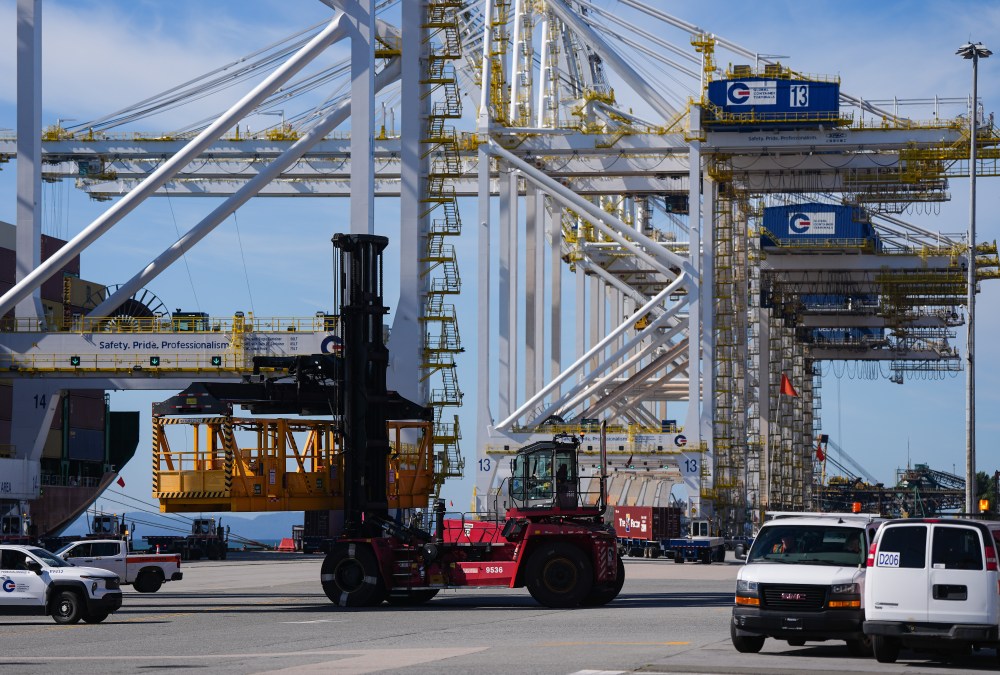
That percentage, Riley said, is “higher than any other province in the country.”
“The businesses hit hardest are small and medium-sized, and they’re in every community in this province,” Riley said in a statement.
“We want to collect real stories for government and bring willing businesses into roundtables. Every hand raised strengthens the case for supports.”
Prime Minister Mark Carney promised Saturday to retaliate with dollar-for-dollar tariffs on the U.S. by Sept. 8, along with supports for affected sectors.
On Monday, U.S. President Donald Trump threatened to double tariffs on Canadian automobiles and auto parts to 50 per cent starting Jan. 1.
The B.C. chamber is among a number of major business groups calling on the province to act, saying local stakeholders have already been hard hit by inflation and other challenges.
Bridgitte Anderson, president of the Greater Vancouver Board of Trade, said the tariffs unfairly target B.C. businesses and threaten jobs and that the province must help by reducing barriers to trade and economic growth.
“It’s been challenging enough for tariffs to be applied to steel and aluminum and autos and softwood,” Anderson said. “But now what we’re talking about is that these new tariffs would be so broad-based here in British Columbia.”
She said B.C. businesses involved in the manufacturing of electrical machinery and equipment, plastics, and wood and wood products will be especially hard hit.
On Saturday, B.C. Premier David Eby called the tariffs “an economic attack on our province and our country.”
“I think they really revealed their true nature of what the Americans are seeking from the White House in terms of their relationship with Canada,” Eby said, referring to accusations that the U.S. tried to introduce last-minute measures in trade negotiations.
“The suggestion that Canada would not trade with other countries, or reduce our trade with other countries because the Americans tell us to, would reduce us to the economic equivalent of the 51st state. It’s never acceptable to Canadians.”
Anderson agreed.
“It’s hard not to see that as anything but a threat to our sovereignty,” she said. “This access to open markets is something that Canada must do and is doing — and should do more of.”
The Business Improvement Areas of BC said it’s more crucial now than ever for government and residents to support local businesses.
Jeremy Heighton with the group said small businesses are already beset by a number of challenges and “cumulative burden” that should be removed to mitigate the impact of the tariffs.
“Supporting Canadian businesses cannot simply be a slogan,” Heighton said in a statement.
“Government procurement, taxation, regulation and economic development decisions should all be viewed through a very straightforward lens: Does this make it easier or harder for a B.C. or Canadian business to succeed?”
Eby has said there were previous conversations with the federal government on helping businesses and that Ottawa will co-ordinate the supports.
“The businesses that are likely to be most affected by this in British Columbia might have 20 to 50 employees,” Eby said. “They don’t have huge resources to navigate complicated bureaucratic processes in order to be able to access federal supports.
“So that’ll be a key part of our work with the federal government — to harmonize our efforts with theirs and to make sure they’re as available as possible for some of the smallest enterprises in B.C. that will be affected by this.”
Anderson said interprovincial trade barriers need to be addressed first in mitigating the impacts of U.S. tariffs.
“Internal trade, internal trade and internal trade,” she said.

“I have been in and involved in discussions around internal trade for many, many years now. And while we have seen some progress, it’s not enough.
“There (are) still thousands of hurdles, whether they’re regulatory hurdles, administrative hurdles that need to be removed. We have to be able to trade freely within Canada, and it’s imperative we do so in an urgent way.”
Anderson also suggested that in the meantime B.C. prioritize building “trade-enabling infrastructure,” while driving export diversification and advancing major resource and industrial projects.
“The only thing that we can count on from the U.S. administration is uncertainty,” she said.
This report by The Canadian Press was first published Aug. 24, 2026.
Related Articles
Ottawa to announce details of retaliatory tariffs on U.S. Tuesday
Advertisement Advertise With Us
Advertisement Advertise With Us