

Fact File: U.S. could inflict pain on Canada through energy trade
Advertisement
Read this article for free:
or
Already have an account? Log in here »
To continue reading, please subscribe:

Digital Subscription
One year of digital access for only $205*
- Enjoy unlimited reading on winnipegfreepress.com
- Read the E-Edition, our digital replica newspaper
- Access News Break, our award-winning app
- Play interactive puzzles
*First annual payment billed as $205.00 + GST for one year. This annual subscription will automatically renew at $233.00 + GST every 52 weeks (10% off the regular annual price of $259.35). Offer available to new and qualified returning subscribers only. Cancel any time.
To continue reading, please subscribe:
Add Free Press access to your Brandon Sun subscription for only an additional
$1 for the first 4 weeks*
- Enjoy unlimited reading on winnipegfreepress.com
- Read the E-Edition, our digital replica newspaper
- Access News Break, our award-winning app
- Play interactive puzzles
*Your next Brandon Sun subscription payment will increase by $1.00 and you will be charged $17.95 plus GST for four weeks. After four weeks, your payment will increase to $24.95 plus GST every four weeks.
Read unlimited articles for free today:
or
Already have an account? Log in here »
CALGARY – A post this week from U.S. President Donald Trump on his Truth Social platform included an implied threat to energy products flowing into Canada from south of the border. Though Canada is by far an overall bigger supplier to its southern neighbour than the other way around, there are some regions of the country that would be hit hard in the event of a U.S.-initiated disruption.
THE CLAIM
Trump began his Monday post by insulting Ontario Premier Doug Ford, who had lashed out at the president in the aftermath of the eleventh-hour breakdown in trade talks late Friday.
Trump’s post then segued into Canada’s reliance on its “far bigger, richer and stronger” southern neighbour. He wrote that “governor” Prime Minister Mark Carney and his “flunky” Ford won’t be allowed to keep “taking advantage” of the U.S.
“Remember, much of the Electricity, Oil, and Gas that Canada gets is transported through the U.S.A. Someone should get these clowns to ‘fall in line’ or, the consequences for Canada will be far WORSE!” the president continued.
THE FACTS
The Canada Energy Regulator published an overview in May detailing Canada-U.S. energy trade flows in 2025. It looked at both countries’ imports and exports of crude oil and natural gas, as well as refined products like gasoline and diesel, and natural gas liquids like propane and butane.
Overall, Canada’s exports of all those products to the U.S. totalled $157.5 billion last year. That far eclipses the total of $34.4 billion Canada imported from south of the border.
Canada’s electricity exports to the U.S. were $3.3 billion, while it imported $1.4 billion in power, the report said.
The overall numbers would suggest Canada is a more significant supplier to the U.S. than vice-versa, but some regions — like Ontario — would find themselves squeezed should Trump’s threat bear out.
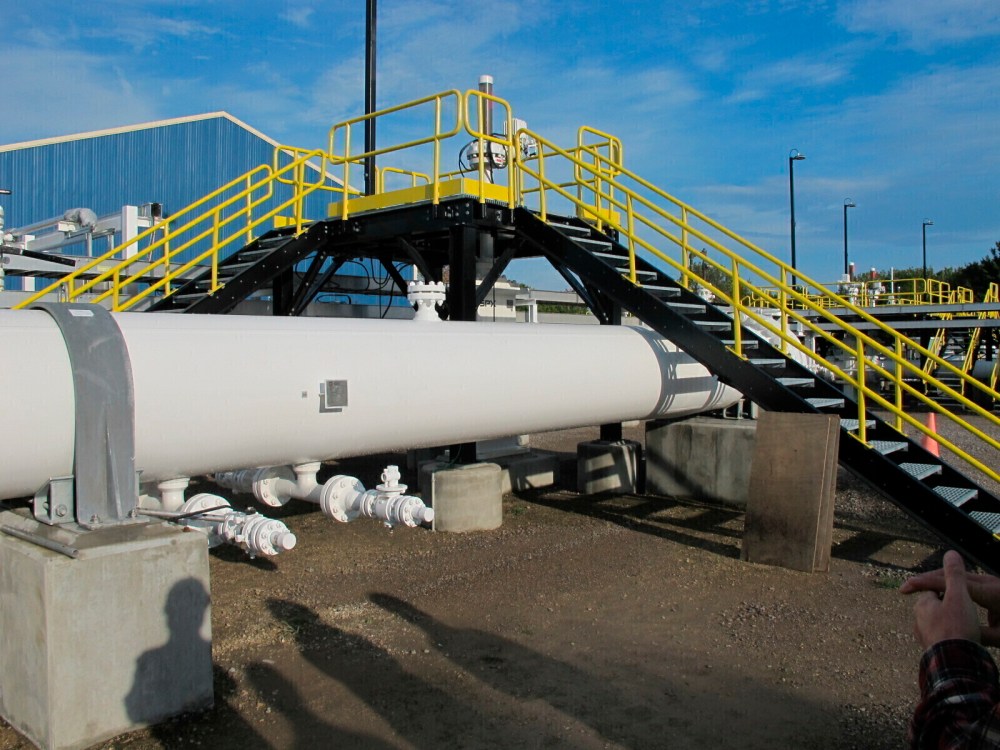
For crude oil, Calgary-based pipeline giant Enbridge Inc. operates the backbone of Canada’s cross-country transport infrastructure. Its Canadian Mainline begins in Edmonton, cuts across the Canada-U.S. border in Manitoba, runs through various U.S. Midwestern states and then re-enters Canada in Sarnia, Ont., before connecting to another pipeline serving Montreal.
Suncor Energy, Imperial Oil and Shell Canada operate refineries in Sarnia. Imperial has another refinery in Nanticoke, Ont. They’re vital suppliers of gasoline, jet fuel and diesel in Canada’s most populous province.
Richard Masson, an energy consultant who formerly led the Alberta Petroleum Marketing Commission, said those refineries are “almost wholly dependent” on Western Canadian crude travelling through Enbridge’s system via the U.S.
“There are really no other pipelines that could bring oil to them,” Masson said.
“If the U.S. ever did something goofy like trying to shut those lines down, those four refineries would be between a rock and a hard place right away.”
In theory, a Canada-U.S. pipeline treaty dating back to the ’70s and the Canada-U.S.-Mexico trade agreement make it illegal for the Trump administration to target Enbridge’s system, Masson said.
“But I don’t think the U.S. is paying a lot of attention to law anymore,” he said.
The spectre of Enbridge’s network being disrupted in the U.S. is not new. There has been a years-long legal battle in Michigan over what to do with its aging Line 5 pipeline that connects to Sarnia.
Ford and his Alberta counterpart have floated the possibility of building a new pipeline that takes a route through northern Ontario to Sarnia.
“That isn’t an answer to the problem we face today,” Masson said, as such a plan could cost tens of billions and take a decade to complete. A cheaper and faster move would be to build more rail unloading infrastructure in Ontario so crude can move on trains in the event of a pipeline disruption.
For natural gas, an analysis published earlier this year by the Canada Energy Regulator said just under half of central Canada’s gas came from U.S. imports in 2023.
The electricity element is especially complex, said Kent Fellows, an economist at the University of Calgary’s School of Public Policy.
Different parts of each country pivot from being exporters to importers of power, depending on when it’s being used and where it’s coming from.
For example, British Columbia might find it’s cheaper to use its own hydroelectric energy at some times of the year when water is flowing more strongly, and then import it from the U.S. when it’s not.
“The rhetoric that we’ve seen on this side of the border from some folks about cutting off electricity exports to do damage to the U.S. – they could do the same thing to us,” Fellows said.
Heather Exner-Pirot, senior fellow at the Macdonald-Laurier Institute, said there’s a lesser-known petroleum product from the U.S. upon which Canada depends heavily: natural gas liquids, often referred to as condensate or diluent.
Sticky oilsands bitumen can’t move through pipelines without first being blended with that lighter product, and Canada doesn’t produce enough of its own, she said. About 30 per cent of its supply comes from the U.S., she added.
Exner-Pirot said talk on the Canadian side of turning off the energy taps to the U.S. or imposing an export tax on those products is just as damaging and senseless as what Trump seemed to suggest in his post.
“These are nuclear options, and I think people are tossing them out and don’t understand the practical or legal or political implications,” she said.

Canada using its energy exports as a cudgel would erode much of the goodwill it has garnered amid the trade war, she added.
“Having American public opinion on our side is so valuable,” she said.
“And I think it’s really at risk if you start making their energy more expensive in the middle of an energy crisis — an energy crisis which is Trump’s fault right now.
“Let’s keep it Trump’s fault.”
This report by The Canadian Press was first published Aug. 26, 2026.
Related Articles
Alberta's Smith wants Canada to be friendly and double down on U.S. diplomacy efforts





Advertisement Advertise With Us
Advertisement Advertise With Us