‘One-stop powwow shop’ Trail Creations opens doors to traditional, ceremonial clothing
Read this article for free:
or
Already have an account? Log in here »
To continue reading, please subscribe:

Digital Subscription
One year of digital access for only $205*
- Enjoy unlimited reading on winnipegfreepress.com
- Read the E-Edition, our digital replica newspaper
- Access News Break, our award-winning app
- Play interactive puzzles
*First annual payment billed as $205.00 + GST for one year. This annual subscription will automatically renew at $233.00 + GST every 52 weeks (10% off the regular annual price of $259.35). Offer available to new and qualified returning subscribers only. Cancel any time.
To continue reading, please subscribe:
Add Free Press access to your Brandon Sun subscription for only an additional
$1 for the first 4 weeks*
- Enjoy unlimited reading on winnipegfreepress.com
- Read the E-Edition, our digital replica newspaper
- Access News Break, our award-winning app
- Play interactive puzzles
*Your next Brandon Sun subscription payment will increase by $1.00 and you will be charged $17.95 plus GST for four weeks. After four weeks, your payment will increase to $24.95 plus GST every four weeks.
Read unlimited articles for free today:
or
Already have an account? Log in here »
Spoons hang on the wall — small, silver and, unlike most items in the shop, not for sale.
One from Saskatchewan, another from Florida. Each represents a place Jessica Lavallee and her family visited during a powwow circuit. The 32,000-kilometre trek led Jessica to 3096 Portage Ave.
She opened Trail Creations, a Winnipeg store selling materials to make traditional Indigenous garb, in the space last month.
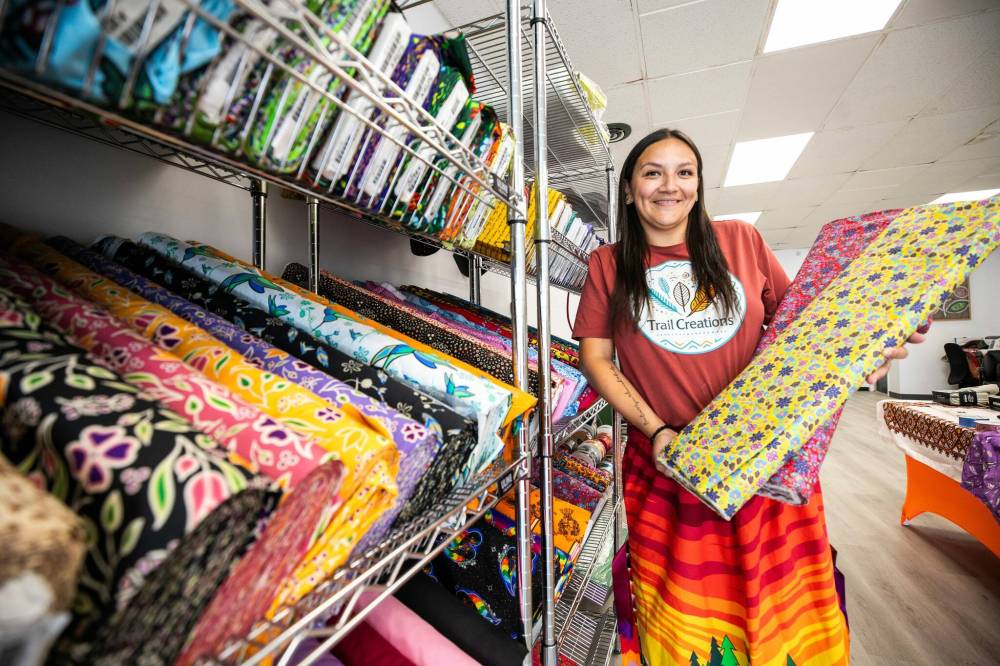
MIKAELA MACKENZIE / FREE PRESS
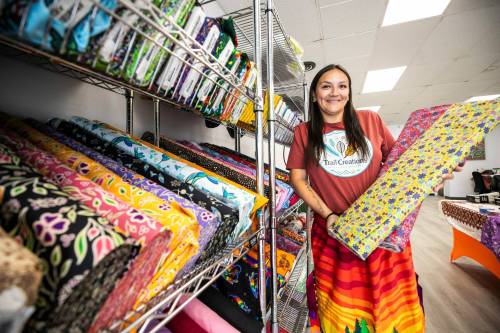
Jessica Lavallee, 39, is the owner of Trail Creations.
“We want it to be a one-stop powwow shop,” Lavallee said.
Rows of fabric, jingles and thread line the west Winnipeg store. Lavallee has spent the past year sourcing otter tails, compiling ribbon skirt kits with her children, and buying products from makers in her home community to sell in Manitoba’s capital.
Fully made jingle dresses and Lavallee’s handmade quilted bags take shelf space.
Lavallee sat in one of two armchairs in a corner of the shop days before Trail Creations opened. She’d labelled the space Kookum’s Corner — an homage to grandmothers’ homes, where hanging spoon collections aren’t uncommon.
A cookie tin — more likely to hold sewing supplies than sweet treats — lay nearby.
“I want my kids to be proud of who they (are),” said Lavallee, 39.
She didn’t grow up participating in traditional events. She’s a member of Misipawistik Cree Nation and lived on the town side of Grand Rapids (roughly four hours north of Winnipeg).
She and her husband, Tyler, 42, would attend powwows together but not dance. Powwows were something they idolized, Lavallee said. In their mid-twenties — as they began having children — they leapt into learning their culture.
“We didn’t grow up in this lifestyle, but we really wanted it for our kids,” she said.
She worked with a language teacher; she and Tyler sat with elders and knowledge keepers.
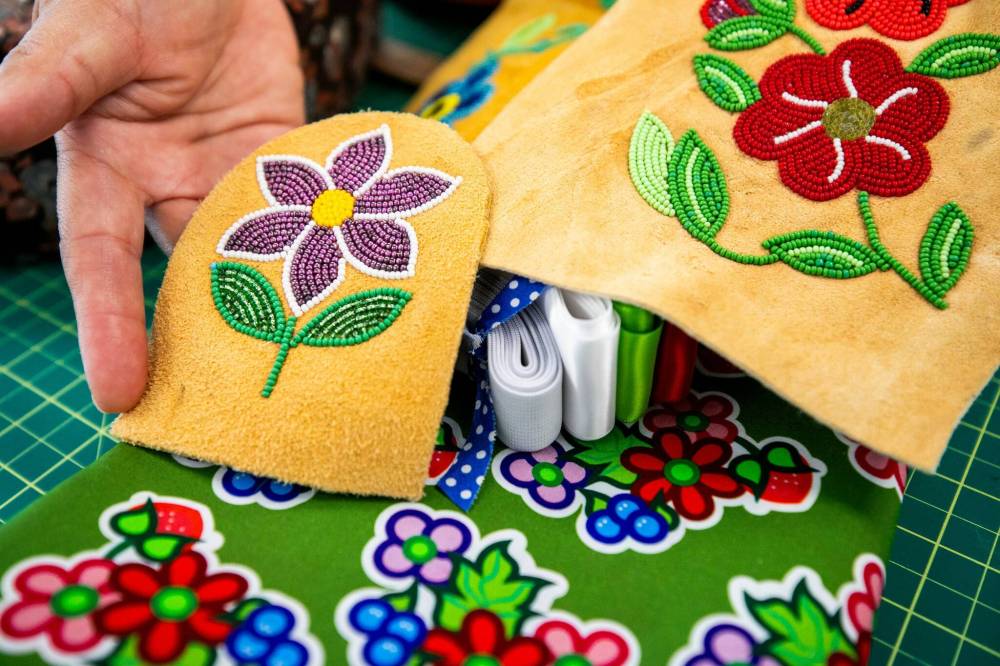
MIKAELA MACKENZIE / FREE PRESS
Lavallee has spent the past year sourcing otter tails, compiling ribbon skirt kits with her children, and buying products from makers in her home community to sell at the shop.
The Lavallees met some Oklahomans at a powwow near Grand Rapids in August 2023. The Americans invited the Lavallees to their home state.
Jessica and Tyler had already been planning an 11-month leave to travel, starting later that month. Lavallee had gotten permission from the school she worked at as a kindergarten teacher; Tyler would exit his post teaching high schoolers.
They’d tentatively planned a trip around North America. After meeting the Oklahomans — “powwow people,” by Lavallee’s standards — the couple added southern United States powwows to their itinerary.
They sold their house and most of their belongings. That August, they left in a newly purchased motorhome with their four children (ages four, seven, nine and 11 at the time).
“We experienced so many different tribes in the (United States) where they can dance all year round,” Lavallee said.
The family trekked across three provinces and 23 states. They attended 14 powwows — in the Black Hills, Florida, Texas and California, among other areas. The Oklahomans introduced the Lavallees to more American powwow-goers, who’d then invite the Canadians to gatherings.
The men wore their hair long; the children played and danced together.
“We found … so much of ourselves and what we wanted for our family,” Lavallee said.
Her children danced in each powwow. Lavallee would make their regalia on the road, when she wasn’t homeschooling. She’d brought her sewing machine. An American friend showed her how to make a jingle dress.
“I felt like, when I was on this trip, ‘I don’t know how I go back to teaching in a classroom,’” Lavallee said.
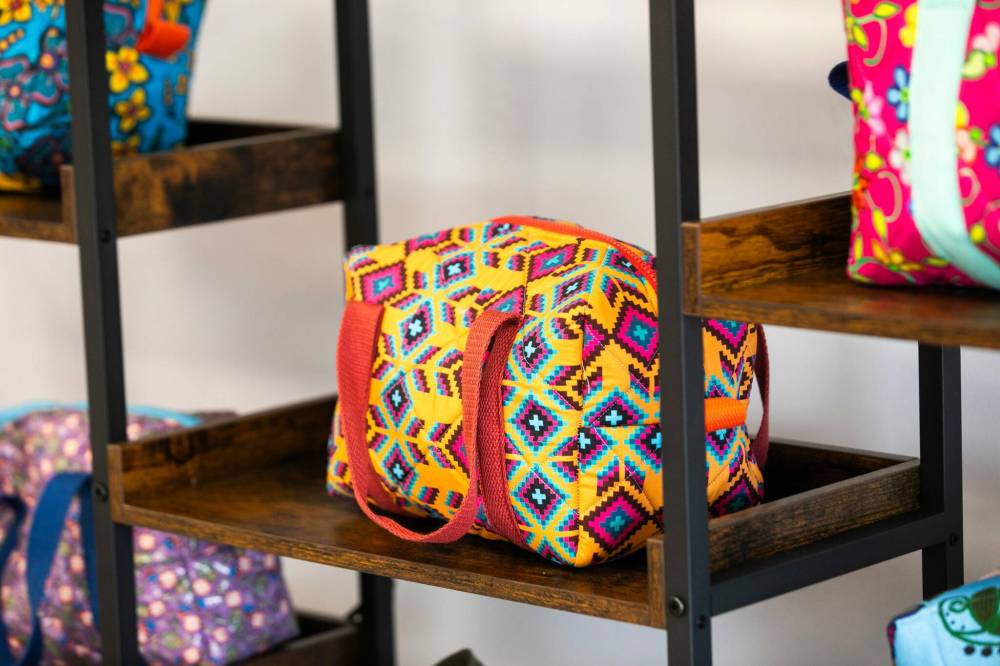
MIKAELA MACKENZIE / FREE PRESS
A handmade quilted bag sits on a shelf at Trail Creations.
Meantime, she was meeting Indigenous entrepreneurs — makers of belts, jewelry, cleaning solutions.
The Lavallees ended their trip and moved to Winnipeg in 2024. They sought to buy materials to make new regalia for their daughter. This required online orders and trips to several shops, Lavallee said.
“We saw how many people are attending powwows now,” she said. “There’s so many people that are looking to reconnect … and looking to buy all of their stuff for regalia.”
Last year, Lavallee began working on her business with Futurpreneur, a non-profit aimed at startups.
“(Lavallee is) a young Indigenous woman … understanding there’s a gap within the ecosystem,” said Holly Atjecoutay, Futurpreneur’s head of inclusive impact and director of Indigenous and northern entrepreneurs.
Indigenous peoples were legally barred from participating in their culture, including performing Sun Dance ceremonies, in Canada’s earlier years.
It’s generally safer to embrace culture now — and many people seem to be doing so, Atjecoutay said: “I think the tides are shifting, and we’re definitely seeing much more of a resurgence of pride and appetite to learn the right way.”
The federal government tracked 372,450 people who identified as Indigenous in 2021 after marking non-Indigenous in the 2016 census. The group accounted for nearly a quarter of Indigenous respondents in the 2021 census.
Around one-fifth of the 2016 Indigenous population — or 272,300 people — said they weren’t Indigenous in 2021. The flip was most common among people without registered or treaty Indian status, an April 2026 federal report says.
Futurpreneur, meanwhile, has clocked a steady increase of aspiring Indigenous entrepreneurs. It saw 10 per cent more applications year over year, Atjecoutay said.
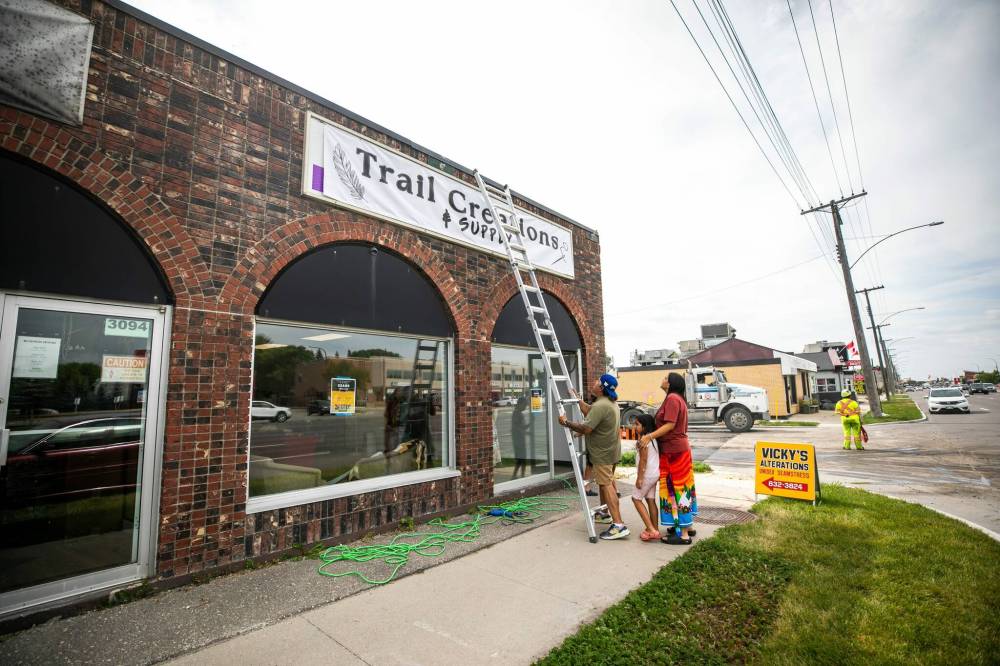
MIKAELA MACKENZIE / FREE PRESS
Trail Creations opened at 3096 Portage Ave. last month.
The Lavallees aim to motivate customers to explore their Indigenous culture, Tyler said. He helps at the shop.
“It’s easy to go to the big box stores and pick up fabric, but … you don’t get to hear from people who are doing what you’re doing,” he said.
There are sewing machines in the back for people who want to learn. Lavallee said she’ll teach walk-ins, and events may come later.
Trail Creations is open Tuesday through Friday from 11 a.m. to 6 p.m., and Saturdays and Sundays from 1 p.m. to 5 p.m., though store hours are subject to change.
gabrielle.piche@winnipegfreepress.com


Gabrielle Piché reports on business for the Free Press. She interned at the Free Press and worked for its sister outlet, Canstar Community News, before entering the business beat in 2021. Read more about Gabrielle.
Every piece of reporting Gabrielle produces is reviewed by an editing team before it is posted online or published in print — part of the Free Press‘s tradition, since 1872, of producing reliable independent journalism. Read more about Free Press’s history and mandate, and learn how our newsroom operates.
Our newsroom depends on a growing audience of readers to power our journalism. If you are not a paid reader, please consider becoming a subscriber.
Our newsroom depends on its audience of readers to power our journalism. Thank you for your support.
Related Articles
Entrepreneurial spotlight finds IndigiHub